ABSOLUTE BEGINNERS
AURORAE
AURORAE are also known as 'Aurora Borealis'
or the 'Northern Lights' or 'Aurora Australis' the 'Southern Lights'. On a clear night the aurora is visible as waves of
coloured light moving across
the sky. Although
not common from the south of the British Isles they are quite
common in the far north of Scotland and even more common nearer
to the North Pole.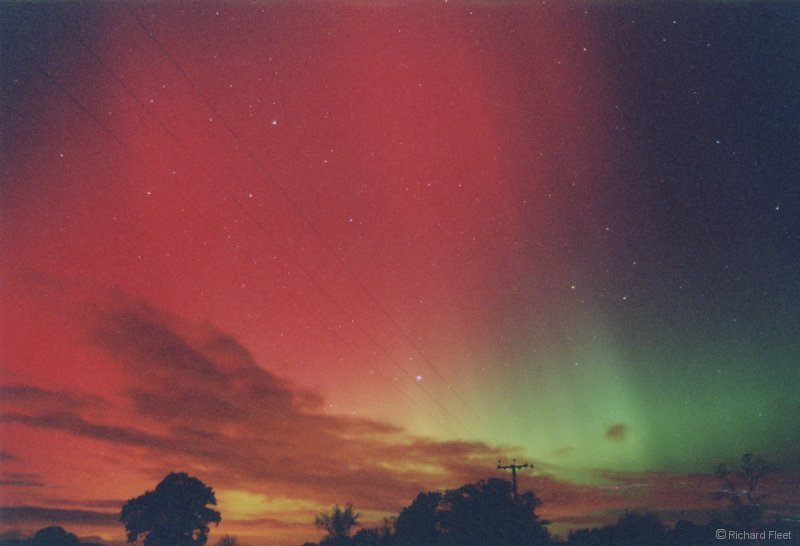
Aurorae over Wiltshire in 2003 image by Richard Fleet
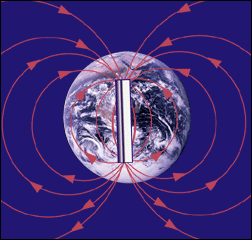
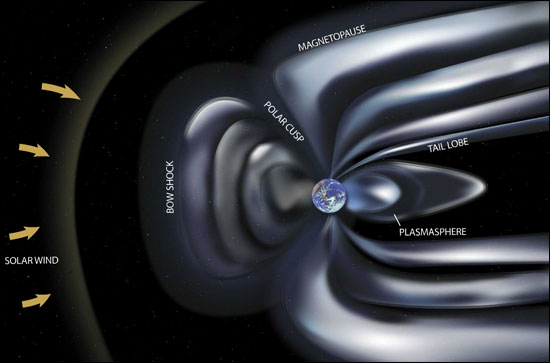
Aurorea (the plural, Aurora singular) are caused by energetic particles which have been ejected from the Sun, hitting the Earths atmosphere. Earth has a strong magnetic field and the particles ejected from the Sun are also magnetic. When the particles hit the Earth's magnetic field they are deflected around the magnetic field and towards the poles. As the particles move through the upper atmosphere they ionise the atoms of the atmosphere and cause them to glow much like in a florescent light.
 |
 |
Earth has a North and South Pole like a bar magnet |
Particles from the Sun are deflected around the magnetic field |
.
Aurorea
take many shapes and colours and move in different ways. The main colours are red from Nitrogen and green from
Oxygen but when the show is faint colours are hard to discern
a grey glow may be all that is seen. The colours are caused by the constituent gases in
the atmosphere being ionised depending on how energetic the
in-coming particles are.