WHAT'S UP THIS MONTH - MAY 2020
Special event this month - Comet 2019 Y4 (Atlas)
(Link to What's Up April 2020)
THESE PAGES ARE INTENDED TO HELP YOU FIND YOUR WAY AROUND THE SKY
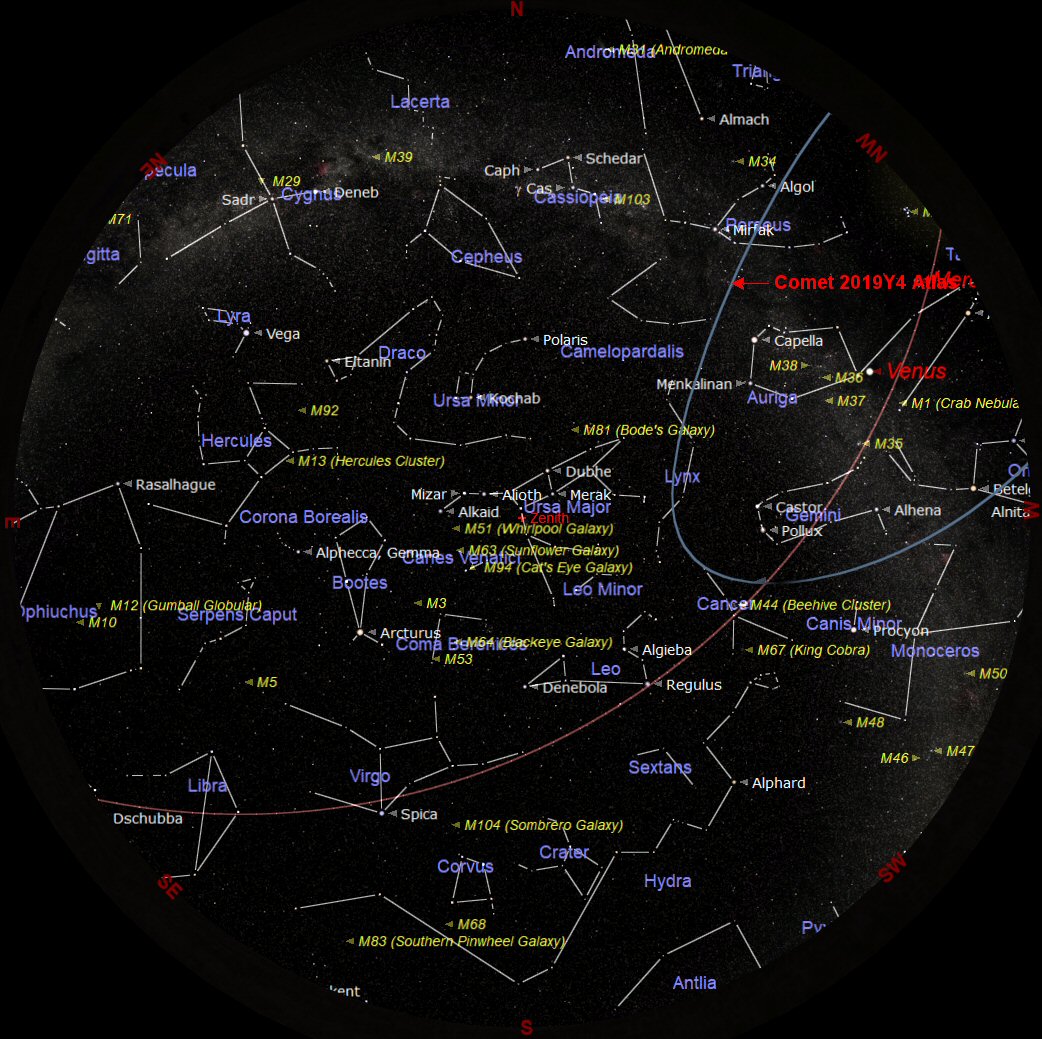
The chart above shows the night sky as it appears on 15 th May at 21:00 (9 o'clock) in the evening British Summer Time (BST). As the Earth orbits the Sun and we look out into space each night the stars will appear to have moved across the sky by a small amount. Every month Earth moves one twelfth of its circuit around the Sun, this amounts to 30 degrees each month. There are about 30 days in each month so each night the stars appear to move about 1 degree. The sky will therefore appear the same as shown on the chart above at 10 o'clock BST at the beginning of the month and at 8 o'clock BST at the end of the month. The stars also appear to move 15º (360º divided by 24) each hour from east to west, due to the Earth rotating once every 24 hours.
The centre of the chart will be the position in the sky directly overhead, called the Zenith. First we need to find some familiar objects so we can get our bearings. The Pole Star Polaris can be easily found by first finding the familiar shape of the Great Bear ‘Ursa Major' that is also sometimes called the Plough or even the Big Dipper by the Americans. Ursa Major is visible throughout the year from Britain and is always easy to find. This month it is high and almost overhead. Look for the distinctive saucepan shape, four stars forming the bowl and three stars forming the handle. Follow an imaginary line, up from the two stars in the bowl furthest from the handle. These will point the way to Polaris which will be to the north of overhead at about 50º above the northern horizon. Polaris is the only moderately bright star in a fairly empty patch of sky. When you have found Polaris turn completely around and you will be facing south. To use this chart, position yourself looking south and hold the chart above your eyes.
Planets observable: Venus and Mercury in the early evening with Mars, Saturn and Jupiter in the early morning.
EXPLORING THE NIGHT SKY THIS MONTH
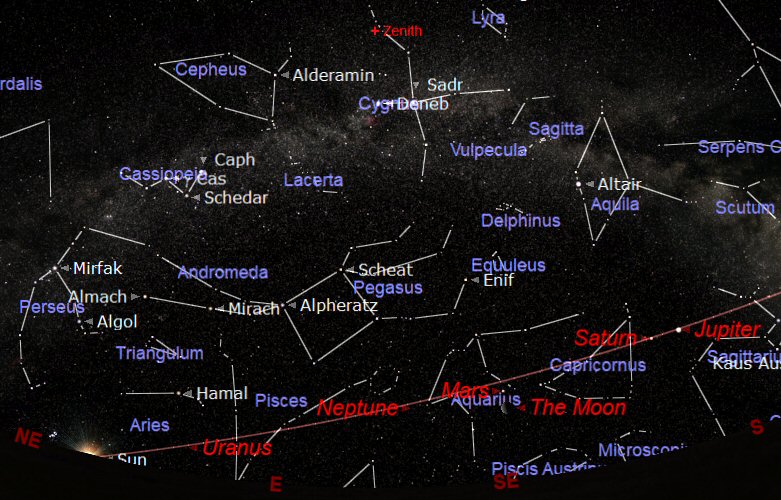
The Southern Night Sky during May 2020 at 20:00 BST
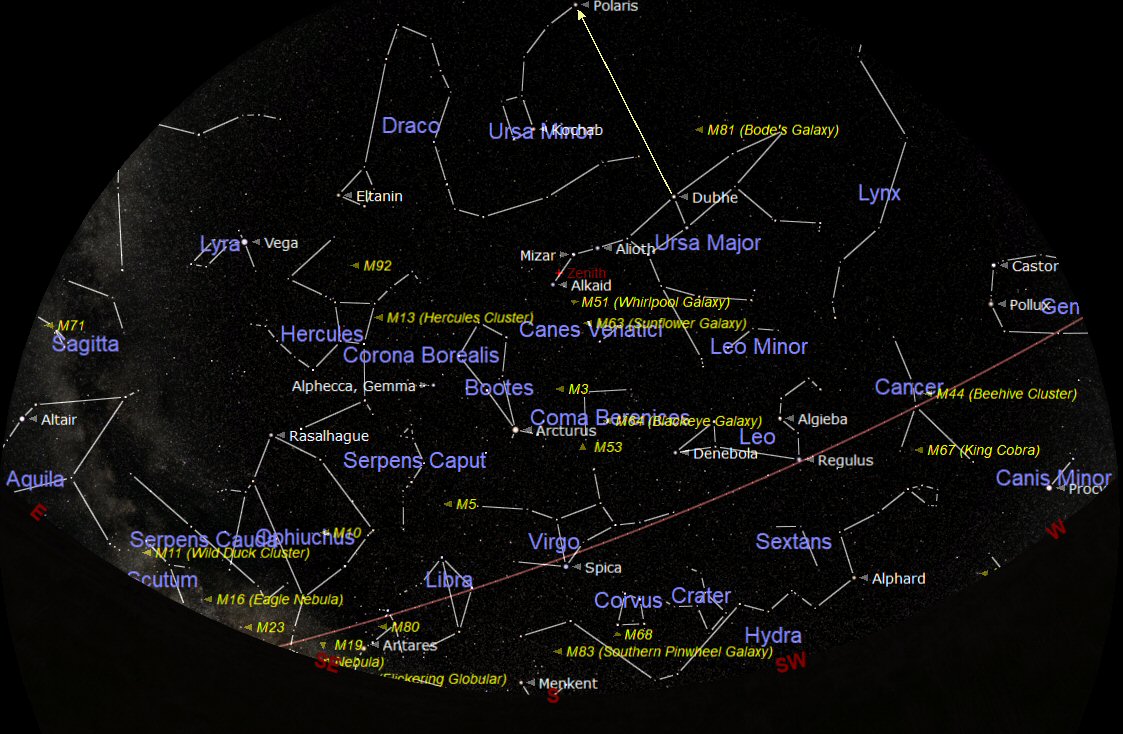
The chart above shows the night sky looking south at about 22:00 BST on 15th May. West is to the right and east to the left. The point in the sky directly overhead is known as the Zenith and is shown, marked in red' at the top and centre of the chart. The curved brown line across the sky at the bottom is the Ecliptic or Zodiac. This is the imaginary line along which the Sun, Moon and planets appear to move across the sky. The brightest stars often appear to form a group or recognisable pattern; we call these ‘Constellations'.
Constellations through which the ecliptic passes this month are Gemini (the Twins), Cancer (the Crab), Leo (the Lion), Virgo (the Virgin) and Libra (the Scales) rising over the eastern horizon. The constellation of Sagittarius will rise in the east later in the evening.
Jupiter will be in the south in the early morning close to the southern horizon before the Sun rises. It is quite prominent in the constellation of Sagittarius. Saturn is to the east (left) of Jupiter in the constellation of Capricornus with Mars following a little further to the east. The view of the planets will not be good because they will be in the dirty and turbulent air close to the horizon.
Mars is just about visible in the bright sky, just above the eastern horizon, before sunrise but is still looking small. Earth is approaching Mars and in a few months will overtake it as Earth moves faster along its smaller orbit inside the orbit of Mars.
In the west and sitting astride of the Ecliptic is the constellation of Gemini (the Twins). The twin stars Castor and Pollux are easy to identify. For those that have a telescope, Castor can be seen as a double star. By increasing the magnification, Castor itself will be seen as a pair of stars. It will push a small telescope to its limits to see but this lovely triple star system it is worth the effort.
To the east of Gemini is the constellation of Cancer with its lovely Open Cluster Messier 44 (M44) also known as Praesepe or the Beehive Cluster. This is a lovely Cluster that is best seen using binoculars or a small telescope using a low power eyepiece. The cluster is about twice the diameter of the Full Moon and contains about 200 stars. It is located about 577 light years away and its stars are estimated to be around 400 million years old.
Further to the east (left) of Gemini is the constellation of Leo (the Lion). Leo is quite distinctive with the ‘Sickle' shaped pattern of stars looking much like the head of the lion that Leo represents. In fact the traditional ‘stick figure' shape of Leo as shown on the chart above does look rather like the lion's body or the Sphinx in Egypt. The ‘Sickle' shape is also described as looking like a backwards question mark (?).
Following Leo is the less obvious constellation of Virgo but it does have one fairly bright star called Spica. Virgo gives its name to a large cluster of Galaxies that is also spread over into the neighbouring constellations of Coma Berenices (Berenices' Hair) and into Leo.
To the north of Virgo is the bright orange coloured star called Arcturus in the constellation of Boötes (see the constellation of the month). Arctaurus is a Red Giant star that is nearing the end of its ‘life' as a normal star. It has used almost all of its Hydrogen fuel and has expanded to become a Red Giant 25 times the diameter of our Sun. At the moment it shines 115 times brighter than our Sun but it is destined to collapse and become a White Dwarf.
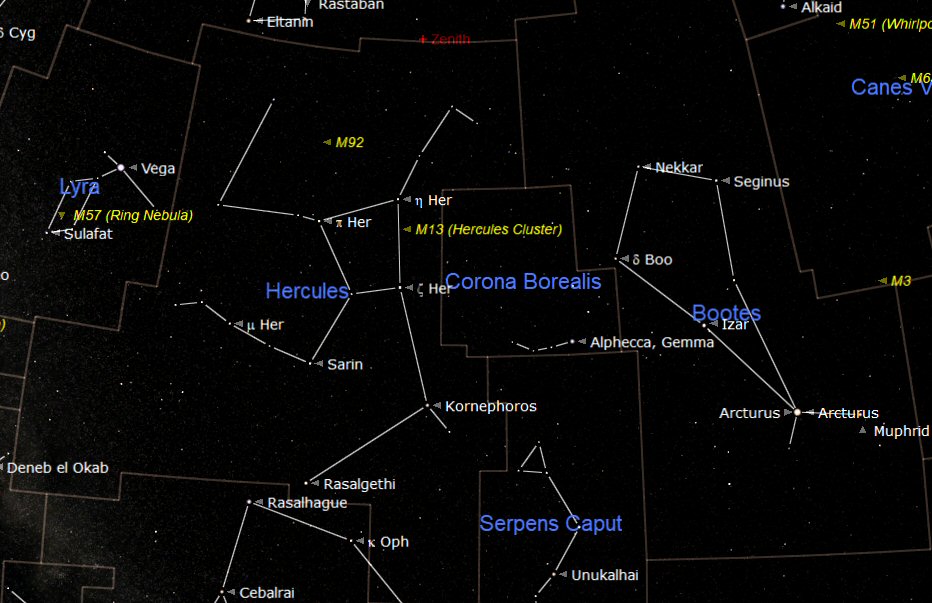
Higher in the south east is the constellation of Hercules (the Strong Man). Hercules has a rather distinctive distorted square shape, at its centre, called the ‘Keystone'. This is due to its resemblance to the centre stone of an arch or bridge.
THE CONSTELLATIONS OF HERCULES AND BOÖTES
The constellations of Hercules and Boötes
The chart above shows the constellation of Hercules and its location to the west (right) of the bright star Vega in the Summer Triangle. Hercules is the great strongman from Greek mythology. He is illustrated in the picture below (up-side-down), as he appears in the sky, with a club held above his head. The ‘Keystone' asterism (shape) can be a little difficult to identify in a light polluted sky but easy to find again.
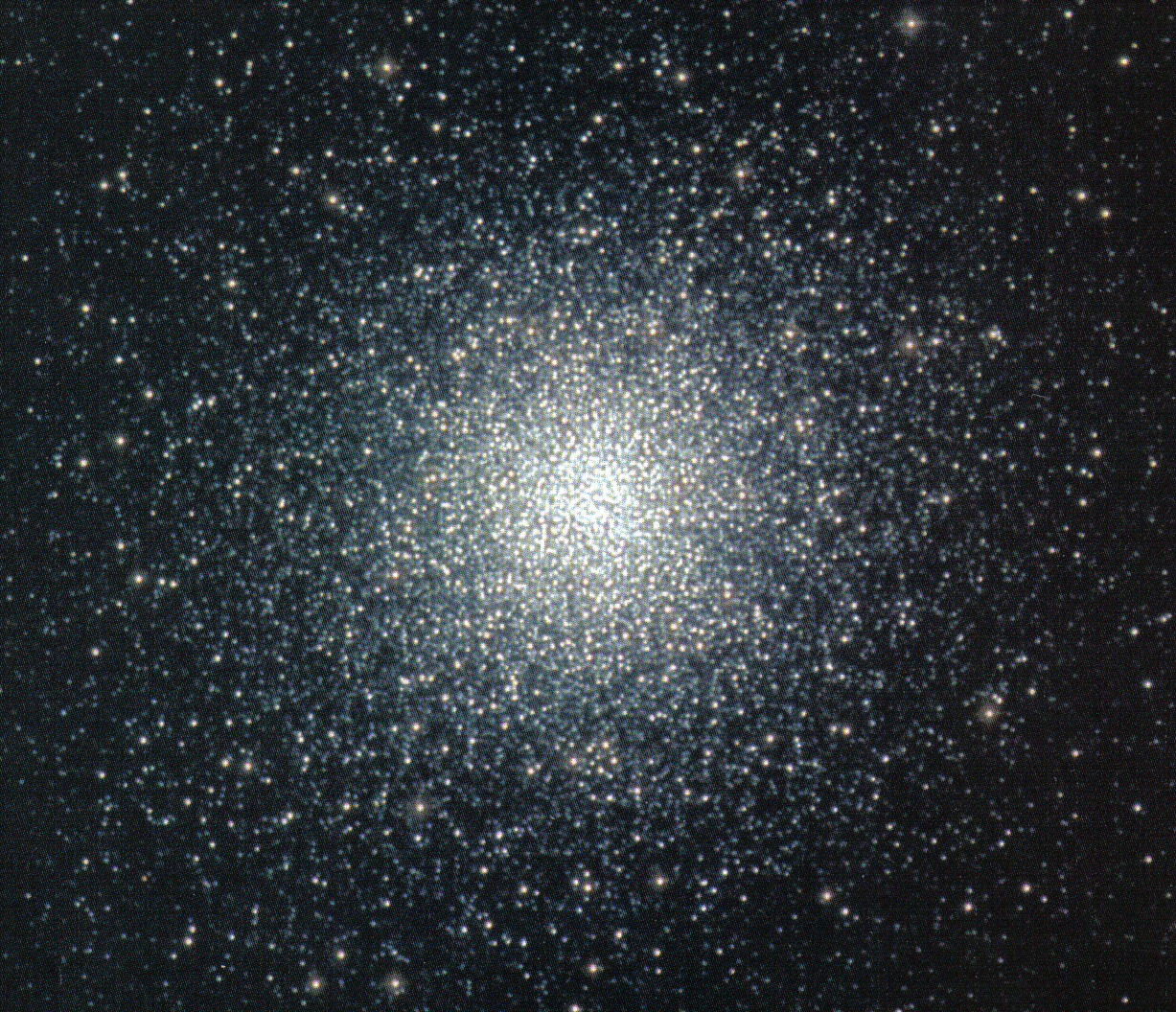
The jewel of Hercules is without doubt is the Great Globular Cluster, Messier 13 (M13). M13 can be found in the western (right) vertical imaginary line of the ‘Keystone'. It is just visible using a good pair of 9 x 50 binoculars. The cluster, of about a million stars, can be seen using a 90mm f 10 telescope but will look even more impressive when using a larger telescope.
The Great Globular Cluster M13 in Hercules
Globular clusters are thought to be the cores of small galaxies that have ventured too close to a Giant Spiral Galaxy like our Milky Way.
The outer stars of these smaller galaxies have been stripped away, by the gravity of the giant spiral. This process has left the dense cores as clusters of between 100,000 and a million stars. There are about 100 Globular Clusters in a halo around the Milky Way. There is another Globular Cluster in Hercules M92 but it is further away and needs a telescope to see.
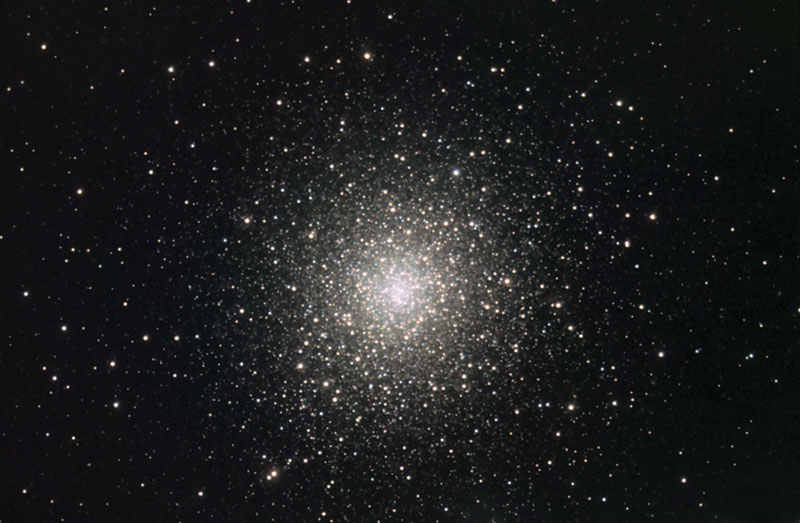
The Globular Cluster Messier 92 (M92) in Hercules
To the west of Hercules is the bright orange coloured star called Arctaurus in the constellation of Boötes the Herdsman. Arctaurus is the only bright star in Boötes, the other stars are fainter and form the shape of an old fashioned diamond shaped kite with Arctaurus located where the string of the tail would be attached.
Arctaurus is a Red Giant star that is 2.2 times more massive than our Sun and more advanced. It has used almost all of its Hydrogen fuel and has expanded in diameter to around 25 times that of our Sun. As it has expanded, the energy created in its core has been spread over its increasing surface area so the surface is becoming cooler and ‘redder' so it has become a ‘Red Giant' star. At the moment it shines 115 times brighter than our Sun but it is destined to eventually collapse to become a White Dwarf, surrounded by a Planetary Nebula.
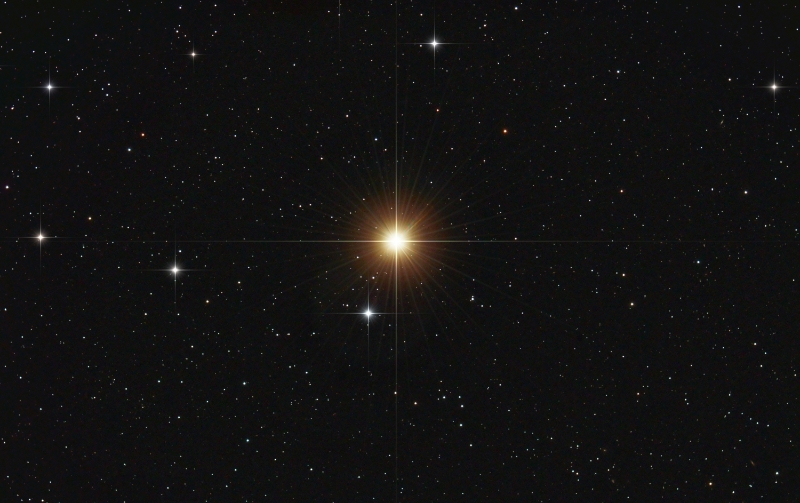
The beautiful red giant star Arctaurus in Boötes
THE SOLAR SYSTEM THIS MONTH
MERCURY will be observable, low in the west, at the end of the month. Mercury will be in close ‘Conjunction' with Venus on 21st and 22nd May.
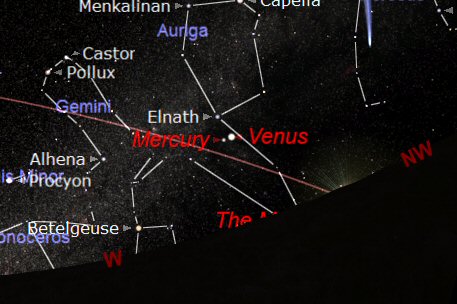
Mercury and Venus at sunset on 22nd May
VENUS is appearing to moving towards the Sun and will reach Inferior Conjunction (passing between Earth and the Sun) on 3rd June. This conjunction will see the two planets much closer than they were last month on 25th April as shown in the image below taken by Pauline Phillips. Venus appears as a narrower crescent shape but larger in diameter as it moves closer to us. It will become more difficult to see as it moves closer towards the Sun at the end of the month.
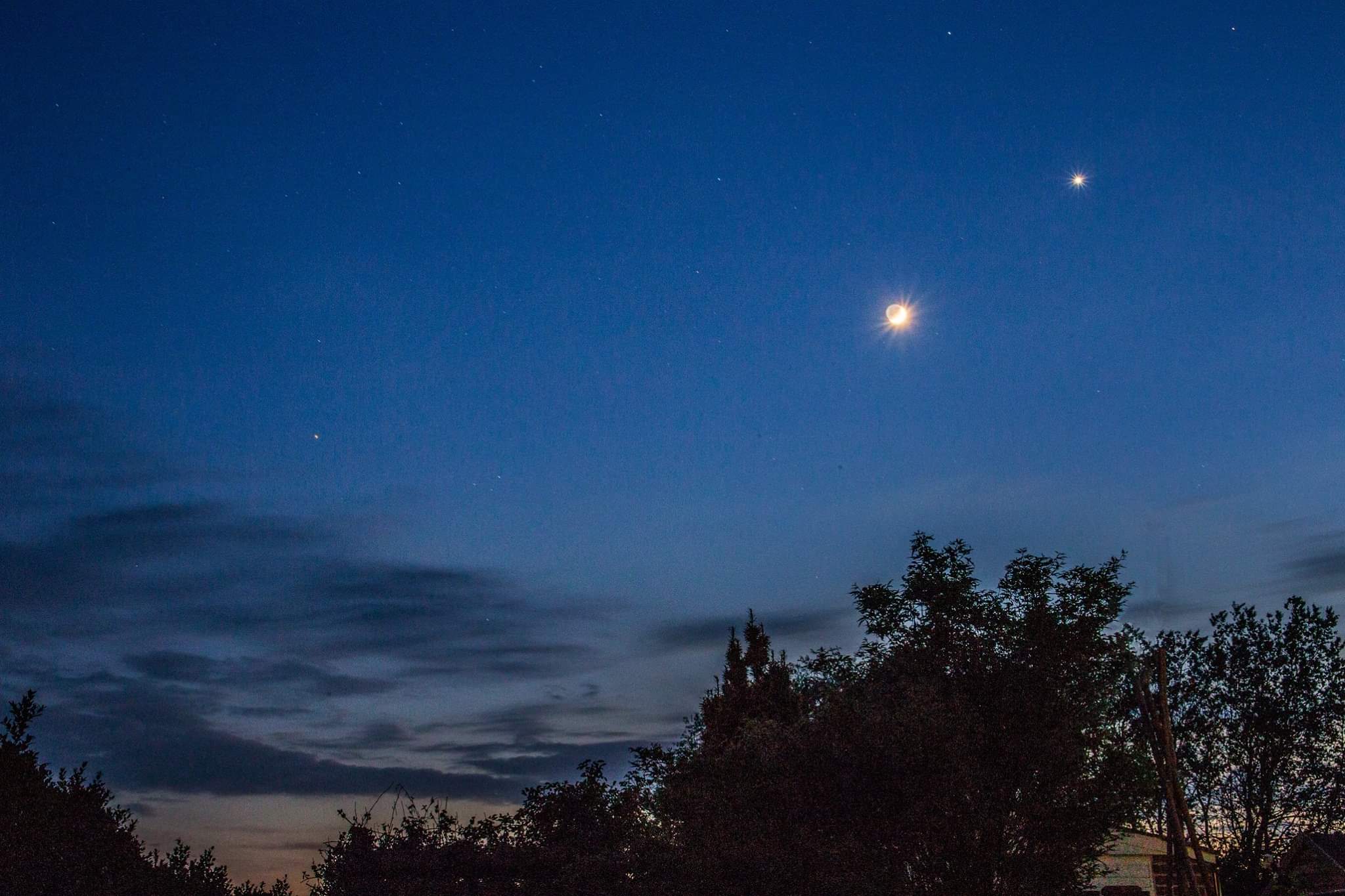
Venus close to the Moon on 25th April Pauline Phillips
MARS will be observable this month, low in the south before sunrise. Mars is still a long way from us on the other side of the Solar System so it looks small at just 8.5” (arc seconds). See the chart below.
The planets visible before sunrise in May
JUPITER will be observable in the south east after 02:30 and until sunrise during May. It will however be very low and in the dense, murky and turbulent air close to the horizon. Consequently it will be unstable and details will be difficult to see. See the chart above.
SATURN will rise in the south east at about 03:00 and be observable until the sky brightens before the Sun rises over the eastern horizon. Saturn is very low and in the murky and turbulent air close to the southern horizon. See the Mars chart.
URANUS will be rising in the east just before sunrise and will be very difficult to see. See the Mars chart.
NEPTUNE will be rising in the east at about 03:00 and will be very difficult to see. See the Mars chart.
THE SUN
The Sun rises at 06:30 BST at the beginning of the month and at 05:45 BST by the end of the month. It will be setting at 19:40 BST at the beginning and 20:30 BST by the end of the month.
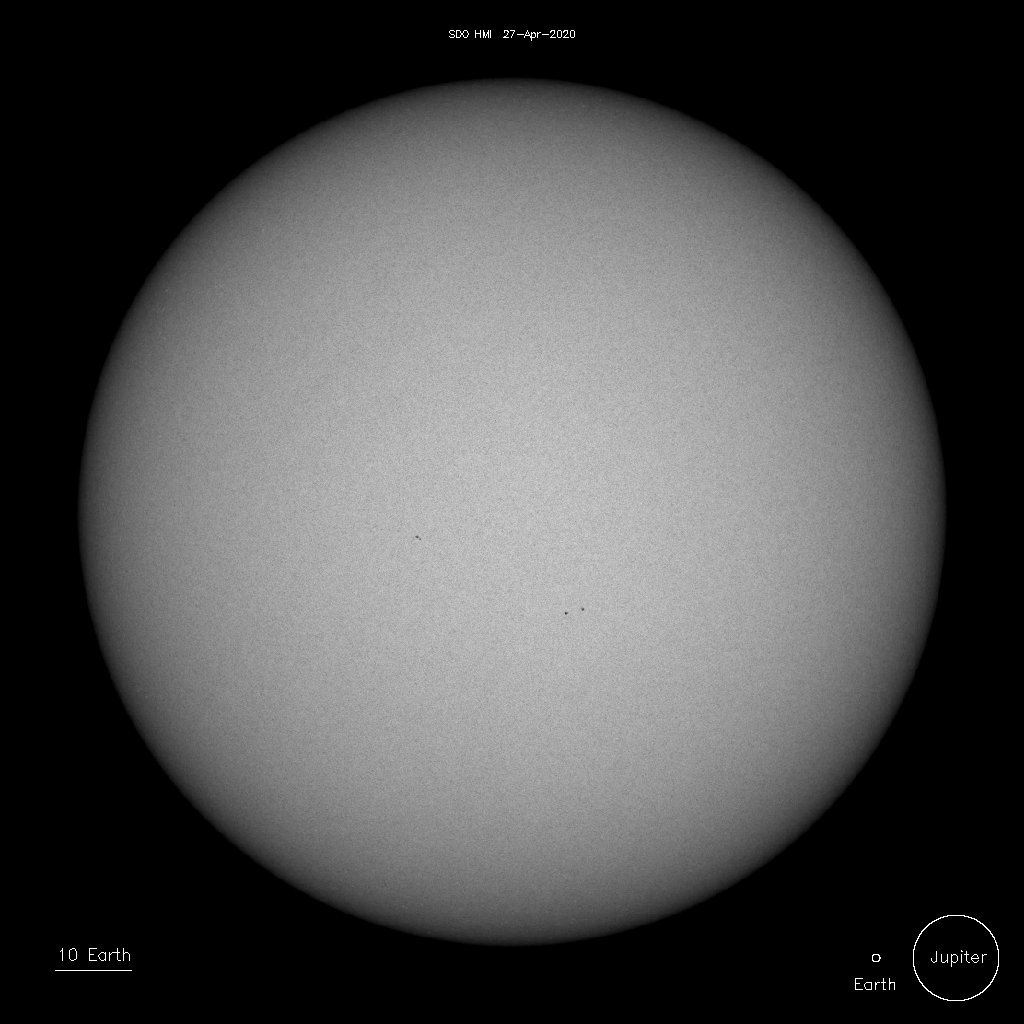
The Sun Imaged on 27th April 2020
There have been no significant sunspots for months. This is not necessarily worrying but it may be a bit unusual. Sunspots and other activity on the Sun can be followed live and day to day by visiting the SOHO website at: http://sohowww.nascom.nasa.gov/ .
THE MOON PHASES IN MAY
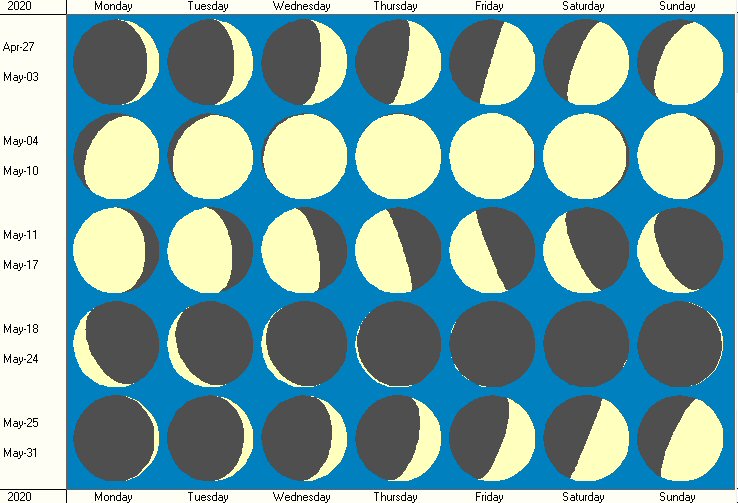
Full Moon will be on 7th May
Last Quarter will be on 14th May
New Moon will be on the 22nd May
First Quarter will be on 30th May
COMET 2019 Y4 (ATLAS)
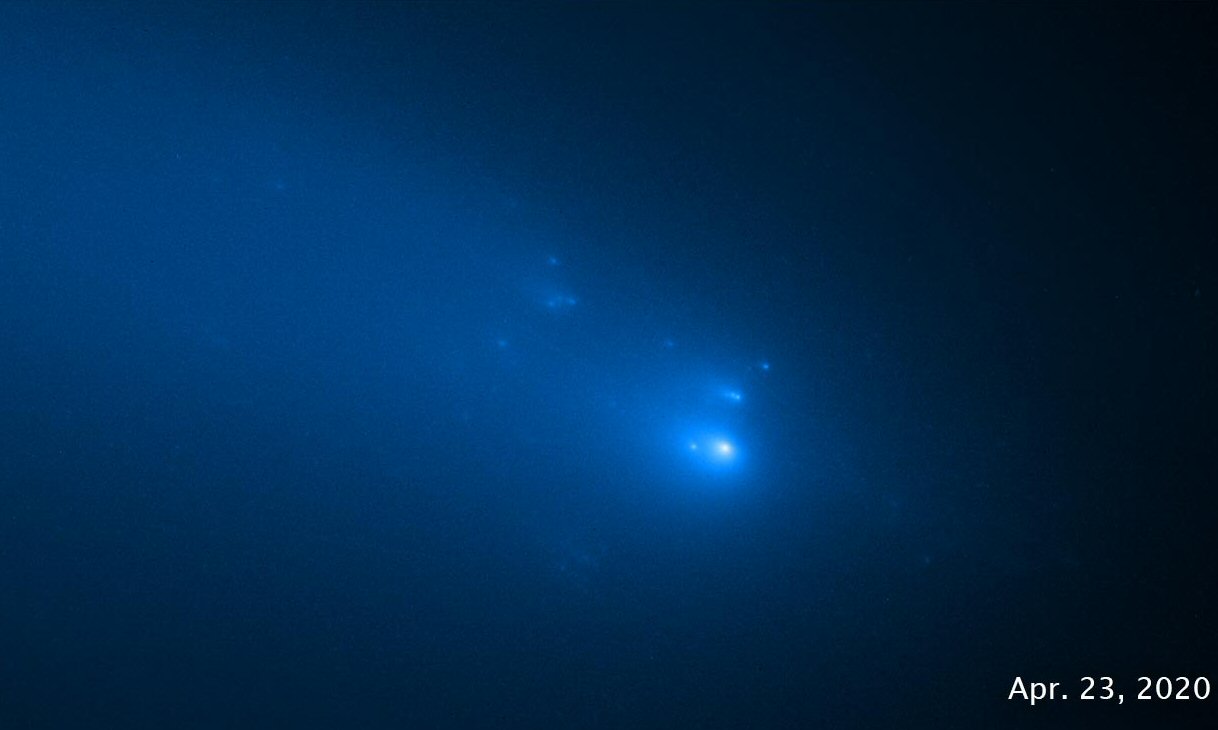
Comet 2019 Y4 (Atlas) has broken up imaged by Hubble on 23rd April 2020
There is a chance that we may be able to see a ‘naked eye' comet during May this year. This comet is called 2019 Y4 (Atlas) and it is heading for its closest approach to the Sun (Perihelion) on 31st May when it should be at its brightest.
At the end of March comet C/2019 Y4 was at 8th magnitude making the object easily visible in modest-sized backyard telescopes as a fuzzy ball. In good conditions and dark skies, the comet should also be visible in supported binoculars. Recent observations have surprised astronomers as the comet has rapidly increased in brightness since its discovery in December. The latest pictures taken by Hubble show the comet's nucleus has fragmented with four large pieces broken off along with many smaller pieces.
Back in December the object was a desperately faint magnitude 20th magnitude in the constellation of Ursa Major at a distance of 273 million miles. Most astronomers would agree that this is typical behaviour for comets as they approach the Sun. Originally, predictions were that Comet Atlas would peak at somewhere around magnitude +9. This would mean yet another mediocre comet to be noticed only by telescope owners.
However, things changed when astronomers realised the incredible rate of brightness increase due to the fragmentation. Almost day-by-day rapid changes have been observed and are now at a stage where the comet is 600 times brighter than predicted to be at this point. Another feature is the comet's apparent size in the sky given its distance. Currently, the icy space object is around 20 arcminutes wide (the full Moon is 30 arcminutes). This means that the comet already has a very large coma.
Given that the comet's orbit follows that of the great comet in 1844 and has an orbital period of over 5000 years, the comet will certainly have some fresh, untouched icy material in there just waiting to be warmed up by our Star. There is a chance the comet could be quite bright. However at its' predicted brightest on 31st May it will close to the Sun as it sets over the North Western horizon. It will be easier to see up until the middle of May.
CHARTS SHOWING THE ORBITAL PATH OF COMET 2019Y4 (Atlas)
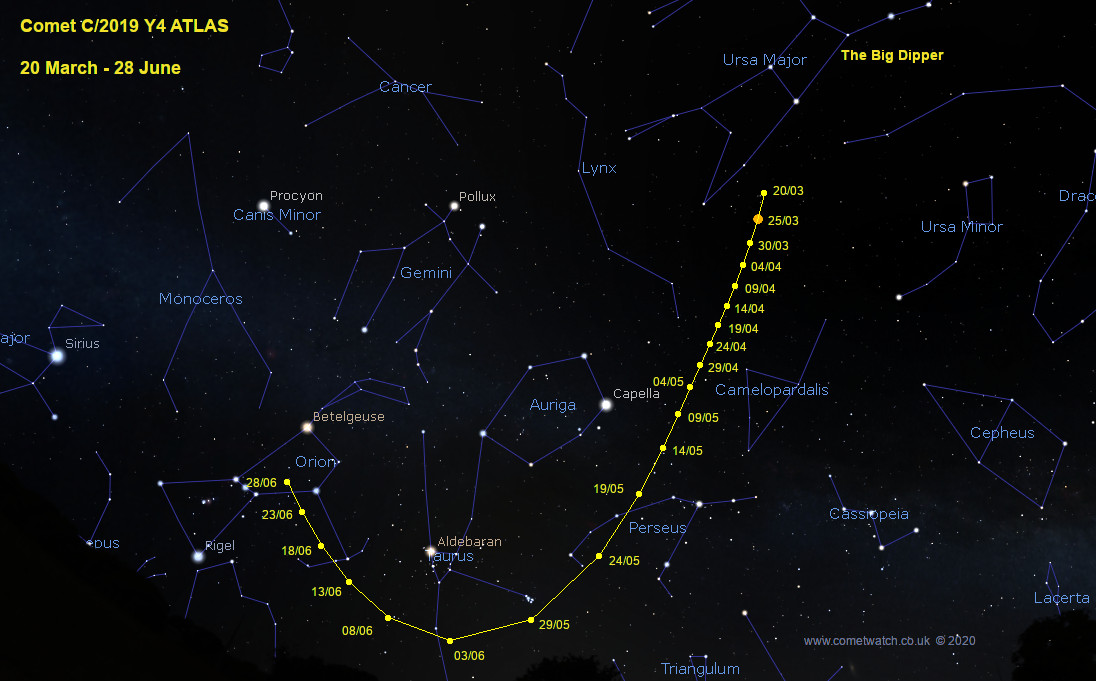
Chart showing the path of Comet Atlas from 20th March to 28th June
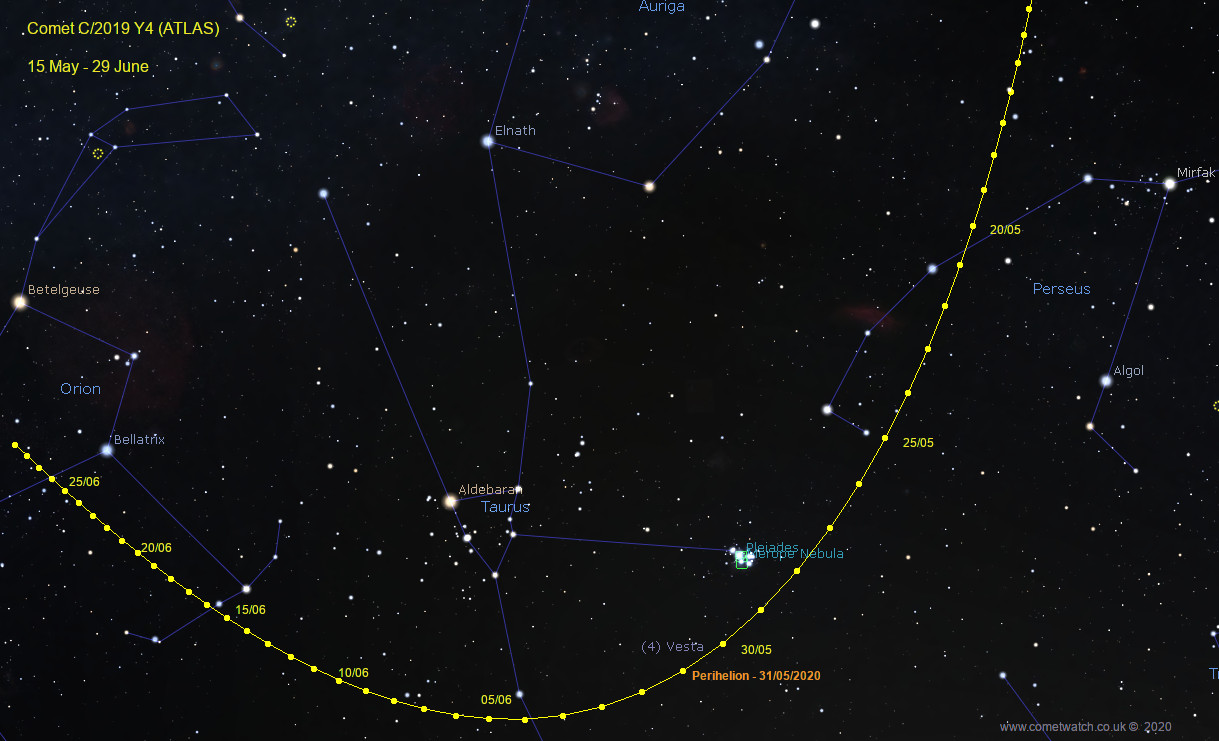
Detailed chart showing the path of Comet Atlas from 13th May to 29th June
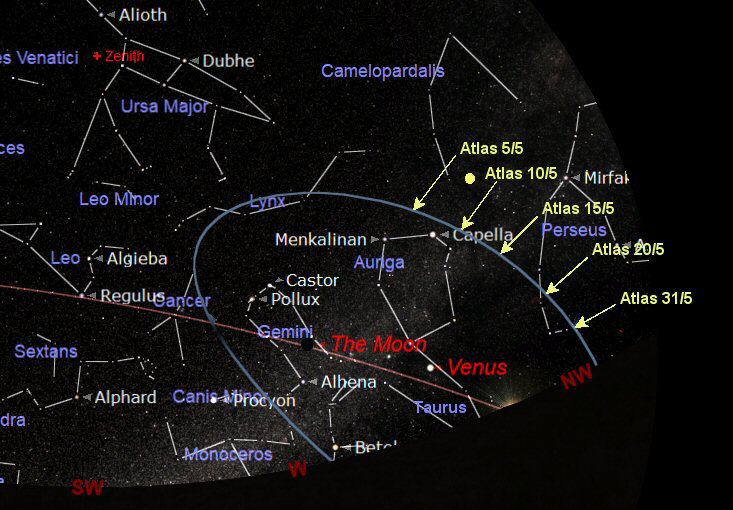
The approximate position of Atlas during May at sunset
The chart above has been included to show how (in reality) the comet will be further from the bright sky at sunset as Atlas approaches Perihelion on 31st May. After 15th May the comet is going to be in the bright sky after sunset 21:00 BST (9 o'clock).
NOTE: The position of Atlas shown is approximately correct on 31st May. The earlier positions have been superimposed on the chart for 31st May so the location relative to the surrounding stars must be checked against the previous charts. For example on 10/5 Atlas will actually be positioned closer to where the yellow circle is positioned.
For those who would like to search for the comet using binoculars or a telescope they should start as early as possible. The recent reports are that the comet is getting brighter and should continue brightening as it approaches the Sun. So start as early in May as possible with weather darkness permitting. At the beginning of May the comet will be further away from the Sun and the brighter sky near the North West horizon where the Sun has set. Later in the month the Sun sets later and the comet moves closer to the Sun and the horizon and will be more difficult to see.
For those who have a telescope with an equatorial mount here are some coordinates that can be set on the mounting Setting Circles. This will allow the telescope to be guided to the position of the comet in the sky. A similar process can be used for AltAz mounts. Further advice on using the Setting Circles can be found in the January 2019 edition of the Beginners Magazine which is archived on the Beginners website at: www.naasbeginners.co.uk .
Before starting to use Setting Circles the telescope must be set up correctly for observing. It is very important that the mount is carefully levelled before starting. If the mounting is not level it will be tilted compared to the sky and it will not align on the object being sought. The equatorial mounted telescope will also need to be correctly aligned to the northern celestial pole (Polaris).
The RA (Right Ascension) Bezel is a movable full circle disc marked in Hours and minutes from 0 hours to 24 hours. The Dec (Declination) Bezel is fixed to the telescope tube and moves up and down with the tube. It is marked in degrees with the fixed pointer at +90º when pointed to Polaris (close to the North Celestial Pole). Therefore 0º would be the Celestial Equator (Earth's Equator) and -90º would be the South Celestial Pole.
First we must look up the RA and Dec coordinates of a bright star that is easy to find and preferably near to the position of our target, Capella would be perfect. The coordinates obtained from a Computer Planetarium Application for Capella are:
RA: 05 Hr 18 min - Dec: 46 º 0.9'
The RA Bezel can be rotated freely to any position we choose. As the telescope is to be pointed at our target star (Capella) we rotate the RA Bezel to the coordinate shown by the computer, (RA: 05 Hr 18 min) . The settings do not need to be super accurate as we are going to use the finder to locate our target to be observed.
We must now slew the telescope (without moving the ‘RA' bezel) until it is pointing to the chosen star (Capella). The pointers on the telescope mount should be pointing to the coordinates given by the computer. The telescope has now been aligned to the real sky by checking the alignment to the reference star (Capella). We can now use the setting circles to find other objects such as the Comet Atlas.
The coordinates for Comet 2019Y4 (Atlas)
DATE |
RA |
DEC |
1 May |
05h:17m:52s |
+60º 05' 18'' |
5 May |
05h:02m:27s |
+58º 01' 48'' |
10 May |
04h:42m:44s |
+54º 49' 24'' |
15 May |
04h:22m:01s |
+50º 26' 37'' |
20 May |
05h:00m:48s |
+44º 03' 13'' |
25 May |
04h:42m:32s |
+34º 33' 59'' |
31 May |
03h:38m:39s |
+20º 08' 13'' |
To find the Comet we now slew the telescope (without moving the ‘RA' bezel) to the RA and Dec coordinates shown in the table above for the day. When the coordinates are aligned to the fixed pointers the Comet should be be visible in the finder. If it cannot be seen then check the telescope alignment by using the coordinates for the reference star to see if it finds that star again correctly. Then select the coordinates of another bright star and slew to that star. If that star is found in the Finder then the Comet should have been in the field of view of the finder. Remember comets are generally faint and ‘fuzzy' objects and Atlas will probably be in a fairly bright sky so it may just be difficult to see.