WHAT'S UP THIS MONTH - MAY 2023
(Link to What's Up April 2023)
Click here for Perseid Meteor Shower
THESE PAGES ARE INTENDED TO HELP YOU FIND YOUR WAY AROUND THE SKY
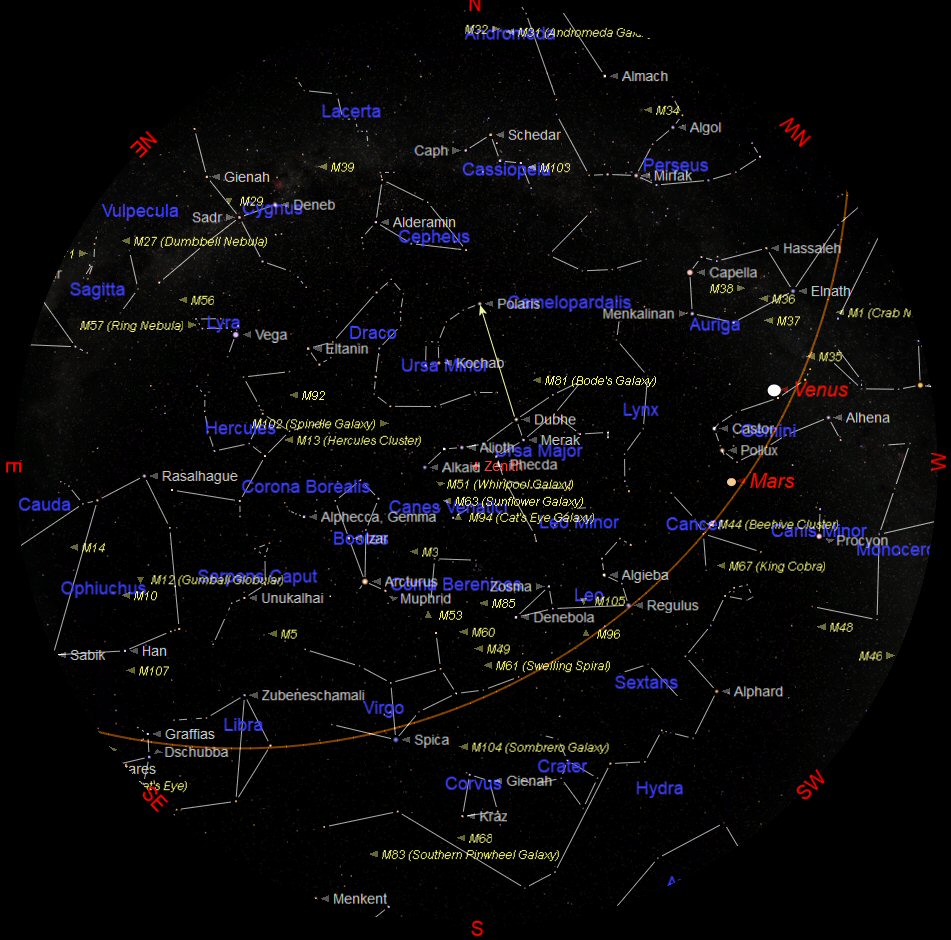
The chart above shows the whole night sky as it appears on 15th May at 21:00 (9 o'clock) British Summer Time (GMT). As the Earth orbits the Sun and we look out into space each night the stars will appear to have moved across the sky by a small amount. Every month Earth moves one twelfth of its circuit around the Sun, this amounts to 30 degrees each month. There are about 30 days in each month so each night the stars appear to move about 1 degree. The sky will therefore appear the same as shown on the chart above at 8 o'clock BST at the beginning of the month and at 10 o'clock BST at the end of the month. The stars also appear to move 15º (360º divided by 24) each hour from east to west, due to the Earth rotating once every 24 hours.
The centre of the chart will be the position in the sky directly overhead, called the Zenith. First we need to find some familiar objects so we can get our bearings. The Pole Star Polaris can be easily found by first finding the familiar shape of the Great Bear ‘Ursa Major' that is also sometimes called the Plough or even the Big Dipper by the Americans. Ursa Major is visible throughout the year from Britain and is always quite easy to find. This month it is directly overhead. Look for the distinctive saucepan shape, four stars forming the bowl and three stars forming the handle. Follow an imaginary line, up from the two stars in the bowl furthest from the handle. These will point the way to Polaris which will be to the north of overhead at about 50º above the northern horizon. Polaris is the only moderately bright star in a fairly empty patch of sky. When you have found Polaris turn completely around and you will be facing south. To use this chart, position yourself looking south and hold the chart above your eyes.
Planets observable in the evening sky: Mars, Venus all the other planets are in the bright daytime sky.
OBSERVING THE SOUTHERN NIGHT SKY THIS MONTH
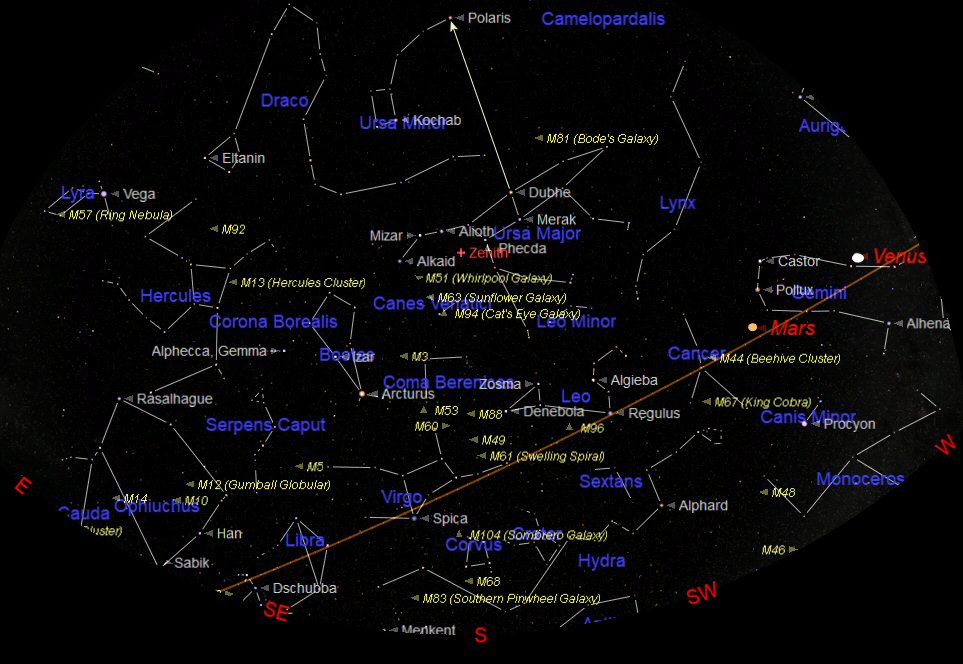
The night sky looking south at about 22:00 BST on 15th May
The chart above shows the night sky looking south at about 01:00 BST (00:00 GMT) on 21st June (Midsummer Night). West is to the right and east to the left. The point in the sky directly overhead is known as the Zenith and is shown (in red) at the upper centre of the chart. The curved brown line across the sky at the bottom is the Ecliptic or Zodiac. This is the imaginary line along which the Sun, Moon and planets appear to move across the sky. The brightest stars often appear to form a group or recognisable pattern; we call these ‘Constellations'.
Constellations through which the ecliptic passes are: Taurus (the Bull), Gemini (the Twins), Cancer (the Crab), Leo (the Lion), Virgo (the Virgin), Libra (the Scales), Scorpius (the Scorpion) and Sagittarius (the Archer)
Moving over the south western horizon is the winter constellation of Leo (the Lion) follows Cancer along the Ecliptic and was the constellation of the month last month. It does actually look a little like a lion or the Sphinx in Egypt. Around and between Leo and the neighboring constellation of Virgo is a cluster of galaxies.
To the north of Virgo is the constellation of Boötes with its bright orange coloured star called Arcturus. The stars in Boötes form the shape of an old fashioned diamond shaped kite with Arcturus located where the string of the tail would be attached. Arcturus is one of just a few stars that do actually appear to be coloured and is noticeably orange to the ‘naked eye'. It is actually a star with a mass similar to our Sun but is older at 7 billion years (our Sun is 4.3 billion years old). Arcturus is a Red Giant approaching the end of its life.
Arctaurus is a Red Giant star that is nearing the end of its ‘life' as a normal star. It has used almost all of its Hydrogen fuel and has expanded to become a Red Giant, 25 times the diameter of our Sun. At the moment it shines 115 times brighter than our Sun but it is destined to collapse and become a White Dwarf. So when we look at this star we can see what our Sun will look like in about 4 billion years time.
Following Leo is the less obvious constellation of Virgo but it does have one fairly bright star called Spica. Virgo gives its name to a large cluster of Galaxies that is also spread over into the neighbouring constellations of Coma Berenices (Berenices' Hair) and into Leo.
Higher in the south east is the constellation of Hercules (the Strong Man). Hercules has a rather distinctive distorted square shape, at its centre, called the ‘Keystone'. This is due to its resemblance to the centre stone of an arch or bridge. The jewel of Hercules is without doubt is the Great Globular Cluster, Messier 13 (M13). M13 can be found in the western (right) vertical imaginary line of the ‘Keystone'. It is just visible using a good pair of 9 x 50 binoculars. The spherical cluster, of about a million stars that can be seen using a 90mm f 10 telescope but will look even more impressive when using a larger telescope.
Prominent in the southern sky is the Summer Triangle that dominates the Summer Sky. The triangle is defined by three obvious bright stars: Deneb in the constellation of Cygnus, Vega in Lyra, and Altair in Aquila. The Milky Way (our Galaxy) flows through the Summer Triangle and passes through Aquila and Cygnus.
The Ecliptic is low in the sky during the summer months so the Moon and planets at appear close to the southern horizon. Saturn and Jupiter are starting enter the night sky but due to their low altitude will not be at their best for observation this year. The thick, murky and turbulent air will cause the planets to appear quite unsteady. However the Full Moon can be very spectacular during the summer. With the Moon being very low it appears to us to be much larger so we call it a ‘Super Moon'. This is just an optical illusion when our brain tries to relate the size of the Moon to objects on the horizon.
WHERE TO FIND THE PLANETS THIS MONTH
Mercury will be in inferior conjunction with the Sun (between Earth and the Sun) on 1st May so will not be visible.
Venus will be visible in the early evening sky as soon as possible after sunset. It will still appear at a rather small diameter (for Venus) and will be and just over half illuminated.
Mars can be seen almost directly overhead and has moved from Taurus into Gemini. It is starting to look small at about 5" (arc-seconds) as it moves further away from us. So Mars is past its best and is now starting to fall behind Earth and will appear to be getting smaller and fainter as it moves away from us.
Jupiter is in now in the bright early morning sky and is not observable.
Saturn has now moved into the bright morning sky and is not observable.
Uranus will be in conjunction with the Sun on 9th May so is not observable.
Neptune has now moved into the bright morning sky and is not observable.
CONSTELLATION OF THE MONTH- PERSEUS
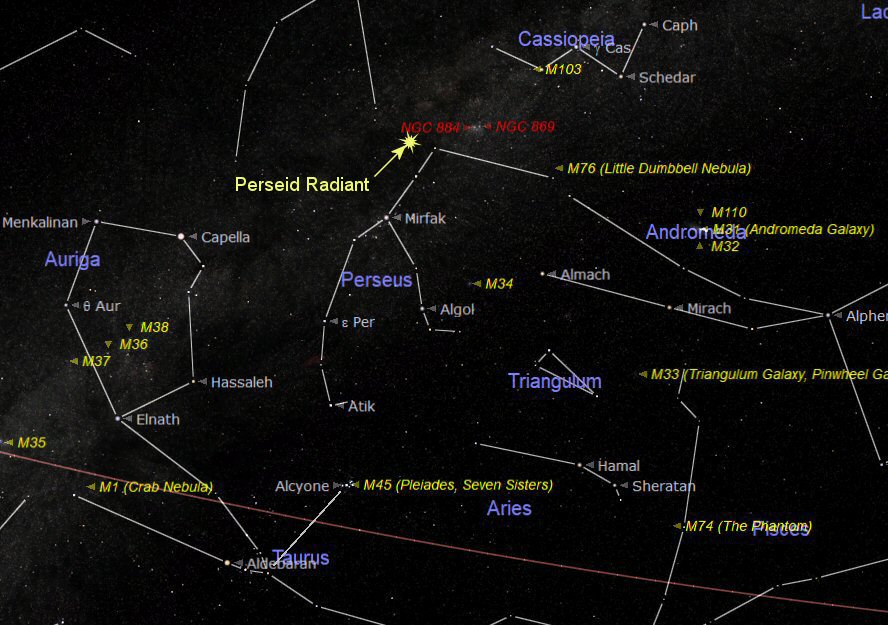
Perseus is our constellation of special interest this month because it is host to the Radiant of the Perseid Meteor shower. The other articles in the magazine this month give the details of the Perseid Meteor shower but the constellation of Perseus has interesting things to see as well.
The asterism (stick figure shape) looks rather like a horse riding stirrup. The two brightest stars Algol and Mirfak along with the fainter star Atik mark out the ‘V' main shape with another line of stars pointing from Mirfak towards the very obvious ‘W' shape of Cassiopeia.
The second brightest star in Perseus is called Algol with the official designation Beta Persei ( ß Persei ) but it is also known colloquially as the Demon Star because it varies in brightnes . It is a bright multiple star system in the constellation of Perseus and one of the first non-eclipsing variable stars to be discovered.
Algol is actually a three-star system, consisting of Beta Persei Aa1, Aa2, and Ab in which the hot luminous primary ß Persei Aa1 and the larger but cooler and fainter, ß Persei Aa2 regularly pass in front of each other, causing the system to vary due to the eclipses. Algol's magnitude is usually near-constant at 2.1 but regularly dips to 3.4 every 2.86 days during the roughly 10-hour-long partial eclipses. There is a secondary eclipse when the brighter primary star occults the fainter secondary this is very shallow and can only be detected photographically.
Other constellations around Perseus are: Cassiopeia to the north, Andromeda to the west (right) Auriga to the east (left) and Taurus to the south (below). Continuing the line of stars from Mirfak to Atik the beautiful Open Cluster of stars Messier 45 (M45) the Pleiades also called the Seven Sisters can be found in the constellation of Taurus (the Bull).
During the summer months Perseus is located in the north close the horizon so that is where it can be found this month. During the winter it is located almost overhead and during November and December is actually host to the Zenith (the point in the sky directly over head).
Perseus is also host to two Messier ‘deep sky' objects Messier 34 (M34) and Messier 76 (M76). M76 is a rather nice Planetary Nebula which is sometimes called the Little Dumbbell. This is a star similar to our Sun that has collapsed to become a White Dwarf and has developed a ‘bubble' of gas around it. It does need a medium sized telescope to see.
Messier 34 is a fairly bright Open Cluster comprised of about 80 stars. It can be seen as a small ‘fuzzy' patch of light using binoculars but does need a telescope to see as a cluster of stars. However there is another Open Cluster or rather two clusters called the Double Cluster that are listed in the New General Catalogue as NGC 869 and NGC 884 and shown in the image below.
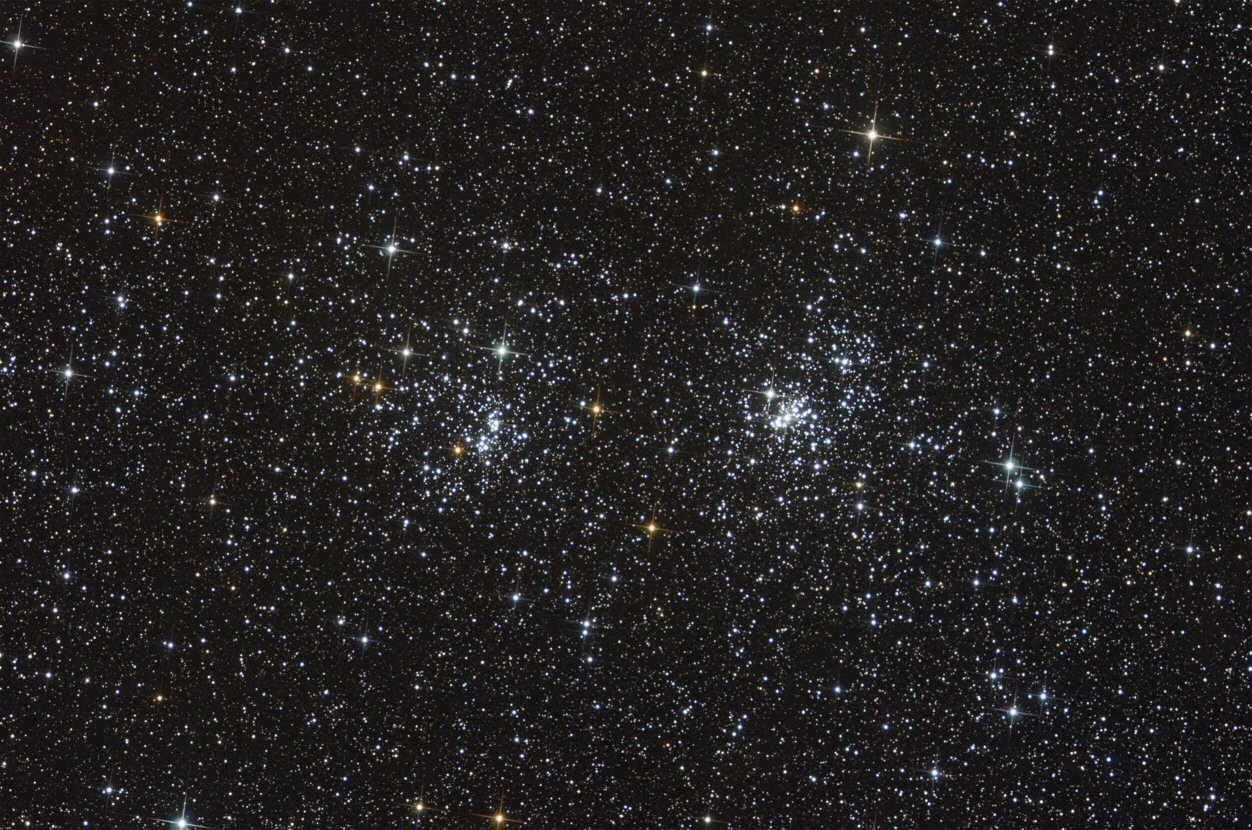
NGC 869 and NGC 884 the Double Cluster
The Double Cluster can be seen on a clear dark night with the ‘Naked Eye' as a ‘fuzzy patch of light in the line of stars leading from the star Mirfak up towards the constellation of Cassiopeia. It is best seen using binoculars or a small telescope fitted with a low power eyepiece (25mm or 32mm). It is not clear whether this is a true associated double cluster or just a ‘line of sight' coincidence.
THE PERSEID METEOR SHOWER THIS MONTH
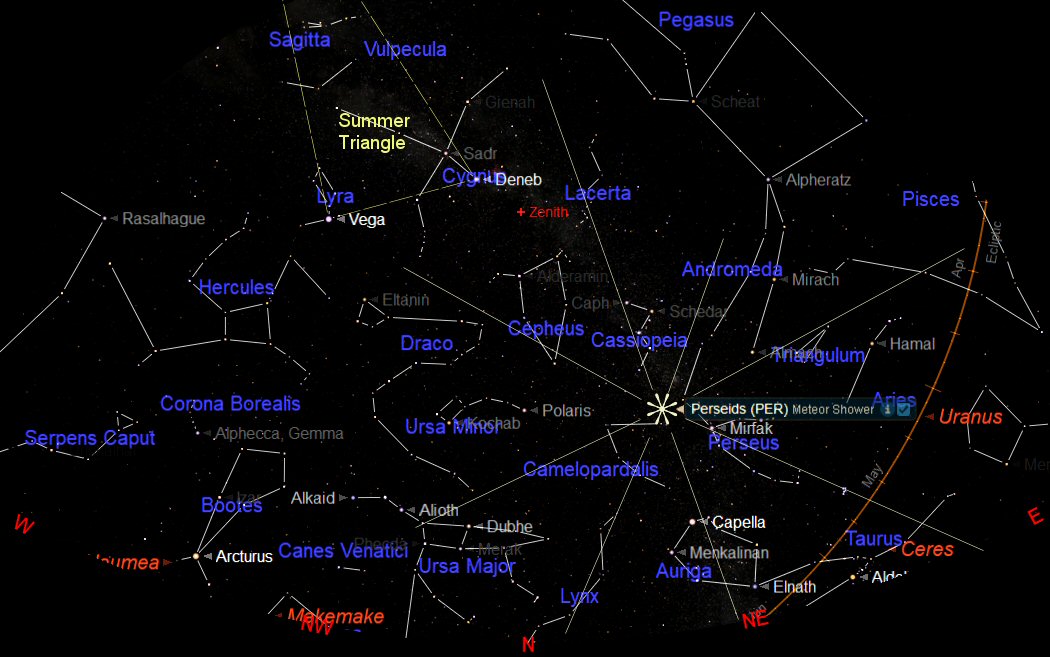
The view of the night sky looking north towards the northern horizon
Meteor showers are notoriously unpredictable. The exact time of any spectacular increase in numbers or if the meteors will be bright is difficult to predict as is the clear weather needed to see them. However every year on the evening of the 12th and morning of 13th August there is a spectacular display from the Perseid Meteor Shower.
The Persied meteors originate from the comet Swift-Tuttle and are named after the constellation Perseus. This is because they appear to radiant from a point in the sky located in Perseus. It may be possible to see up to 60 or even 100 meteors an hour from a very dark place .
Fortunately this year the Moon will not be in the sky so even the fainter meteors may be seen in the dark sky away from street lights. The meteors of a shower appear to radiate from a point in the sky that is called the ‘Radiant'. The meteors of this particular shower appear to originate from a ‘Radiant' point in the constellation of Perseus. See the chart above.
If the trail of any meteor that is seen can be tracked back and found to have originated from this radiant point it will be a Perseid. A few meteors might appear to originate from other directions so these are the meteors that might be seen randomly and not part of any named shower. These are known as Sporadic Meteors.
From a clear dark site, the constellation of Perseus can be clearly seen as a line of stars stretching from the very distinctive ‘W' shape of Cassiopeia and down towards the bright star Capella. The brighter stars of Perseus appear to mark out the rough shape of a horse riding spur.
If the sky is clear the Milky Way (our galaxy) can be seen rising up from the northern horizon passing through Perseus, Cassiopeia and right across the sky though Cygnus and the Summer Triangle. The bright star Capella in the constellation Auriga will be twinkling noticeably close to the northern horizon.
Observing can start as soon as it is dark but there is likely to be more meteors after midnight. Position a lounger chair so the northern horizon can be seen. Look at about 45º above the horizon and anywhere between west, through north and to the east. Meteors will appear as a fast streak of light flashing across the sky. One or two meteors every five to ten minutes may be seen. See the advice for observing meteors below.
Some might be faint and difficult to see from a well-lit area in the towns. Any bright meteors will be seen even from fairly light polluted skies. These may appear anywhere in the sky from close to the radiant in the north to directly overhead. With a clear sky it may be possible to follow the tracks back through the constellations they passed through to the radiant point in Perseus.
There are a number of interesting Meteor Showers throughout the year that are listed below.
PERIOD |
SHOWER |
MAXIMUM |
| 28 Dec – 12 Jan | Quadrantids | 3 Jan |
| 14 April – 30 Apr | Lyrids | April 22 |
| 19 Apr – 28 May | Eta Aquarids | 6 May |
| 3 July – 15 Aug | Alpha Capricrnids | 30 July |
| 12 July – 23 Aug | Delta Aquarids | 30 July |
| 17 July – 24 Aug | Perseids | 12 Aug |
| 6 Oct – 10 Oct | Draconids | 8 Oct |
| 2 Oct – 7 Nov | Orionids | 21 Oct |
| 20 Oct - 10 Dec | Taurids | 3 Nov |
| 6 Nov – 30 Nov | Leonids | 17 Nov |
| 4 Dec – 20 Dec | Geminids | 14 Dec |
| 17 Dec – 26 Dec | Ursids | 22 Dec |
SOME ADVICE FOR OBSERVING METEORS
Before rushing out into the garden to look for meteors, there are a few things to consider for your own comfort, the first and most important is clothing. The nights, even in summer, can be cold so it is essential to dress in warm clothes. A number of layers of clothes are often better than one overcoat. A vest or tee shirt, a long sleeved shirt and a jumper, perhaps a body warmer and then an outer jacket should be considered. Two layers on the legs are also necessary. Long leg thermal pants are excellent for men or women but track suit bottoms are also good as an under garment. Then jeans or a thick pair of trousers should be worn over the top. Water proof trousers and jackets are also good for keeping the damp and wind out. Two pairs of socks are a good idea and warm shoes. Most trainers these days are padded and are quite warm. A woolly or padded hat is essential because a lot of the body heat is lost from the head but peaked hats should be avoided. Finally a pair of gloves must be worn. It is always best to start warm and stay warm because once the cold has set in it is very difficult to get warm again.
A garden ‘lounger' chair is an excellent piece of equipment especially the type that can be reclined into a near horizontal position. This will help avoid neck and back ache when looking up. When sitting in a garden chair a blanket or old quilt can also be used for additional warmth. A sky chart will be useful to locate the part of the sky where the meteor radiant will be located. To read the star chart in a dark garden will require a torch but a bright white light should be avoided. A red lamp such as a rear cycle lamp is better, to avoid ruining the dark adaptation of the eyes. Even this may prove too bright so a piece of card can be used to shutter off some of the light. The card can be secured over the lamp with tape or an elastic band. A 10mm hole cut in the card should provide enough light to read the chart and not ruin the night vision. Turn off any light that you can and set up a screen to hide street lights to stop them dazzling you.
You may wish to take notes of what you have seen or even mark the positions of the meteors on your star chart so a pencil should be taken out to the observing spot. If you intend to have a long observing session, especially for a meteor watch, then a hot drink in a flask would prevent missing some of the show and avoid losing dark adaptation by going indoors to make a hot drink.
Most importantly ensure that you are comfortable before you start observing and have everything you need to hand. It is very irritating to have to keep getting up to try to find something you have forgotten especially if you need to go indoors to get it. Once you are comfortable and settled, with everything you need, then you are ready to start the meteor watch session.
Now let's consider where to position ourselves. For the Perseid Meteor Shower a clear view towards the east to south east is required so set up your lounger seat with your feet facing east to south east. Use the patio or path if possible, they are more comfortable and less prone to dampness from dew. Obviously try to set up away from trees or buildings but this may not be possible so set up in the best place to view your intended target, you can always move to another position later. Make sure you have everything to hand, a small table or box by your side will provide a convenient place to put your chart, torch, spectacles or even a hot drink and will save fumbling around on the ground for things in the dark.
To start viewing allow about five minutes for your eyes to become adapted to the dark. This period can be used to familiarise yourself with the sky and work out where everything is. Try to turn off all lights around you. If there is a street light bothering you, it may be possible to erect a screen around yourself using garden canes, step ladders, washing poles, string and old sheets, curtains, towels or even newspapers. Even lights which appeared dim when you first began your session seem to get very bright when your eyes are fully adjusted to the dark.
It is useful if you can observe from your own back garden because you can quickly get used to the positions of stars from one night to the next. It is not always possible to use your own garden due to the dazzling effect of street lights or perhaps trees or buildings blocking the view. It may be necessary therefore to go to a darker area away from lights. If this is the case it is much better to go with a friend, if possible, as it will be safer and more enjoyable. A remote observing site also has the disadvantage of having to transport any equipment. If it is decided to try a remote site, always check the weather forecast first - this might save a lot of travelling and anguish when the sky clouds over shortly after all has been set up.
After making yourself warm and comfortable and allowing enough time for your eyes to become adapted to the dark it is time to start observing. The first thing to do is to look around the sky to find familiar objects. The most common thing used is the constellation of Ursa Major also called the Plough. Use the instructions on the front page to align the chart. Now position your star chart just above your eyes ensuring that the south position on the map is at the bottom. What you see represented on the chart should be what you see in the sky. Once the orientation is complete the chart can be lowered into a convenient reading position.
Observing can start before midnight but there will most likely be fewer meteors at this time. There are two reasons for this, first the radiant of the Perseid Meteor Shower will be below the eastern horizon until just before midnight so fewer meteors will appear rising up above the horizon. Secondly, after midnight Earth will be ploughing head on into the main meteor stream. It is normally best to look up at an angle of around 45° above the horizon and 30° to 90° right or left from the radiant point. It will also be useful to familiarise yourself with the positions of the constellations in the direction you are looking while you are waiting for the meteors.
If you feel quite enthusiastic about observing the meteors, you may wish to make a log of every one you see - this can be done in two ways: Notes can be made on a pad detailing the time, direction and brightness. It will be necessary to note which constellations the meteor passes through or at least where it ended. These notes can then be plotted on to the chart later. You could alternatively draw the path on your chart and note the time and brightness on the line. The latter should be more fun because if the shower is good you will soon see a pattern developing where the lines trace back to a common point which is the radiant. There may also be some sporadic meteors which are not members of the shower and do not originate from the same place. These are also interesting when marked on the chart it may be possible to establish if they came from another old sparse shower.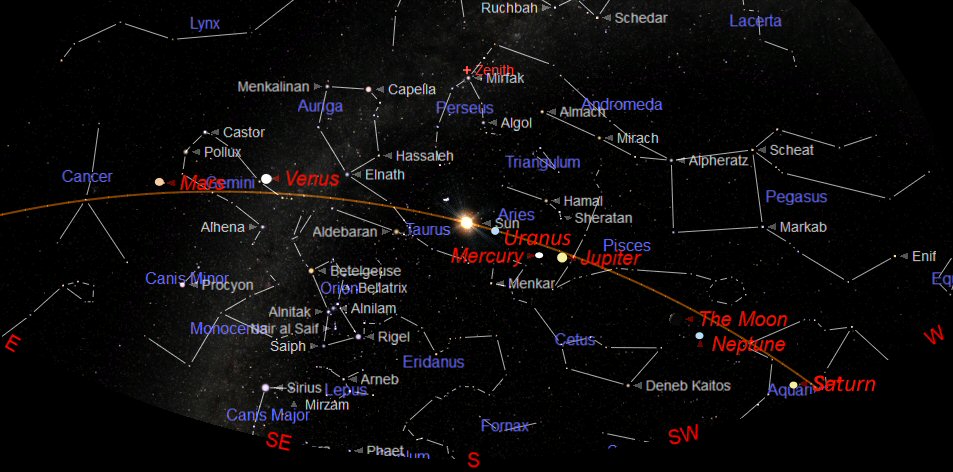
The location of all the planets at midday on 15th May
Over the last few months we have been treated to good views of all the planets in the night sky. The chart above shows the location of all the planets this month.
MERCURY was at its very best on 11th April this year but will be in inferior conjunction with the Sun this month (between Earth and the Sun) on 1st May so will not be visible.
VENUS is moving into its apparent furthest point from the Sun from our point of view this is called ‘Greatest Easterly Elongation'. It will be the same distance as the Sun from our point of view and will be approaching the point on its orbit where it will appear to be half illuminated on 4th June. It is brightest of all the planets but it will still appear with a rather small diameter (for Venus) and will be and just over half illuminated. A telescope will allow the phase development to be followed from ‘full but smaller diameter' to ‘a larger diameter but with a narrowing crescent'. This month it appears ‘gibbous' (wider than half illuminated).
Last month Peter Tickner from Reading Astronomical Society took the following images of Venus using special Inferred (IR) and Ultraviolet (IV) filters to enhance any features in the usual featureless clouds that completely cover the planet.
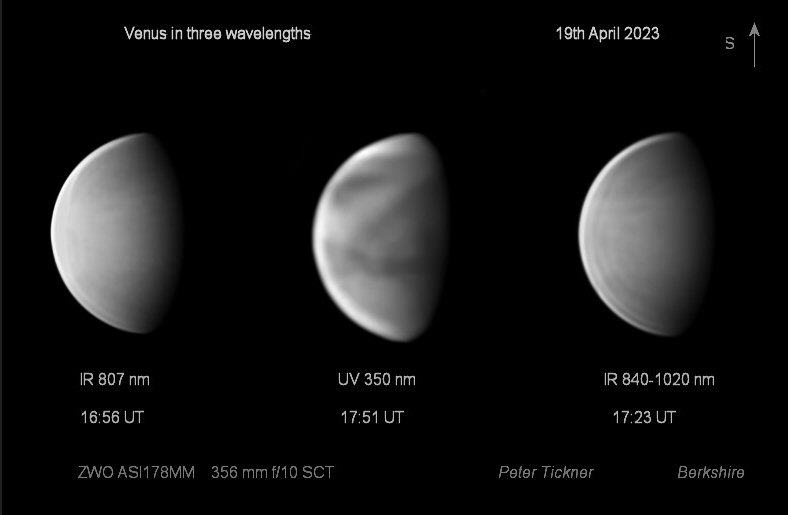
Pictures of Venus imaged by Peter Tickner
Peter added the following comments about his images of Venus:
These images were taken in blustery and difficult conditions although Venus itself was quite steady. The bright area seen in UV on 17th April had now rotated out of view.
I was looking in IR for any sign of the cloud discontinuity spotted by observers in South Africa and Southern Europe on 30th March, 4th , 9th and 14th April, so by rights next expected on 19th but although I was able to detect subtle cloud features in IR as well as UV, I couldn't see any obvious sign of the discontinuity.
MARS can be seen high in the evening sky as soon as the Sun has set and the sky darkens. It is looking small at about 5" (arc-seconds). Mars is past its best and is now falling behind Earth and will appear to be getting smaller as it moves further away from us.
JUPITER is in now in the bright early morning sky and is not observable, see the chart below.
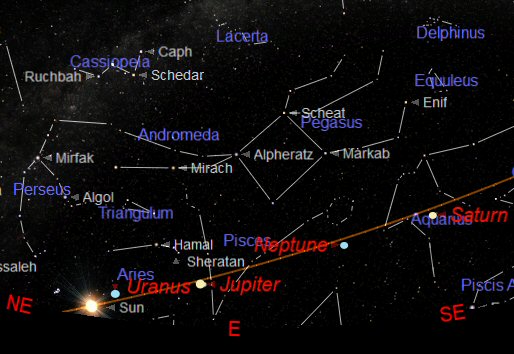
Jupiter, Saturn, Uranus and Neptune at sunrise on 15th May
SATURN has now moved into the bright morning sky and is not observable. See the chart above
URANUS is now in the morning sky and is very close to the Sun so it will not be observable. See the chart above.
NEPTUNE is also in the morning sky and is very close to the Sun so it will not be observable. See the chart above.
THE SUN
The Sun rises at about 05:20 at the beginning of the month and 04:55 at the end. It sets at 20:25 at the beginning of the month and 21:0 at the end. There have been some very nice Sunspots recently and an aurora was seen from the UK on 26th & 27th February. There has been some nice Sunspot activity over the last few months.
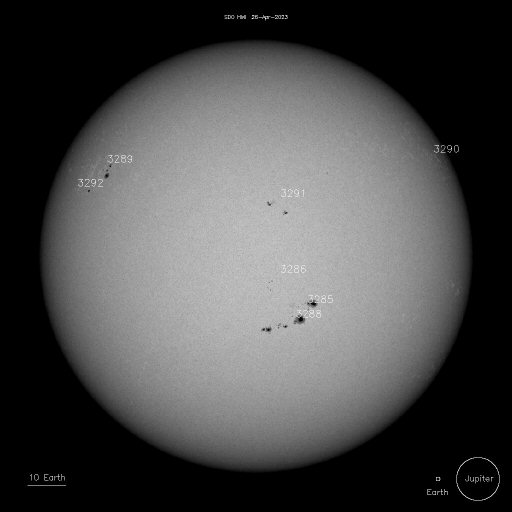
Sunspots imaged by SOHO on 28th April 2023
THE MOON PHASES DURING MAY
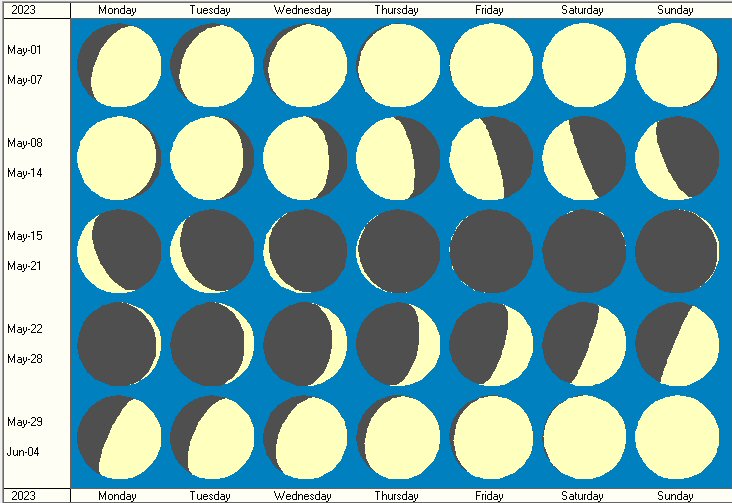
Full Moon will be on 5th May
Last Quarter will be on 12th May
New Moon will be on 19th May
First Quarter will be on 27th May