WHAT'S UP THIS MONTH - DECEMBER 2022
(Link to What's Up January 2023)
(Link to What's Up November 2022)
THESE PAGES ARE INTENDED TO HELP YOU FIND YOUR WAY AROUND THE SKY
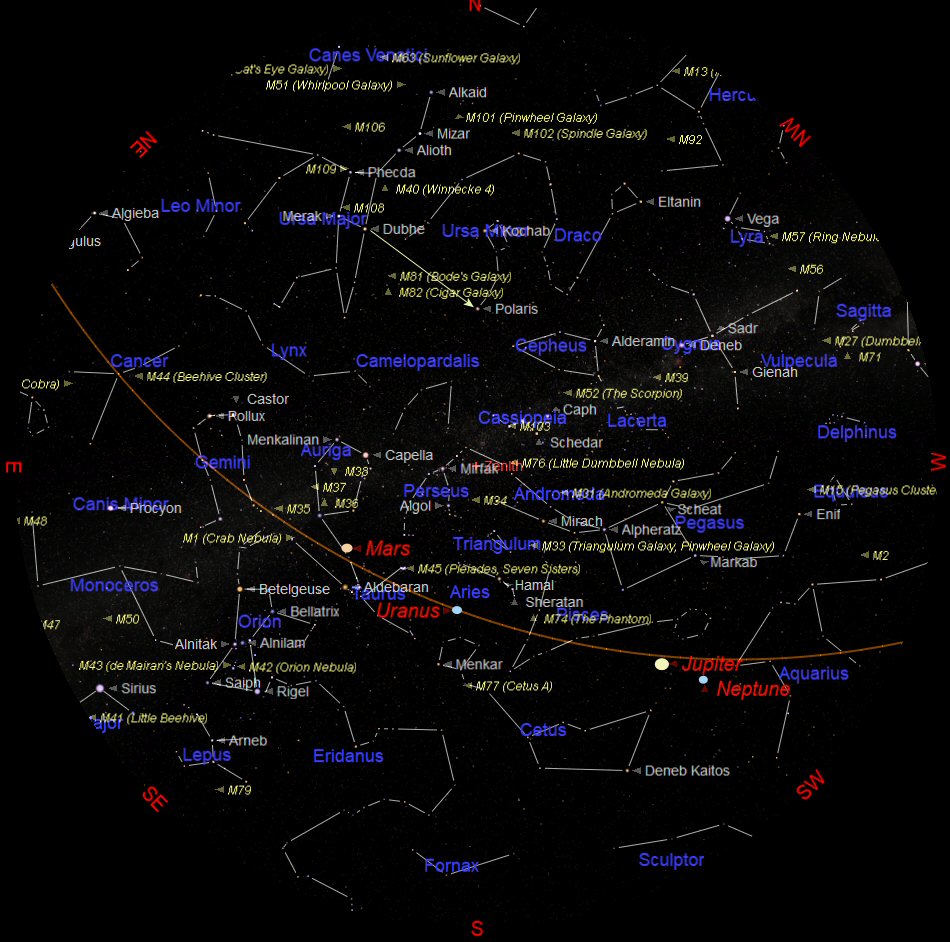
The chart above shows the whole night sky as it appears on 15th December at 22:00 (10 o'clock) Greenwich Mean Time (GMT). As the Earth orbits the Sun and we look out into space each night the stars will appear to have moved across the sky by a small amount. Every month Earth moves one twelfth of its circuit around the Sun, this amounts to 30 degrees each month. There are about 30 days in each month so each night the stars appear to move about 1 degree. The sky will therefore appear the same as shown on the chart above at 9 o'clock GMT at the beginning of the month and at 11 o'clock GMT at the end of the month. The stars also appear to move 15º (360º divided by 24) each hour from east to west, due to the Earth rotating once every 24 hours.
The centre of the chart will be the position in the sky directly overhead, called the Zenith. First we need to find some familiar objects so we can get our bearings. The Pole Star Polaris can be easily found by first finding the familiar shape of the Great Bear ‘Ursa Major' that is also sometimes called the Plough or even the Big Dipper by the Americans. Ursa Major is visible throughout the year from Britain and is always quite easy to find. This month it is in the North East. Look for the distinctive ‘saucepan' shape, four stars forming the bowl and three stars forming the handle. Follow an imaginary line, up from the two stars in the bowl furthest from the handle. These will point the way to Polaris which will be to the north of overhead at about 50º above the northern horizon. Polaris is the only moderately bright star in a fairly empty patch of sky. When you have found Polaris turn completely around and you will be facing south. To use this chart, position yourself looking south and hold the chart above your eyes.
Planets observable in the evening sky: Saturn (early evening), Neptune, Jupiter, Uranus and Mars.
THE SOUTHERN NIGHT SKY THIS MONTH
The night sky looking south at about 22:00 GMT on 15th November
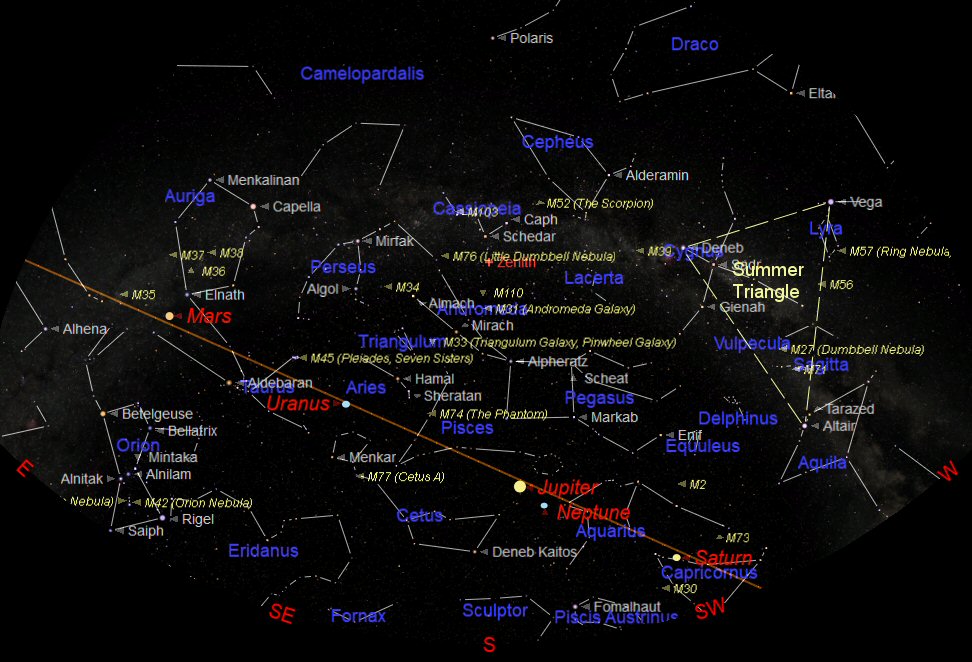
chart above shows the night sky looking south at about 22:00 GMT on 15th December. West is to the right and east to the left. The point in the sky directly overhead is known as the Zenith and is shown (in red) at the upper centre of the chart. The curved brown line across the sky at the bottom is the Ecliptic or Zodiac. This is the imaginary line along which the Sun, Moon and planets appear to move across the sky. The brightest stars often appear to form a group or recognisable pattern; we call these ‘Constellations'.
Constellations through which the ecliptic passes this month are: Aquarius (the Water Carrier), Pisces (the Fishes), Aries (the Ram), Taurus (the Bull), Gemini (the Twins), Cancer (the Crab) and Leo (the Lion).
Moving over the western horizon is the constellation of Pegasus (the Winged Horse). The main feature of Pegasus is the square formed by the four brightest stars. This asterism (shape) is known as the Great Square of Pegasus. The square is larger than might be expected but once found is easier to find again . There is a very nice Globular cluster in Pegasus, it is known as Messier 15 (M15). It is a lovely sight to see using a telescope.
Once the square is found the pointer to Andromeda is the top left star of the square named Alpheratz. Strangely Alpheratz is officially not part of Pegasus but is designated as Alpha (a) Andromedae. The constellation of Andromeda is host to the only ‘naked eye' Galaxy that is known as Messier 31 (M31). It is the most distant object that can be seen with our naked eyes (2.4 million light years away). It is quite easy to find using binoculars and is well place at this time of the year.
The easiest way to find M31 is to follow the line of stars from Alpheratz and locate the second star in the line which is shown as Mirach on the chart above. From Mirach follow a slightly fainter short line of stars to the north (above) Mirach to the second star. Just to the right of this star is the faint fuzzy patch of light that is M31 the Great Andromeda Galaxy. See the following pages.
Taurus is easy to find this month because Mars is shining brightly in the constellation. The most obvious star in Taurus is the lovely Red Giant Star called Aldebaran. It appears slightly orange to the ‘naked eye' but it is very obviously orange when seen using binoculars or a telescope. Aldebaran is located at the centre of the ‘flattened' X shape formed by the brightest stars in Taurus. At the end of the top right (upper west) arm of the ‘X' is the beautiful ‘naked eye' Open Star Cluster Messier 45 (M45) known as the Pleiades (or the Seven Sisters). It really does look magnificent using binoculars. Taurus is the constellation of the month.
Following Taurus is the constellation of Gemini (the Twins). The two brightest stars in Gemini are Castor and Pollux and they are named after mythological twins. To the north of Taurus is the odd pentagon shape of Auriga (the Charioteer). Dominating Auriga is the brilliant white star Capella which is almost directly overhead. For those with a telescope there is a line of lovely open clusters to search out in Taurus and Auriga. These are M35 in Taurus and M36, M37 and M38 in Auriga.
To the south of Taurus is the winter constellation of Orion (the Hunter). Orion is easily found by looking for his very obvious three stars of his belt. Orion will be the constellation of the month in the January Magazine.
To the east (right) of Taurus is the rather indistinct constellation of Cancer (the Crab). The stars of Cancer are quite faint and can be difficult to discern especially in a light polluted sky. It is really worth searching out Cancer using binoculars or a telescope to see the Open Cluster M44 (the Beehive Cluster). M44 is older and further away than M45 (the Seven Sisters) so is fainter than M45 but still looks lovely. It has a group of stars that resemble an old straw Beehive with bees around it.
WHERE TO FIND THE PLANETS THIS MONTH
All the planets, except Mercury and Venus are in the evening sky.
Mercury is not observable this month as it is too close to the Sun .
Venus passed its Superior Conjunction (behind the Sun) on 22nd October and is not visible .
Mars will be at its closest to Earth on 1st December but will be at opposition when it actually overtakes Mars on 8th December .
Jupiter is bright and observable over the southern horizon. The cloud markings can be seen and the four brightest moons will be visible in binoculars or a small telescope.
Saturn is still well placed over the southern western horizon in the early evening.
Uranus is in a good position for observing on the constellation of Aires (the Ram).
Neptune is well placed in the southern night sky and located close to Jupiter.
CONSTELLATION OF THE MONTH – TAURUS (the Bull)
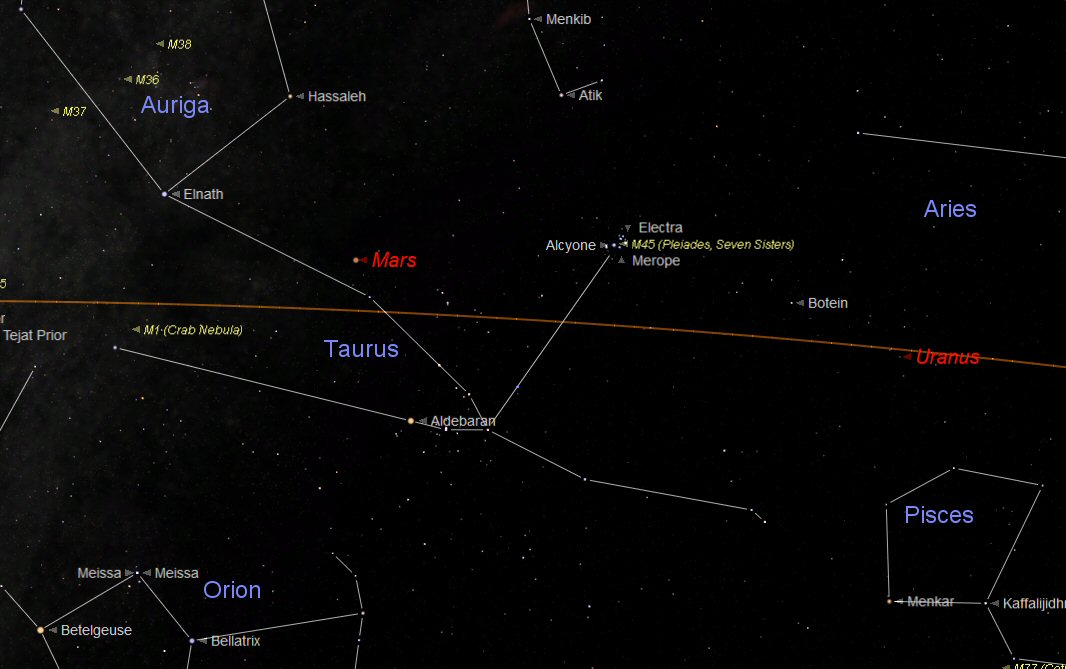
The chart above shows the constellation of Taurus the Bull. There are many different representations of Taurus but he is generally shown with his horns tipped by the stars at the end of the obvious ‘>' shape. The bright red star Aldebaran is normally used to show the bull's eye. Taurus is a special constellation this month especially as it host to the beautiful red planet Mars. Mars is located just above the bright red giant star Aldebaran that normally dominates Taurus. Using binoculars Mars and Aldebaran look similar but Mars is much brighter.
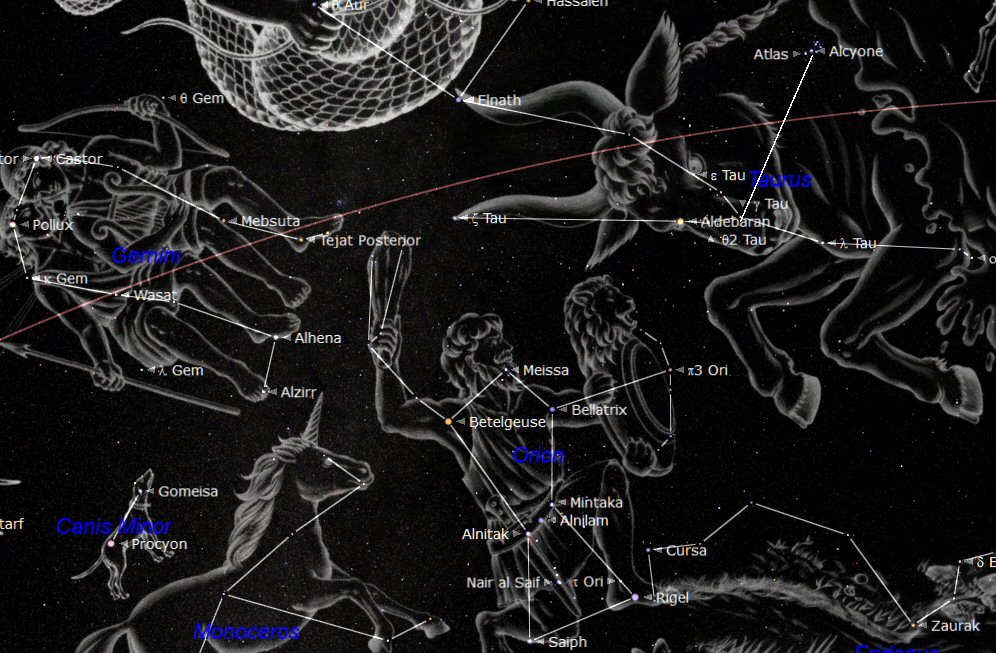
An illustration of the constellation of Taurus
With a little imagination Taurus appears to be charging Orion in the illustration. It sits on the Ecliptic and is one of the star signs of the Zodiac. The asterism (shape) used to identify Taurus resembles a stretched ‘X'.
The bright red star Aldebaran is located at the centre of Taurus. It is easy to find and therefore helps to identify the constellation of Taurus. It is in fact a Red Giant Star and that is why it appears distinctly orange. A Red Giant is a star similar to our Sun (perhaps a little larger) that is approaching the end of life as a normal star. It has used up most of its Hydrogen fuel and has swollen into a giant . Its outer layers are now stretched over a larger area so the available heat is also spread over a bigger area so its surface is cooler and appears orange in colour .
Surrounding the bright red star Aldebaran is an Open Cluster of Stars known as the Hyades. It is an older cluster than M45 so its stars have begun to disperse. It is also quite far away from us so the stars appear quite faint. In a dark Moonless sky the cluster can be seen with the naked eye but is best seen using binoculars. The cluster is large, at 3.5° in diameter (about 7 Moon diameters) and well dispersed.
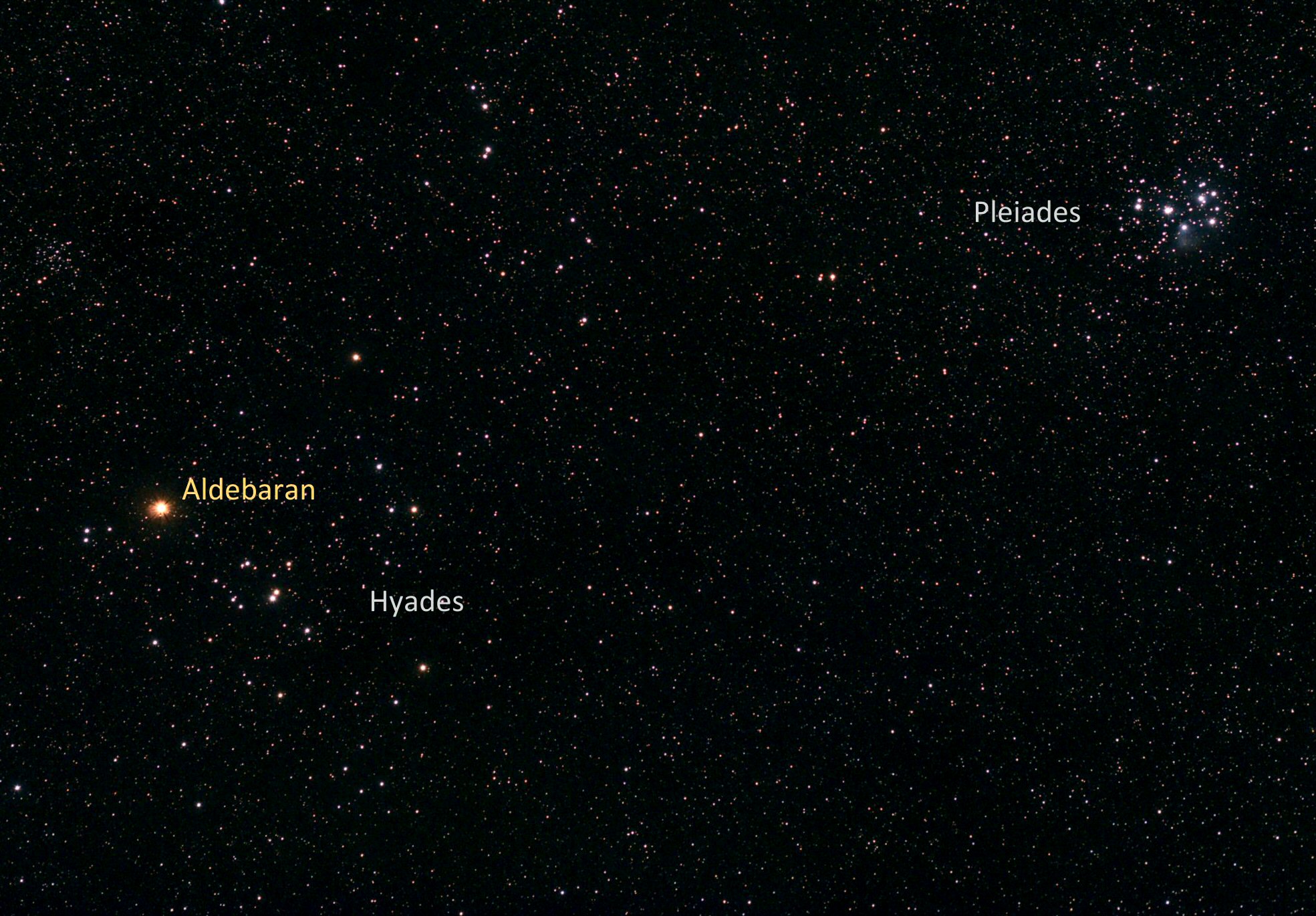
The Open Star Clusters Hyades and Pleiades (Messier 45)
The real jewel of Taurus is without doubt the beautiful Open Cluster, Messier 45 (M45) also called the Pleiades or the Seven Sisters. An Open cluster is created as stars form in a giant cloud of gas and dust called a ‘Nebula'. M45 is visible to the naked eye initially looking like a patch of light. Closer observation will reveal a cluster of up to seven stars. Using a good pair of binoculars many more stars will be seen. There are in fact about 300 young stars in the cluster that is estimated to be about 100 million years old. M45 is one of the closest open clusters to us at 400 light years.
The Pleiades look brighter than the stars of the Hyades because they are very bright large young stars and are relatively close to us. The largest and brightest is Alcyone which is 10 times the mass of our Sun and 1000 times brighter. The larger and brighter stars of the Pleiades are also rotating very fast.
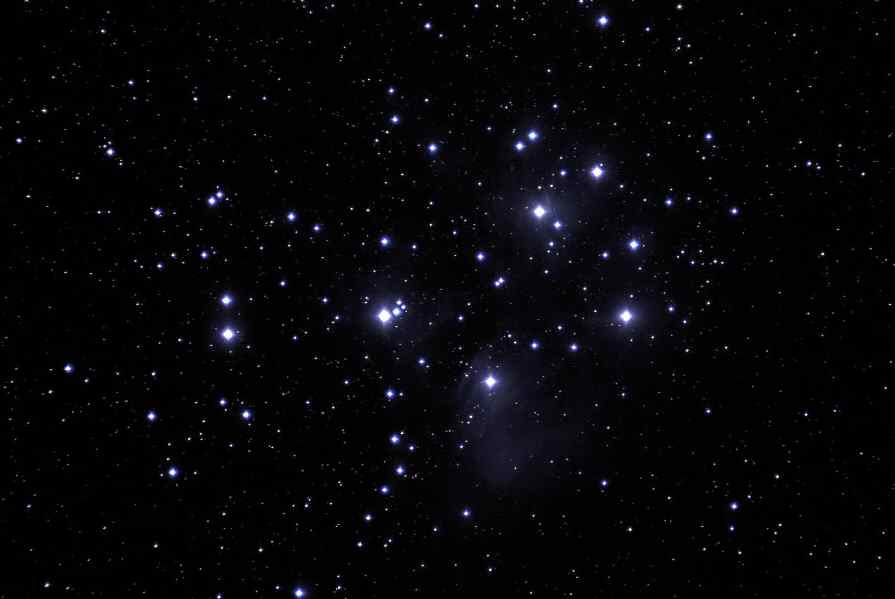
Messier 45 (M45) the Pleiades (Seven Sisters)
The stars of the Pleiades cluster would have formed from the gas and dust of a Nebula. Gravity draws the atoms of the Nebula together to form denser clumps of gas that become ever denser. Eventually the gas is squeezed into dense spheres where the pressure and high temperature at the core causes Hydrogen atoms to combine through Nuclear Fusion. As Hydrogen atoms are fused into Helium heat is produced and the sphere becomes a shining star. Any left-over gas and dust is blown away by intense radiation from the young stars and a cluster of new stars is revealed. This type of star cluster is called an ‘Open Cluster'.
The biggest and brightest stars of M45 (the Seven Sisters) have been named after seven sisters from Greek Mythology. They were the seven daughters of the Titan god called Atlas and the sea-nymph Pleione. Atlas and Pleione are included as the naked eye stars but the 6 th & 7 th sisters are actually Sterope (Asterope) and Celaeno.
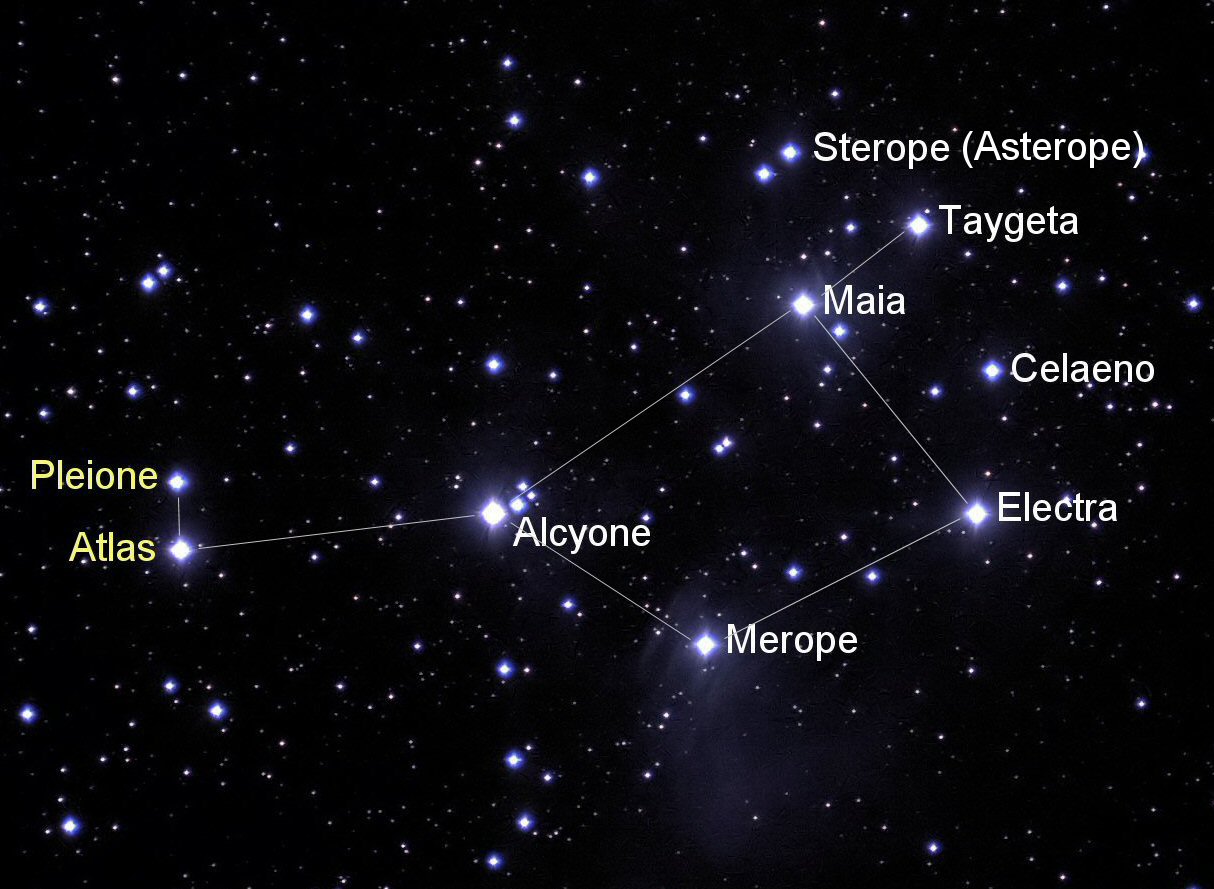
Names of the Seven Sisters and Parents (yellow)
Impressive as they are, the Seven Sisters are just the brightest (naked eye) stars in a cluster of around 300 young stars. In the images above the Seven Sisters appear to be surrounded by gas remaining from the original nebula. However it is now thought the cluster is just passing through a cloud of Hydrogen gas in space .
As M45 is so close to us the cluster has a relatively high apparent movement across the sky although it is still too slow for us to perceive. It will take 30,000 years to move a distance equal to the diameter of our Moon.
Although the cluster is moving through space the individual stars all have slightly different trajectories and relative speeds. Gradually over millions of years the stars will move further apart and the cluster will disperse, like the Hyades. Binoculars will reveal around 30 to 50 stars in the cluster and a telescope will reveal about 300 stars in the cluster. However the cluster is too large to fit into the field of view of most telescopes so the outline of the cluster will be lost.
There is another very interesting object in Taurus. At the end of the lower left (eastern) arm of Taurus is Messier 1 (M1) the Crab Nebula. It can be seen using binoculars in a dark clear sky but really needs a telescope. From Aldebaran look east to the star ? (Ksi) Tauri. Just above ? Tauri is a small smudge of light, this is M1.
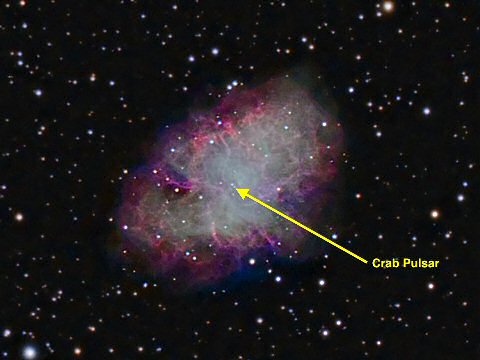
Messier 1 (M1) the Crab Nebula imaged by Hubble
M1 is the remnant of a giant star that exploded as a Supernova about 7000 years ago. Its light took 6000 years to reach Earth and was observed by Chinese astronomers in the year 1054 AD. It can still be seen in a dark clear sky as a ‘fuzzy' patch of light using a medium sized telescope.
A Supernova is the ‘death' of a star more than three times the mass of our Sun. Giant stars consume their Hydrogen fuel at an experientially faster rate than smaller stars. Consequently bigger stars do not ‘live' as long as smaller stars. As stars begin to exhaust their supply of Hydrogen they develop into a Red Giant like Aldebaran. Even larger stars develop into even larger Red Super Giants like Betelgeuse in Orion.
A star like our Sun and those up to about twice the mass of our Sun eventually slowly collapse as their fuel eventually runs out. The outer layers of the Red Giant drift away to form a gas bubble. The core ‘gently' collapses to form a White Dwarf Star.
Stars that are over 2½ to 3 times the mass of our Sun come to a more dramatic end. As the fuel of a larger Red Giant Star finally runs out the star suddenly collapses and all the mass of the star falls inwards under the massive force of its own gravity. The collapse reaches a point where the pressure and heat causes a gigantic thermonuclear explosion. The outer regions are blown into space to create a Supernova Remnant like M1 and a dense Neutron Star about 12,000km in diameter. These tiny, super dense stars are also called ‘Pulsars'.
THE SOLAR SYSTEM – DECEMBER 2022
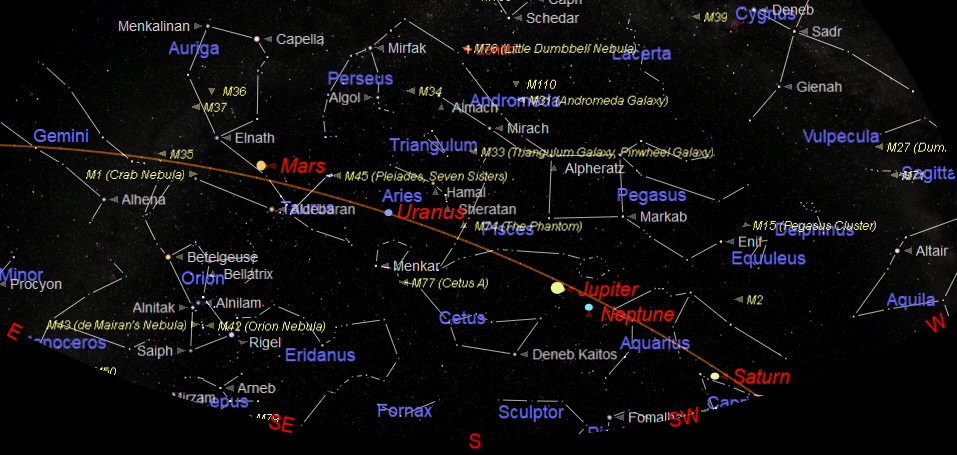
The planets at 20:00 on 15th December
The chart above shows the location of the planets along the Ecliptic. The outer (Superior) planets (that orbit outside the orbit of Earth) will be visible during evening and in the early morning sky before sunrise. The inner planets are to the east of the Sun (left) and will be visible in the early evening sky after sunset.
MERCURY will be very close the Sun after sunset. Experts may be able to find it in the bright evening sky but it will require a clear view to the western horizon.
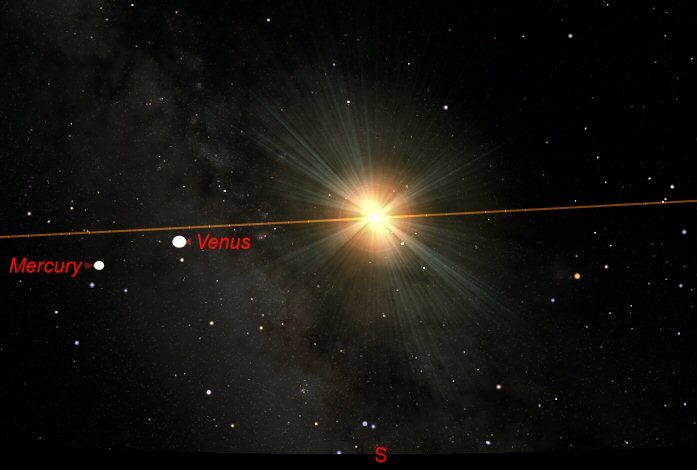
Mercury and Venus at midday on 15th December
VENUS will be visible in the early evening sky as soon as possible after sunset. It will be easy to find but it will require a clear view to the western horizon. Venus was in Superior Conjunction on 22nd October and is now emerging from its excursion behind the Sun so it will be difficult to see this month. It will appear at its smallest diameter and will be fully illuminated because it is still beyond the Sun from our point of view.
MARS can be seen in the evening sky as soon as the Sun has set and the sky darkens. It is looking small at about 17" (arc-seconds). As Earth approaches Mars the Red Planet will appear to become bigger until Earth actually overtakes on its inner orbit. This is what astronomers call ‘Opposition'. As Earth overtakes Mars on the inside Earth, Mars and the Sun are aligned with Earth between the Sun and Mars on the outside. Mars will actually be at its closest to Earth on 1st December but will be at opposition when it actually overtakes Mars on 8th December. So Mars will be at its very best this month.
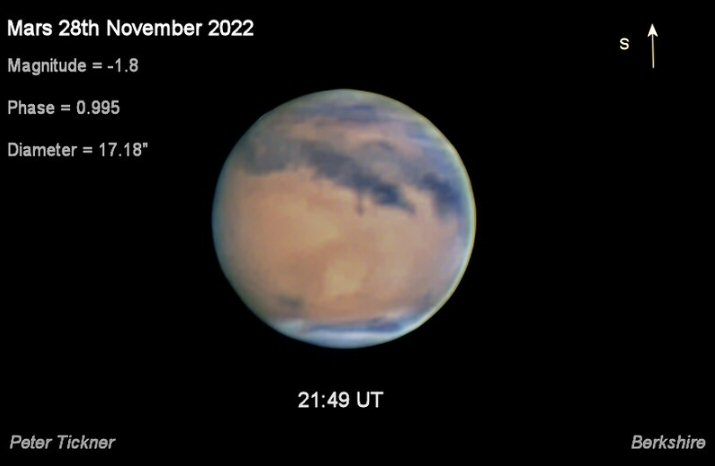
Mars imaged by Peter Tickner Reading A.S.
The image of Mars above shows much more detail than can be seen using a telescope. However some of the dark markings and it will be possible to see the white North Pole using a modest telescope and high magnification under good observing conditions.
JUPITER is past its best for this year but is still good for observing in the evening. Jupiter was at its very best when it was at opposition on 26th September. At this time it was due south at midnight 01:00 BST and appearing at its highest above the southern horizon.
Jupiter is now moving towards the western horizon during the evening. It will set over the horizon at 01:00 GMT at the beginning of this month and set by 23:45 GMT at the end of the month. In reality it will start to be unsteady up to an hour before these times due to the turbulent and muggy air closer to the horizon. However it is still very worthwhile to observe the King of the Planets in the early evening of late autumn and early winter. The moons are still easy to follow and very interesting as they move around the planet.
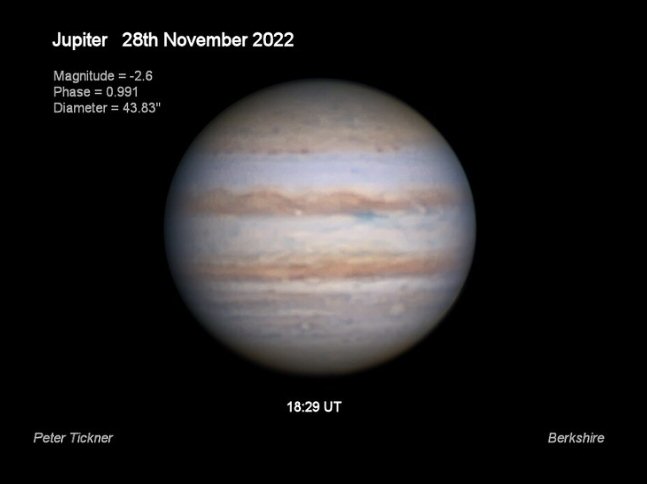
Jupiter imaged by Peter Tickner
SATURN is getting more difficult to follow as it is obviously moving towards the western horizon. Saturn will be setting over the horizon at 21:00 at the beginning of December and will have setting over the horizon by 20:00 by the end of the month.
As Saturn appears much smaller and fainter than Jupiter the view through a telescope will seem to deteriorate much sooner than the larger Jupiter. To get the best view of Saturn observing must start early, in fact almost as soon as it is dark enough.
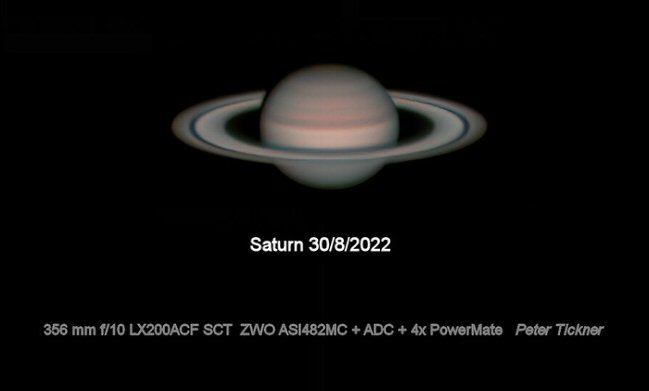
Saturn imaged by Peter Tickner
URANUS was at Opposition on 9th November so was at its best position for observing this year. As Earth overtakes Uranus on the inside Earth, Uranus and the Sun are aligned with Earth between the Sun and Uranus on the outside. This means Uranus will be in the south at midnight 00:00 GMT and at its highest point above the southern horizon. As it is so far away from us it appears very small in fact just 3.7" (arc-seconds).
NEPTUNE will be just visible this month to the east of Jupiter (see chart above). It will be difficult to see in the sky close to Jupiter as it is very small at just 2.3" (arc-seconds) only magnitude +7.9.
THE SUN
The Sun rises at about 07:45 at the beginning of the month and 08:05 by the end. It sets at 15:50 at the beginning of the month and 15:55 at the end of the month.
The Sun is about half way through its Active Phase when there is more activity on the surface. There is an 11 year cycle when the Sun increases and decreases activity on the surface. The most obvious change on the Sun is the appearance of Sunspots as shown on the image below. These and other activity is caused by the interaction of powerful magnetic fields in the Sun.
More sunspots appear and there are often huge ejections of energetic particles thrown into space. When these particles encounter the Magnetic fields surrounding Earth they are captured and drawn into the north and south poles. The energetic particles cause the upper atmosphere to glow and produce the Aurora Borealis (northern lights) and the Aurora Australis (southern lights).
Nearly all telescopes can be modified to allow the safe observation of the surface features on the Sun by fitting a special Solar Filter to the telescope. These filters reject most of the sunlight and only allow a small fraction of the light to pass through. These must be the correct approved type or permanent eye damage can occur.
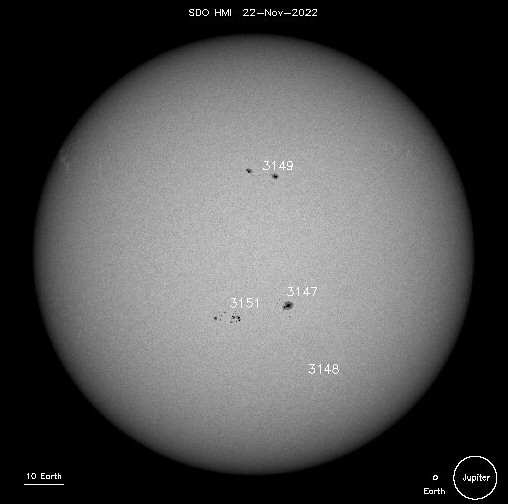
Sunspots imaged by SOHO on 22nd November
THE MOON PHASES DURING DECEMBER
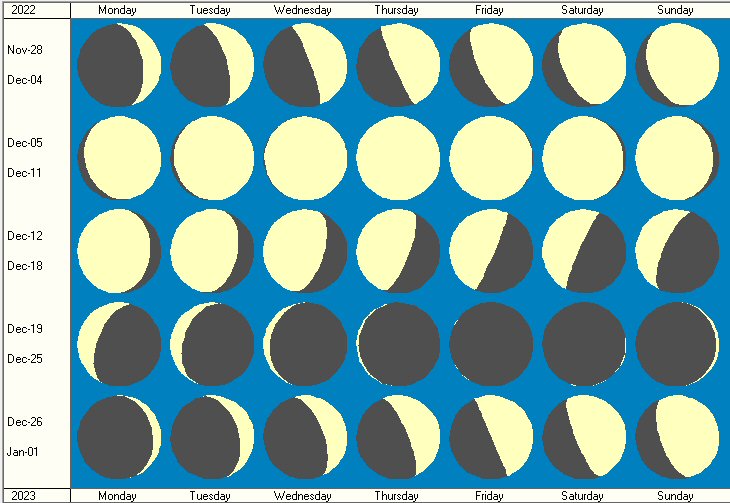
Full Moon will be on 8th December
Last Quarter will be on 16th December
New Moon will be on 23rd December
First Quarter will be on 30th December
THE GEMINID METEOR SHOWER – 13th and 14th December
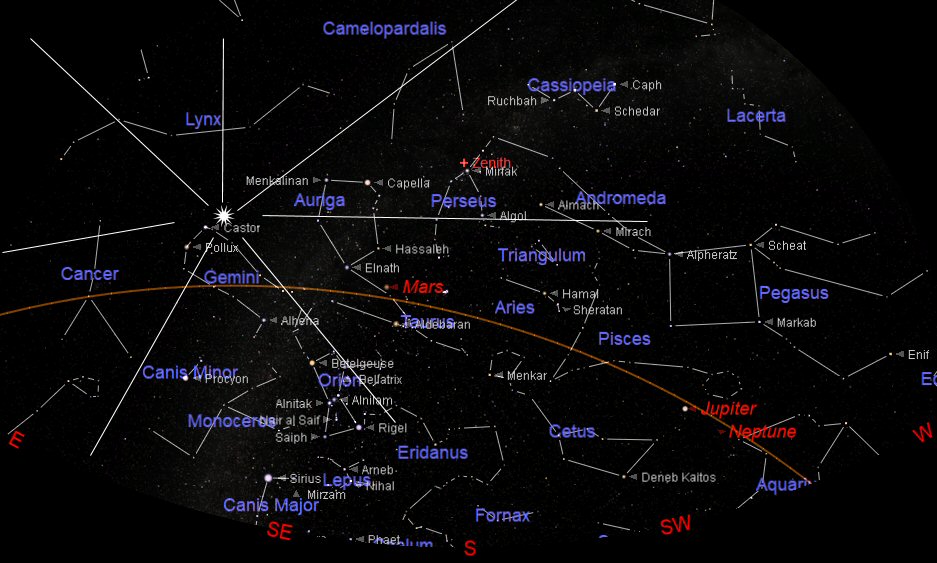
The position of the Radiant of the Geminid Meteor Shower at 22:00 on 14th December
Meteor showers are notoriously unpredictable. The exact time of any spectacular increase in numbers or if the meteors will be bright is as difficult to predict as is the clear weather needed to see them. However every year on the evening of the 14th of December there is usually a fairly spectacular display from the peak of activity during the Geminid Meteor Shower.
This month, between 9th and 14th December, there will be a meteor shower known as the Geminid shower. There should be a peak in activity during the evening of the 13th and morning of 14th December. The shower is called the Geminid Meteor Shower because its meteors appear to radiate from a point in the sky close to the star Castor in the constellation of Gemini, see the chart above .
The Moon will be rising over the eastern horizon after midnight on 14th December but it should not interfere with any serious meteor watching. Conditions look very promising, weather permitting and the sky will be dark and moonless most of the night.
The type of meteor that occurs in showers usually originates from a comet and is much more common than the ‘Fireballs' that originate from asteroids. The Geminid shower for this reason is unusual because it is thought to originate from an asteroid known as 3200 Phaethon. This means that some of the meteoroids (the particles moving through space) may be of a rocky nature so they will often be bright and survive for quite a long time. When they enter Earth's atmosphere about 100km up they might produce a bright and persistent trail.
The Geminid meteors also enter the atmosphere comparatively slowly at about 35 km/second compared with other showers that enter at over 75 km/second. As a result of this slower entry and some having a more robust make up, the Geminid meteors may appear brighter and their trails across the sky last longer.
The actual peek of activity will occur at 13:00 on 14th December but will not be visible from the UK as we will be in daylight. Observers in the USA will be luckier as they will be able to see it in their darkness before dawn.
Because the constellation of Gemini is above the horizon from early evening, the meteors can be seen for most of the night and in almost any part of the sky. By midnight the constellation will be almost due south and high in the sky. If you are intending to have a look remember to wrap up warm before you go out because you will soon feel very cold and that will spoil your enjoyment of the shower. Make yourself comfortable in a garden chair in a shielded from lights and spend at least an hour looking.
The best way to observe the meteors is to position the lounger with your feet pointing to the south so the observer can see the whole sky from the southern horizon to the Zenith (the point directly overhead). The sky can be observed from the south east across to the south west and from the horizon to the Zenith. Now we can just sit and wait. Don't look at just one point in the sky, from time to time look at a different part of the sky. Meteors are very fast and rarely last for more than a second or two so just sit and wait.