WHAT'S UP THIS MONTH - NOVEMBER 2022
(Link to What's Up December 2022)
(Link to What's Up October 2022)
THESE PAGES ARE INTENDED TO HELP YOU FIND YOUR WAY AROUND THE SKY
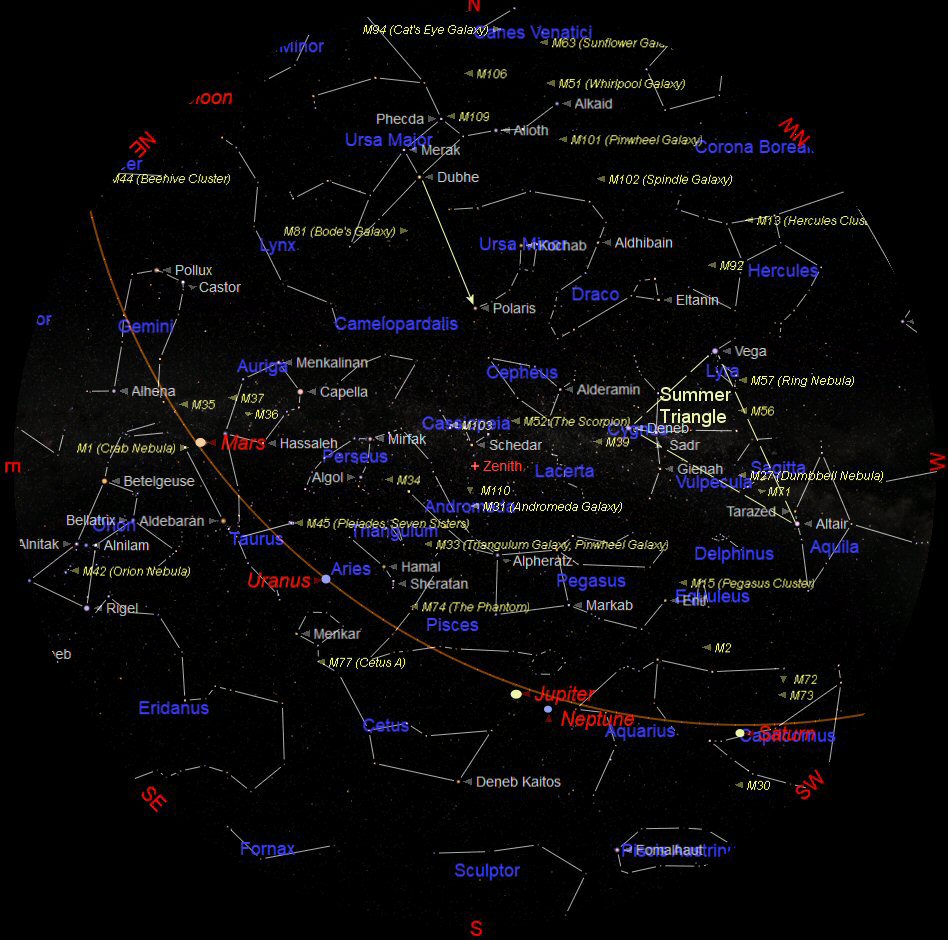
The chart above shows the whole night sky as it appears on 15th November at 22:00 (10 o'clock) Greenwich Mean Time (GMT). As the Earth orbits the Sun and we look out into space each night the stars will appear to have moved across the sky by a small amount. Every month Earth moves one twelfth of its circuit around the Sun, this amounts to 30 degrees each month. There are about 30 days in each month so each night the stars appear to move about 1 degree. The sky will therefore appear the same as shown on the chart above at 9 o'clock GMT at the beginning of the month and at 11 o'clock GMT at the end of the month. The stars also appear to move 15º (360º divided by 24) each hour from east to west, due to the Earth rotating once every 24 hours.
The centre of the chart will be the position in the sky directly overhead, called the Zenith. First we need to find some familiar objects so we can get our bearings. The Pole Star Polaris can be easily found by first finding the familiar shape of the Great Bear ‘Ursa Major' that is also sometimes called the Plough or even the Big Dipper by the Americans. Ursa Major is visible throughout the year from Britain and is always quite easy to find. This month it is low over the Northern horizon. Look for the distinctive ‘saucepan' shape, four stars forming the bowl and three stars forming the handle. Follow an imaginary line, up from the two stars in the bowl furthest from the handle. These will point the way to Polaris which will be to the north of overhead at about 50º above the northern horizon. Polaris is the only moderately bright star in a fairly empty patch of sky. When you have found Polaris turn completely around and you will be facing south. To use this chart, position yourself looking south and hold the chart above your eyes.
Planets observable in the evening sky: Saturn, Neptune, Jupiter, Uranus and Mars.
THE SOUTHERN NIGHT SKY THIS MONTH
The night sky looking south at about 22:00 GMT on 15th November
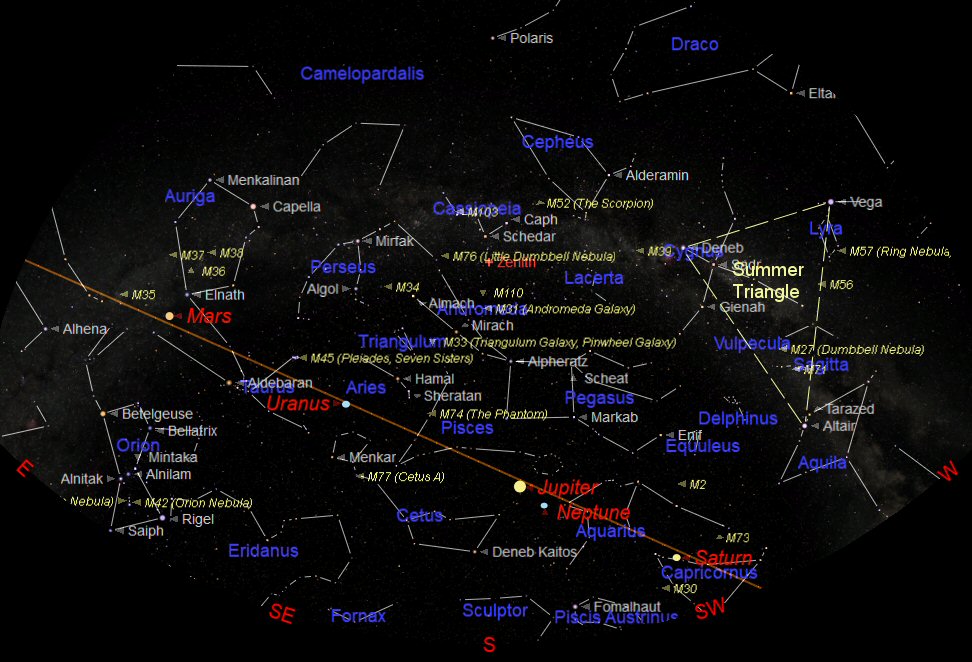
The chart above shows the night sky looking south at about 21:00 GMT on 15th November. West is to the right and east to the left. The point in the sky directly overhead is known as the Zenith and is shown (in red) at the upper centre of the chart. The curved brown line across the sky at the bottom is the Ecliptic or Zodiac. This is the imaginary line along which the Sun, Moon and planets appear to move across the sky. The brightest stars often appear to form a group or recognisable pattern; we call these ‘Constellations'.
Constellations through which the Ecliptic passes this month are: Capricornus (the Goat), Aquarius (the Water Carrier), Pisces (the Fishes), Aries (the Ram), Taurus (the Bull) and Gemini (the Twins) (just off to the east).
Moving towards the western horizon is the Summer Triangle that dominates the Summer Sky and was described in detail in September issue of this magazine. The triangle is defined by three obvious bright stars: Deneb in the constellation of Cygnus, Vega in Lyra, and Altair in Aquila. The Milky Way flows through the Summer Triangle and passes through Aquila and Cygnus. The Summer Triangle is bigger than expected but once it has been found it is easy to find again.
To the East of the Summer Triangle is the constellation of Pegasus (the Winged Horse). The main feature of Pegasus is the square formed by the four brightest stars. This asterism (shape) is known as the Great Square of Pegasus. The square is larger than might be expected but once found is easier to find again . There is a very nice Globular Cluster in Pegasus, it is known as Messier 15 (M15). It is a lovely sight to see using a telescope, see page 5. Globular Clusters are thought to be the dense core of small galaxies that have ventured too close to our Giant Spiral Galaxy that we call the Milky Way. The outer stars have been torn off by the powerful gravity of the giant galaxy leaving just the dense spherical core of stars.
Once the square is found the pointer to Andromeda is the top left star of the square named Alpheratz. Strangely Alpheratz is officially not part of Pegasus but is designated as Alpha (a) Andromedae. The constellation of Andromeda is host to the only ‘naked eye' Galaxy that is known as Messier 31 (M31). It is the most distant object that can be seen with our naked eyes (2.4 million light years away). It is quite easy to find using binoculars and is well place at this time of the year and is almost overhead and close to the Zenith.
The easiest way to find M31 is to follow the line of stars from Alpheratz and locate the second star in the line which is shown as Mirach on the chart above and page 5. From Mirach follow a slightly fainter short line of stars to the north (above) Mirach to the second star. Just to the right of this star is the faint fuzzy patch of light that is M31 the Great Andromeda Galaxy.
Coming into view in the south east is the constellation of Taurus (the Bull). The most obvious star in Taurus is the lovely Red Giant Star called Aldebaran. It appears slightly orange to the ‘naked eye' but it is very obviously orange when seen using binoculars or a telescope. Aldebaran is located at the centre of the ‘flattened' X shape formed by the brightest stars in Taurus. At the end of the top right (upper west) arm of the ‘X' is the beautiful ‘naked eye' Open Star Cluster Messier 45 (M45) known as the Pleiades (or the Seven Sisters). It really does look magnificent using binoculars.
Following Taurus is the constellation of Gemini (the Twins). The two brightest stars in Gemini are Castor and Pollux and they are named after mythological twins. To the north of Taurus is the odd pentagon shape of Auriga (the Charioteer). Dominating Auriga is the brilliant white star Capella which is almost directly overhead later in the month. For those with a telescope there is a line of lovely open clusters to search out in Taurus and Auriga. These are M35 in Taurus and M36, M37 and M38 in Auriga.
The Ecliptic was low in the sky during the summer months so the Moon and planets appeared close to the southern horizon.
WHERE TO FIND THE PLANETS THIS MONTH
All the planets, except Mercury and Venus are in the evening sky.
Mercury is not observable this month as it is too close to the Sun .
Venus passed its Superior Conjunction (behind the Sun) on 22nd October and is not visible .
Mars will be at its closest to Earth on 1st December but will be at opposition when it actually overtakes Mars on 8th December .
Jupiter is bright and observable over the southern horizon. The cloud markings can be seen and the four brightest moons will be visible in binoculars or a small telescope.
Saturn is still well placed over the southern western horizon in the early evening.
Uranus is in a good position for observing on the constellation of Aires (the Ram).
Neptune is well placed in the southern night sky and located close to Jupiter.
CONSTELLATIONS OF THE MONTH – PEGASUS AND ANDROMEDA

The constellations of Pegasus and Andromeda to the east (left) of the Summer Triangle
The constellations of Pegasus and Andromeda share and are joined at the star Alpheratz. Alpheratz is actually designated as belonging to Andromeda but looks to be more a part of Pegasus as it is required to complete the familiar ‘Great Square of Pegasus'. The Great Square is larger than may be expected which sometimes makes it a little difficult to initially identify. It is defined by the four stars: Alpheratz, Scheat, Markab and Algenib. However once it has been identified it is then easy to find again especially in a clear dark sky.

The constellation of Pegasus
Pegasus is named after the mythical winged horse and with Andromeda included to provide the wings and a lot of imagination the stars could be said to resemble the flying horse. The square generally is used to represent the body of the horse and the three lines to the west (right) of the stars Scheat and Markab do look a little like the horse's legs. The square can be used to judge the seeing condition of the night sky. Under perfect conditions about ten stars can be seen inside the square this would indicate a very good night for observing. If three to five stars can be seen then conditions will still be good. If fewer or none can be seen then stick to looking at the Moon or planets.
There is a very nice Globular cluster in Pegasus it is known as Messier 15 (M15). It is a lovely sight to see in a medium to large telescope.

Messier 15 (M15) A Globular Cluster in Pegasus
To find M15 start at the star Markab, located at the bottom right of the Great Square. Follow the fainter line of stars to the west (right) to the star Baham then North West (up and right) to the star Enif, see the charts above and the previous column. Continue the imaginary line on for about the same distance to find the fuzzy patch that will be the Globular Cluster M15.
SPECIAL CONSTELLATION OF THE MONTH – ANDROMEDA

The constellation of Andromeda is host to the only ‘naked eye' Galaxy that is known as Messier 31 (M31). It is the most distant object that can be seen with our naked eyes (2.4 million light years away). It is quite easy to find using binoculars and is well place at this time of year.
The easiest way to find M31 is to first locate the Great Square of Pegasus. Once the square is found the pointer to Andromeda is the top left star of the square named Alpheratz. Strangely Alpheratz is officially not part of Pegasus but is designated as Alpha (a) Andromedae. From Alpheratz follow the fairly obvious line of stars to the left (east). Locate the second star in the line which is shown as Mirach on the chart above. From Mirach follow a slightly fainter short line of stars to the north (above) Mirach to the second star. Just to the right of this star is the faint fuzzy patch of light that is M31 the Great Andromeda Galaxy. See the chart above.

M31 The Great Spiral Galaxy in Andromeda
The picture in the previous column shows M31 imaged through a telescope and is much clearer than can be hoped to be seen with the naked eye. However a pair of binoculars will enable the galaxy to be seen. A small telescope will show a cigar shaped hazy patch with a brighter spot in the centre. Larger telescopes will show it more clearly but photographic imaging is required to reveal its true nature.
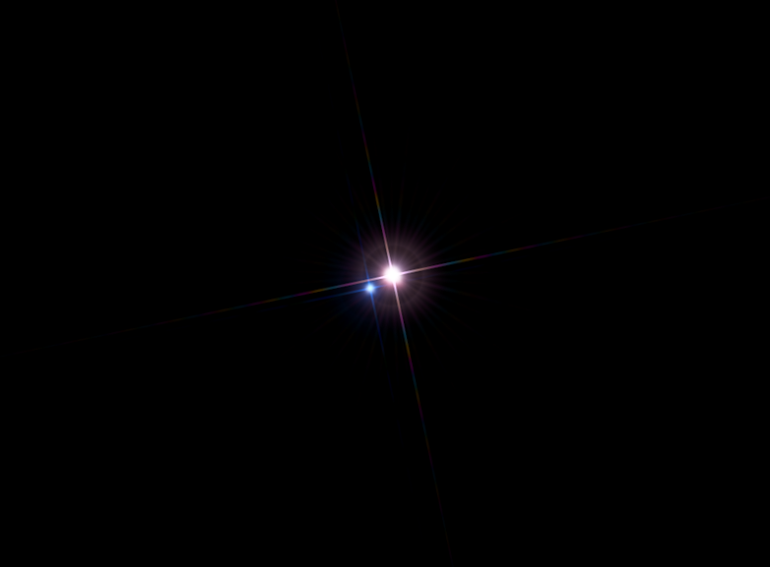
At the end of the lower line of stars that constitute the constellation of Andromeda is the star Almach or (Almaach). It is a beautiful example of a pair of stars that are not physically related. They are thought to be at different distances but appear to be in the same ‘line of sight' as seen from Earth. The apparently brighter golden coloured star is thought to be located much nearer to us than the apparently fainter blue star. The blue star is in fact a Blue Giant, a very hot and powerful star that is many thousands of times brighter than the golden star but much further away. The golden coloured star is much smaller and a similar star to our Sun.
Almach the ‘line of sight' double star in Andromeda
THE SOLAR SYSTEM – NOVEMBER 2022

The planets at 22:00 on 15th November
The chart above shows the location of the planets along the Ecliptic. The outer (Superior) planets (that orbit outside the orbit of Earth) will be visible during evening and in the early morning sky before sunrise. The inner planets are to the east of the Sun (left) and will be visible in the early evening sky after sunset.
MERCURY will be very close the Sun after sunset. Expert astronomers may be able to find it in the bright evening sky but it will require a clear view to the western horizon.

Mercury and Venus at sunset on 15th November
VENUS will be visible in the early evening sky as soon as possible after sunset. It will be easy to find but it will require a clear view to the western horizon. Venus is emerging from its excursion behind the Sun when it was in ‘Conjunction' with the Sun. It will appear at its smallest diameter and will be fully illuminated because it is still beyond the Sun from our point of view. See the chart above the shows the location of Mercury and Venus on 15th November.
MARS can be seen in the evening sky as soon as the Sun has set and the sky darkens. It is looking small at about 16" (arc-seconds). As Earth approaches Mars the Red Planet will appear to become bigger until Earth actually overtakes Mars on its inner orbit. This is what astronomers call ‘Opposition'. As Earth overtakes Mars on the inside, Earth, Mars and the Sun are aligned with Earth between the Sun and Mars that is on the outside. Mars will actually be at its closest to Earth on 1st December but will be at opposition when it actually overtakes Mars on 8th December.

Mars imaged by Peter Tickner Reading A.S.
The image of Mars above shows much more detail than can be seen using a telescope. However some of the dark markings and the white pole can be seen using a telescope under good observing conditions.
JUPITER is past its best for this year but is still good for observing in the evening. Jupiter was at its very best when it was at opposition on 26th September. At this time it was due south at midnight 01:00 BST and appearing at its highest point above the southern horizon. However it is very bright at magnitude -2.7 and has a diameter 45.8" (arc-seconds).
Jupiter is now moving towards the western horizon during the evening. It will set over the horizon at 03:00 GMT at the beginning of this month and set by 01:30 GMT at the end of the month. In reality it will start to be unsteady up to an hour before these times due to the turbulent and ‘muggy' air closer to the horizon. However it is still very worthwhile to observe the King of the Planets in the early evening of late autumn and early winter. The moons are still easy to follow with a telescope and very interesting to see as they move around the planet.

Jupiter with two of its moons imaged by Peter Tickner
SATURN is getting more difficult to follow as it is obviously moving towards the western horizon. Saturn will be setting over the horizon at 23:00 at the beginning of November and will have set over the horizon by 21:45 at the end of the month.
As Saturn appears much smaller at a diameter of just 16.8" (arc-seconds) and appears much fainter than Jupiter at magnitude +0.7. Therefore the view through a telescope will seem to deteriorate much sooner than the larger and brighter Jupiter. To get the best view of Saturn observing must start early, in fact almost as soon as it is dark enough.

Saturn imaged by Peter Tickner in August
URANUS Will be at Opposition on 9th November so will be in its best position for observing this year. As Earth overtakes Uranus on the inside Earth, Uranus and the Sun are aligned with Earth between the Sun and Uranus on the outside. This means Uranus will be in the south at midnight 00:00 GMT and at its highest point above the southern horizon. As it is so far away from us it appears very small in fact just 3.8" (arc-seconds).
NEPTUNE will be just visible this month to the east of Jupiter. It will be difficult to see in the sky close to Jupiter as it is very small at just 2.3" (arc-seconds) with a magnitude of only +7.9.
THE SUN
The Sun rises at about 07:00 at the beginning of the month and 07:35 by the end. It sets at 16:30 at the beginning of the month and 16:00 at the end of the month.
There was a Partial Solar Eclipse on 25th October when the Moon's silhouette covered about 25% of the Sun. Unfortunately it was cloudy but the cloud was thin enough at times to follow the eclipse. The projected image of the Sun was photographed at 11:58 when the eclipse was at its maximum cover.

The Partial Eclipse at 11:58 (through the cloud)

The set-up used for imaging the Partial Solar Eclipse shown above

A mosaic of the eclipse progress imaged by Peter Tickner
THE MOON PHASES DURING NOVEMBER

First Quarter will be on 1st November
Full Moon will be on 8th November
Last Quarter will be on 16th November
New Moon will be on 23rd November
First Quarter will be on 30th November
GETTING TO KNOW HOW OUR MOON WORKS

The phases of the Moon (Sun is off to the left)
In the diagram above the Sun is shining from the left. The inner Moon images demonstrate the orbit of the Moon around Earth and shows how the Moon is illuminated by the Sun. The outer Moon images show the view of the Moon as seen from Earth.
From Earth the same side of the Moon is always facing us so the Moon appears not to rotate for us. However if viewed from the Sun the Moon can be seen orbiting around Earth and as it orbits it would appear to rotate once on every orbit. This means over the course of one orbit (about 29.5 days) the whole surface of the Moon will be illuminated at some time. Therefore for a given point on the Moon, a day will last for one half of the month and it will be night for the rest of the month.
So the two Moon images on the left that show the Moon positioned between the Sun and Earth. From Earth the dark side of the Moon is facing towards us so we cannot see it. As the Moon moves around its orbit some of the illuminated side begins to appear and we see the Moon as a New Moon (the growing crescent is called ‘waxing').
After about seven days the Moon would reach the lower middle point of its orbit and half of the illuminated side of the Moon is visible from Earth, this is called ‘First Quarter'. On the seventh day of the month the moon will have moved a quarter of its orbit around Earth. So at sunset on the seventh day the ‘Half Moon' (First Quarter) will be located in the southern sky.
After a further seven days (14th day) the Moon will have moved halfway around its orbit and reached the right side of the diagram. The whole of the Moon facing Earth is illuminated so we call this the ‘Full Moon'. The phase between First Quarter and Full is called Waxing Gibbous (growing wider than Half Moon). The Full Moon will always be rising over the eastern horizon as the Sun is setting over the western horizon.
A further seven days (21 days into its orbit around Earth) takes the Moon to the upper position on the diagram where the opposite side to the ‘First Quarter' is illuminated, we call this ‘Last Quarter'. The final phase (called Waning) is rarely seen by people who sleep normal hours. This is because the ‘Last Quarter' Moon does not rise until after midnight in the east. The crescent becomes thinner as it draws closer to the Sun to start the next New Moon phase.
From the ‘Last Quarter' (21st day) to the 28th day (last day of the Moon's orbit) the crescent Moon will be visible in the morning sky in the east. It will be visible and bright in the dawn sky but as the crescent becomes thinner with every subsequent day and the Moon moves towards the Sun it will become more difficult to see in the brightening dawn sky.

Chart showing the phases of the Moon