WHAT'S UP THIS MONTH - FEBRUARY 2023
(Link to What's Up March 2023)
(Link to What's Up January 2023)
THESE PAGES ARE INTENDED TO HELP YOU FIND YOUR WAY AROUND THE SKY
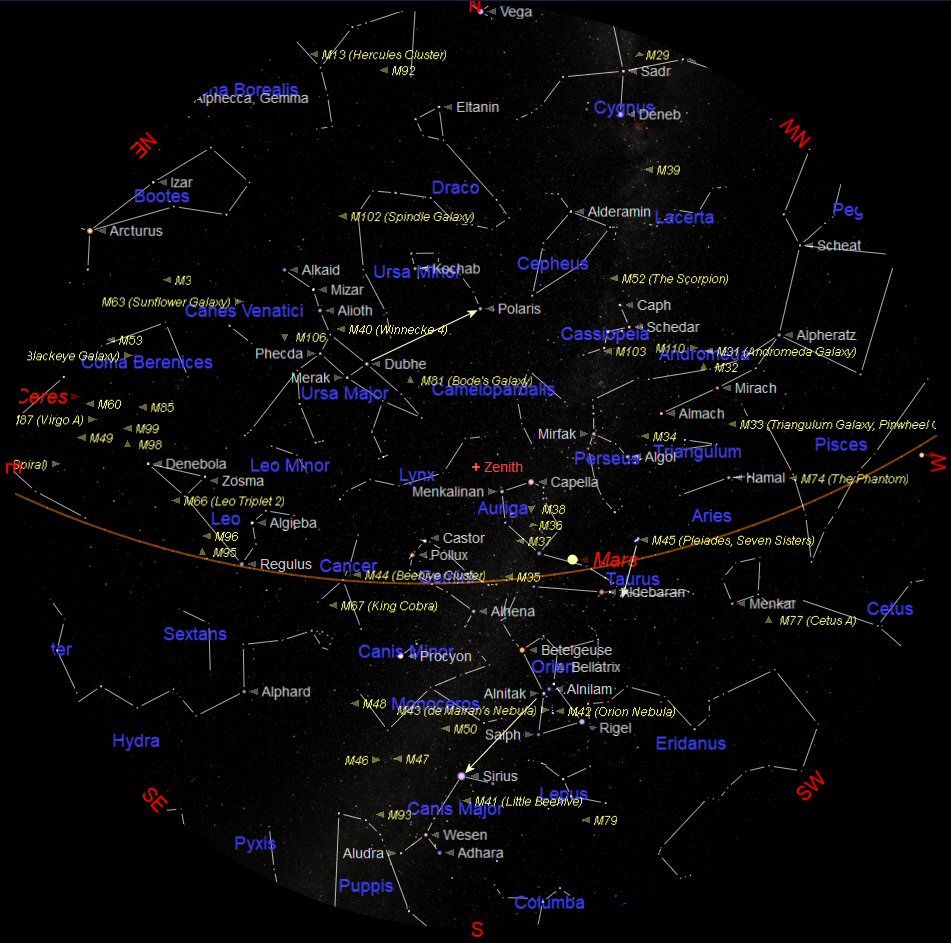
The chart above shows the whole night sky as it appears on 15th February at 22:00 (10 o'clock) Greenwich Mean Time (GMT). As the Earth orbits the Sun and we look out into space each night the stars will appear to have moved across the sky by a small amount. Every month Earth moves one twelfth of its circuit around the Sun, this amounts to 30 degrees each month. There are about 30 days in each month so each night the stars appear to move about 1 degree. The sky will therefore appear the same as shown on the chart above at 9 o'clock GMT at the beginning of the month and at 11 o'clock GMT at the end of the month. The stars also appear to move 15º (360º divided by 24) each hour from east to west, due to the Earth rotating once every 24 hours.
The centre of the chart will be the position in the sky directly overhead, called the Zenith. First we need to find some familiar objects so we can get our bearings. The Pole Star Polaris can be easily found by first finding the familiar shape of the Great Bear ‘Ursa Major' that is also sometimes called the Plough or even the Big Dipper by the Americans. Ursa Major is visible throughout the year from Britain and is always quite easy to find. This month it is in the North East. Look for the distinctive ‘saucepan' shape, four stars forming the bowl and three stars forming the handle. Follow an imaginary line, up from the two stars in the bowl furthest from the handle. These will point the way to Polaris which will be to the north of overhead at about 50º above the northern horizon. Polaris is the only moderately bright star in a fairly empty patch of sky. When you have found Polaris turn completely around and you will be facing south. To use this chart, position yourself looking south and hold the chart above your eyes.
Planets observable in the evening sky: Venus Neptune, Jupiter, Uranus and Mars.
THE SOUTHERN NIGHT SKY THIS MONTH
The night sky looking south at about 19:00 GMT on 15th February
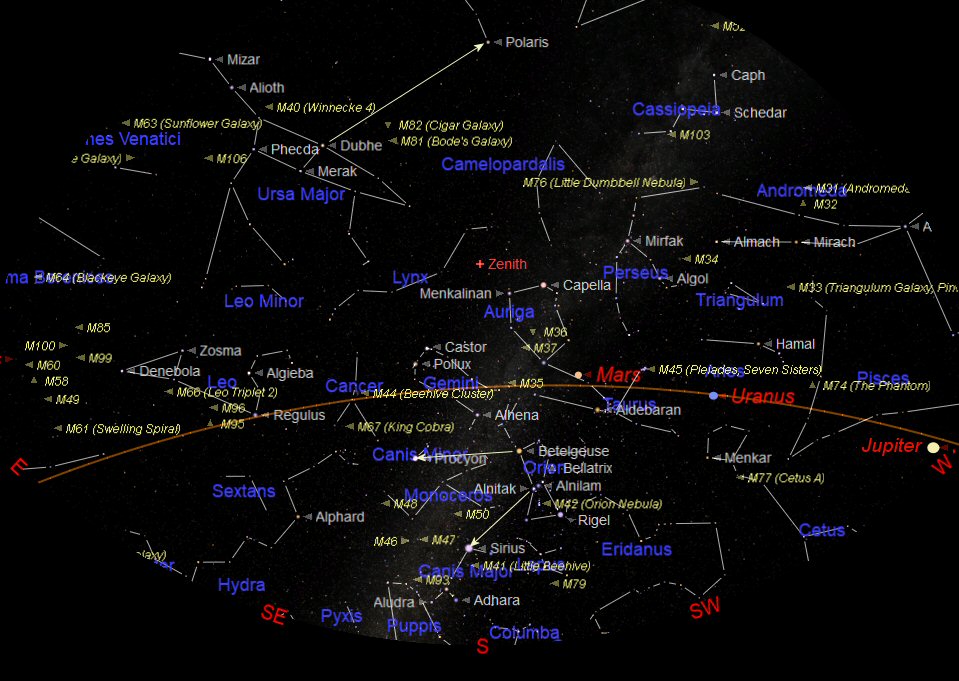
The chart above shows the night sky looking south at about 19:00 GMT (early evening) on 15th February. West is to the right and east to the left. The point in the sky directly overhead is known as the Zenith and is shown (in red) at the upper centre of the chart. The curved brown line across the sky at the bottom is the Ecliptic or Zodiac. This is the imaginary line along which the Sun, Moon and planets appear to move across the sky. The brightest stars often appear to form a group or recognisable pattern; we call these ‘Constellations'.
Constellations through which the ecliptic passes this month are: Pisces (the Fishes), Aries (the Ram), Taurus (the Bull), Gemini (the Twins), Cancer (the Crab) Leo (the Lion) and Virgo (the Virgin).
Moving over the western horizon is the constellation of Pegasus (the Winged Horse). The main feature of Pegasus is the square formed by the four brightest stars. Once the square is found the pointer to Andromeda is the top left star of the square named Alpheratz. Strangely Alpheratz is officially not part of Pegasus but is designated as Alpha (a) Andromedae. The constellation of Andromeda is host to the only ‘naked eye' Galaxy that is known as Messier 31 (M31). It is the most distant object that can be seen with our naked eyes (2.4 million light years away). It is quite easy to find using binoculars and is well place at this time of the year.
The easiest way to find M31 is to follow the line of stars from Alpheratz and locate the second star in the line which is shown as Mirach on the chart above. From Mirach follow a slightly fainter short line of stars to the north (above) Mirach to the second star. Just to the right of this star is the faint fuzzy patch of light that is M31 the Great Andromeda Galaxy.
Taurus is easy to find this month because it is almost overhead and Mars is shining brightly in the constellation. The most obvious star in Taurus is the lovely Red Giant Star called Aldebaran. It appears slightly orange to the ‘naked eye' but it is very obviously orange when seen using binoculars or a telescope. Aldebaran is located at the centre of the ‘flattened' X shape formed by the brightest stars in Taurus. At the end of the top right (upper west) arm of the ‘X' is the beautiful ‘naked eye' Open Star Cluster Messier 45 (M45) known as the Pleiades (or the Seven Sisters). It really does look magnificent using binoculars.
Following Taurus is the constellation of Gemini (the Twins). The two brightest stars in Gemini are Castor and Pollux and they are named after mythological twins. To the north of Taurus is the odd pentagon shape of Auriga (the Charioteer). Dominating Auriga is the brilliant white star Capella which is almost directly overhead. For those with a telescope there is a line of lovely open clusters to search out in Taurus and Auriga. These are M35 in Taurus and M36, M37 and M38 in Auriga.
To the east (left) of Taurus is the rather indistinct constellation of Cancer (the Crab). The stars of Cancer are quite faint and can be difficult to discern especially in a light polluted sky. It is really worth searching out Cancer using binoculars or a telescope to see the Open Cluster M44 (the Beehive Cluster). M44 is older and further away than M45 (the Seven Sisters) so is fainter than M45 but still looks lovely. It has a group of stars that resemble an old straw Beehive with bees around it.
Coming into view in the east this month is the distinctive and interesting constellation of Leo (the Lion) that follows Cancer along the Ecliptic. It is one of the few constellations that does actually resemble what it represents and does look a little like a lion or the Sphinx in Egypt. Around and between Leo and the neighboring constellation of Virgo is a cluster of galaxies. Our Milky Way galaxy and our local group of galaxies are members of this larger group of galaxies called the Virgo Cluster. A medium sized telescope (150mm to 200mm) and a dark sky is required to see these faint objects.
WHERE TO FIND THE PLANETS THIS MONTH
All the planets, except Mercury and Venus are in the evening sky.
Mercury is not really observable this month as it is too close to the Sun in the early morning .
Venus is emerging from its Superior Conjunction (behind the Sun) on 22nd October and is now very low and close to the south western horizon soon after sunset and a little difficult to see .
Mars was at its closest to Earth on 1st December but was at opposition when it actually overtook Mars on 8th December. It is now almost overhead in the constellation of Taurus .
Jupiter is bright just observable over the south western horizon in the early evening. The cloud markings can be seen and the four brightest moons will be visible in binoculars or a small telescope.
Saturn has now moved over the southern western horizon and is in conjunction with the Sun.
Uranus is in a good position for observing on the constellation of Aires (the Ram).
Neptune is in the southern western night sky and very close to Jupiter on 15th February.
CONSTELLATIONS OF THE MONTH – AURIGA, GEMINI AND CANCER
The constellations of Auriga, Gemini and Cancer
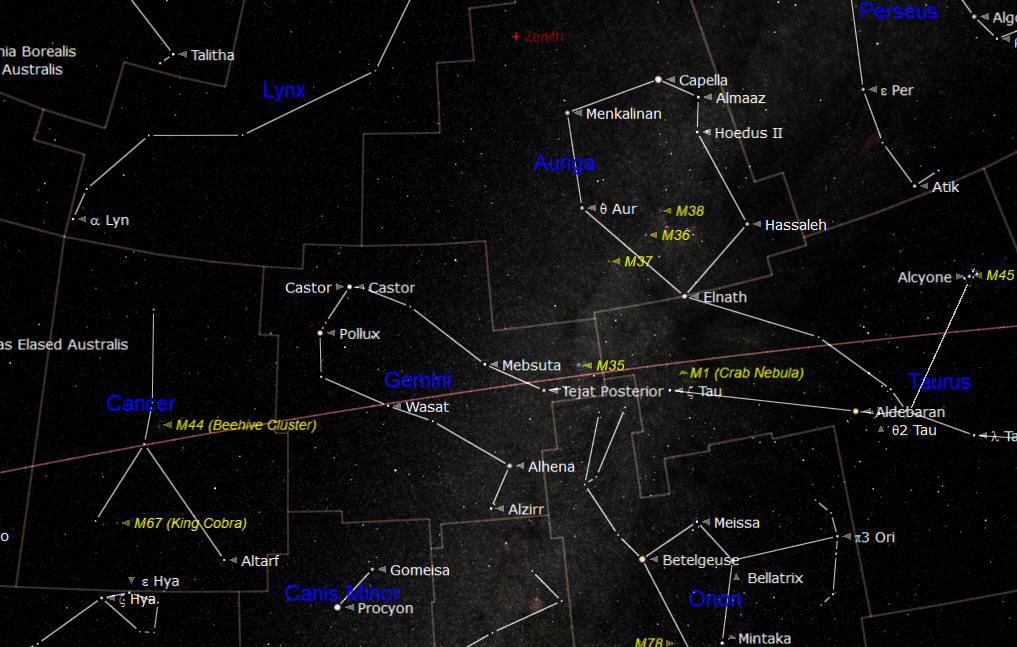
The chart above shows the winter constellations of Auriga (the Charioteer), Gemini (the Twins) and Cancer (the Crab). These are interesting constellations to search out and have some very interesting objects to see even when using just a pair of binoculars. Gemini and Cancer are located on the Ecliptic and therefore are occasional hosts to the Sun, Moon and Planets as they appear to move along this imaginary line.
Capella is the brightest star in the constellation of Auriga, it is the sixth-brightest star in the night sky and the forth-brightest in the northern celestial hemisphere after Sirius, Arcturus and Vega. A prominent object in the northern winter sky, it is circumpolar to observers north of 44°N. Its name means "little goat" in Latin. Capella is depicted as the goat Amalthea that suckled Zeus in classical mythology. The Capella system is relatively close, at only 42.9 light-years from the Sun.
Although it appears to be a single star to the naked eye, Capella is actually a quadruple star system with two binary pairs made up of the stars Capella Aa, Capella Ab along with Capella H and Capella L.
The first pair, Capella Aa and Capella Ab is composed of two bright yellow giant stars, both of which are around 2.5 times as massive as the Sun. The second pair, Capella H and Capella L are positioned around 10,000 astronomical units (AU) from the first pair and are two faint, small and relatively cool red dwarfs.
Auriga has three Messier Open Clusters that can be seen using binoculars. These are M36, M37 and M38. See the chart above. Open Clusters are groups of stars that have formed from the gas and dust in a Nebula (large cloud of gas and dust). These clusters look like small smudges of light using binoculars. They are best seen using a telescope which will show many of the individual stars in the clusters.
During the midwinter months Capella is almost directly overhead which makes it very easy to find. During the summer months it can be seen close to the northern horizon. The Milky Way (our galaxy) passes through Auriga and can be seen on the chart above. The three open clusters in Auriga are seen against the dense star fields of the Milky Way.
The constellation of Auriga is joined to the constellation of Taurus at the most southerly star of Auriga called Elnath. Oddly Elnath is actually included in the lists of the stars belonging to both constellations.
There is a fourth Open Cluster that appears to be in the same line as M36, M37 and M38 over the border in the constellation of Gemini, this is Messier 35 (M35). Gemini is named after the mythical twins Pollux and Castor from Greek mythology.
The recognised shape of Gemini is in the form of a rough rectangle with Pollux and Castor at the eastern short side. A line of stars runs south west from Castor to the star Tejat Posterior. The line from Pollux takes a diversion south through kappa (?) then south west through Wasat to Alhena and Alzirr.
The two brightest stars in Gemini are Castor and Pollux which look quite similar and represent the twins. Castor and Pollux were the children of Leda. However Pollux was actually the son of Zeus who seduced Leda but Castor was the son of Tyndareus, King of Sparta and Leda's husband.
Gemini is easy to find because its two brightest stars are quite close together and similar in appearance. The two brightest stars are called Pollux (ß) and Castor (a) and are known as the Gemini Twins. Although Castor has been given the Greek letter designation a (alpha), which is normally given, to the brightest star in a constellation, Castor is not actually the brightest Pollux is in fact the brighter of the two.
The open Clusters in Auriga and Gemini
|
|
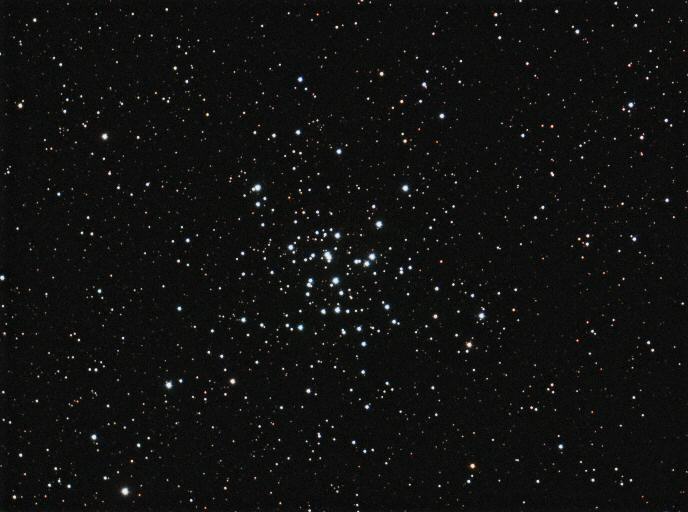
Messier 36 (M36) |
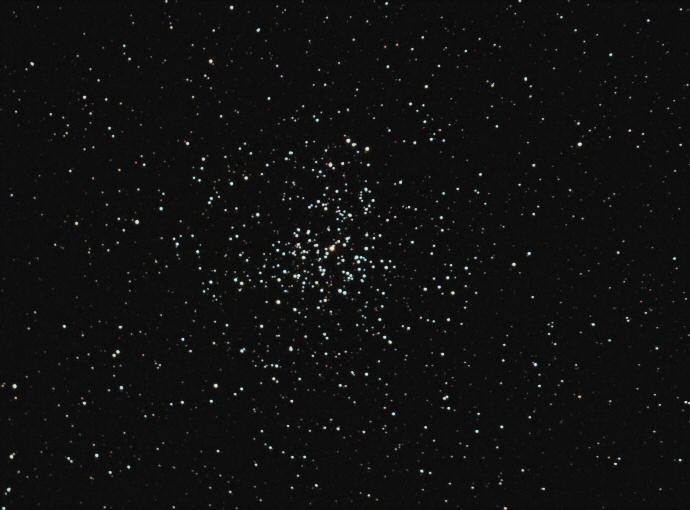
Messier 37 (M37) |
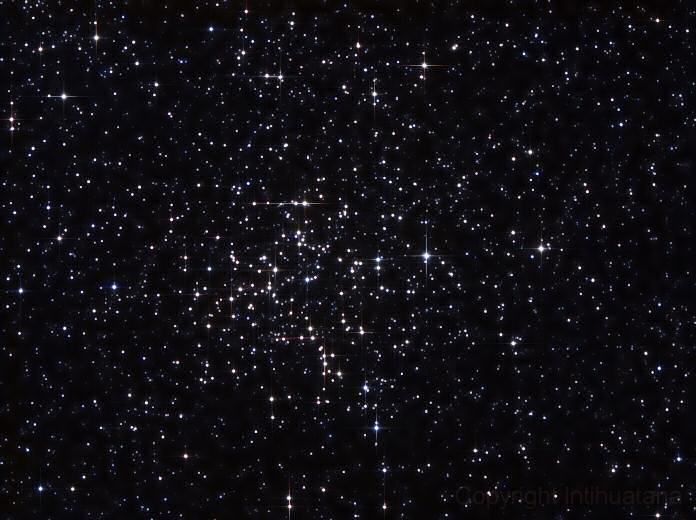
Messier 38 (M38) |
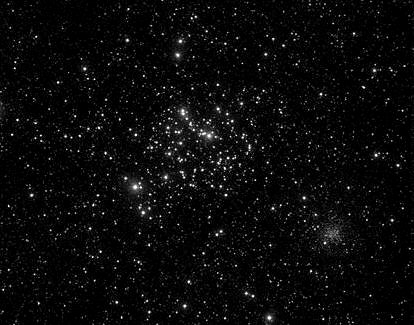
Messier 35 (M35) and NGC2158 |
Pollux is brighter at magnitude +1.59 compared to the +1.9 of Castor. However Castor is a double star with a fainter companion that has a magnitude of +2.9 and separated by 6 arc-seconds. The two stars, known as Castor A and Castor B, orbit their common centre of gravity every 467 years. The pair can be separated in a 75mm aperture telescope on a good clear night.
Messier 35 (M35) is located at the end of the upper of the two lines of stars that emanate from Pollux and Castor. It is the most spectacular of the four Open Clusters and is shown above.
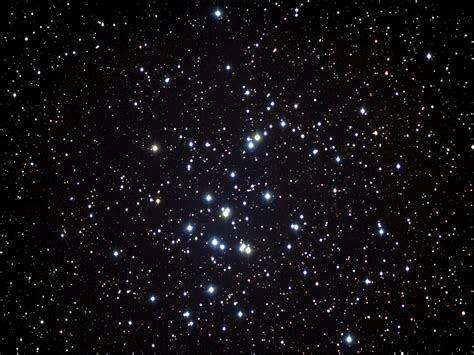
Cancer is a faint and rather indistinct constellation but it does have a rather nice Open Cluster called Messier 44 (M44) Praesepe or ‘the Beehive Cluster'. The stick figure shape of Cancer is an up-side-down letter ‘Y'. Although M44 is large, the stars are dispersed and fairly faint. It is quite difficult to find in a light polluted area so will require binoculars to see it. See the chart on page 4.
Messier 44 (M44) Praesepe the Beehive Cluster
Open Star Clusters are listed in Charles Messier's Catalogue along with other objects of interest to amateur astronomers. Messier listed these objects along with Globular Clusters, Nebulae and Galaxies so they would not be mistaken for the comets he was searching for. Many of the brighter open clusters do look quite comet-like when viewed through binoculars. They are as the name suggests clusters of related stars and many are very beautiful to look at.
It is thought all stars form in vast clouds of gas and dust known as Nebulae (singular Nebula). Gravity pulls the atoms together into denser clumps until the gas and dust is compressed into very dense spheres. The temperature and pressure in the centre of the spheres rises until Nuclear Fusion begins. The Nuclear Fusion in the core produces an enormous amount of energy and the spheres begin to shine as stars and an Open Star Cluster is formed.
The brightest and most easily seen Open Cluster is Messier 45 (M45). See the chart above. This is a cluster of about 300 stars in the constellation of Taurus. The cluster is known as the Pleiades but even more widely known as the Seven Sisters.
Six or possibly seven of the brightest stars in M45 are easily visible to the naked eye in a clear dark sky. They occupy an area of sky about the same size as the full Moon. Using a pair of 10 x 50 binoculars another thirty or so fainter stars can be seen embedded within the Seven Sisters. See the December 2022 ‘What's Up'.
The clusters M35, M36, M37 and M38 are further away so appear smaller and fainter. They can just about be seen using binoculars but a telescope is required to see them well. M35 is particularly lovely as it has a spectacular string of stars that appear to cascade through its centre and cluster NGC2158 is close by.
THE SOLAR SYSTEM – FEBUARY 2023
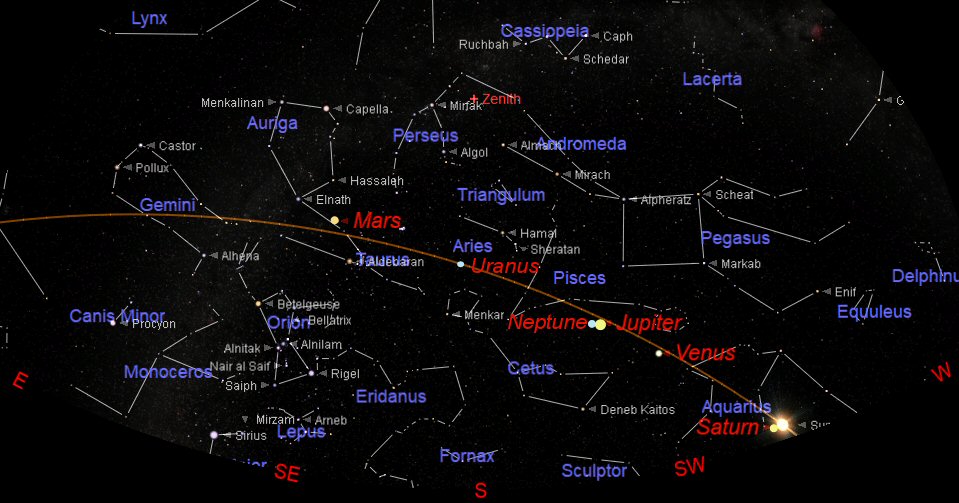
The planets at sunset on 15th February
The chart above shows the location of the planets along the Ecliptic. All of the planets except Saturn and Mercury will be visible during evening before sunset. Saturn is too close to the Sun and Mercury is in the early morning sky before sunrise.
MERCURY will appear very close the Sun just before sunrise in the east. Experts may be able to find it in the brightening morning sky but it will require a clear view to the eastern horizon. Mercury is to the west of the Sun just before Sunrise in the east.
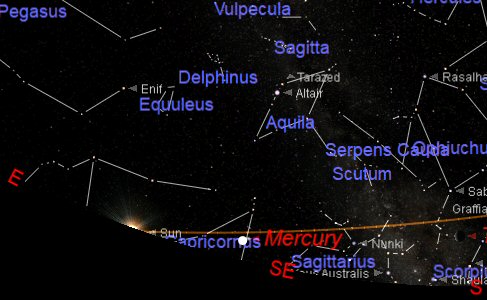
Mercury in the South East at 07:00 on 15th February
VENUS will be visible in the early evening sky as soon as possible after sunset. It will be easy to find but it will require a clear view to the western horizon. Venus was in Superior Conjunction on 22nd October and is now emerging from its excursion behind the Sun. It will appear at its smallest diameter and will be fully illuminated because it is still beyond the Sun from our point of view. See the Jupiter chart below.
MARS can be seen high in the evening sky as soon as the Sun has set and the sky darkens. It is looking small at about 10" (arc-seconds). Earth overtook Mars on the inside on 8 th December. So Mars is past its best and is now starting to fall behind Earth and will appear to be getting smaller as it moves away from us.
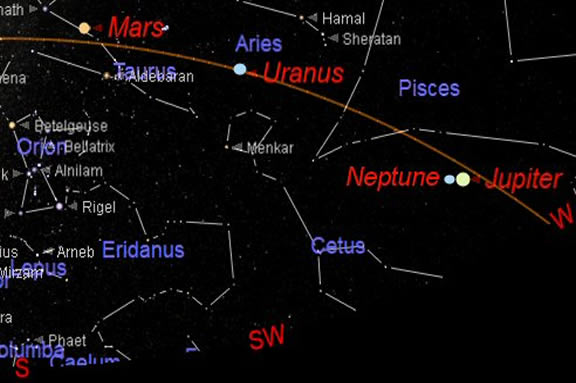
Mars, Uranus, Neptune and Jupiter at 20:00
JUPITER is past its best for this year but is still good for observing in the early evening. Jupiter was at its very best when it was at opposition on 26th September. At this time it was due south at midnight 01:00 BST and appearing at its highest above the southern horizon.
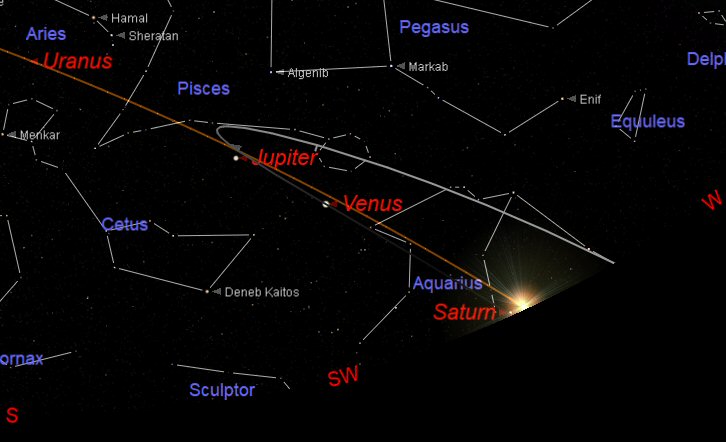
Venus and Jupiter at sunset on 15th February
Jupiter is now moving towards the western horizon during the evening. It will set over the horizon at 21:40 GMT at the beginning of this month and set by 20:40 GMT at the end of the month. In reality it will start to appear unsteady up to an hour before these times due to the turbulent and muggy air closer to the horizon.
However it is still very worthwhile to observe the King of the Planets in the early evening for another month or so. The moons are still easy to follow and can be very interesting to see as they move around the planet. A planetarium application will show the positions of the moons and the times of a transit or occultation.
The movement of Jupiter's moons can be predicted by using a Planetarium Application on a computer. The free to download application called Stellarium is very good for doing this. We are able to predict when a moon will pass in front (transit) or behind the planet (occultation). There is an interesting close approach between Jupiter and Neptune on 14 th and 15 th February. This will provide a good time for finding Neptune using a telescope. See Neptune below.
SATURN is in conjunction with the Sun this month and is not observable, see the chart on the previous page.
URANUS was at Opposition on 9 th November so was at its best position for observing this year. As Earth overtook Uranus on the inside Earth, Uranus and the Sun were aligned with Earth between the Sun and Uranus on the outside. This meant Uranus was in the south at midnight 00:00 GMT and at its highest point above the southern horizon. As it is so far away from us it appears very small in fact just 3.6" (arc-seconds).
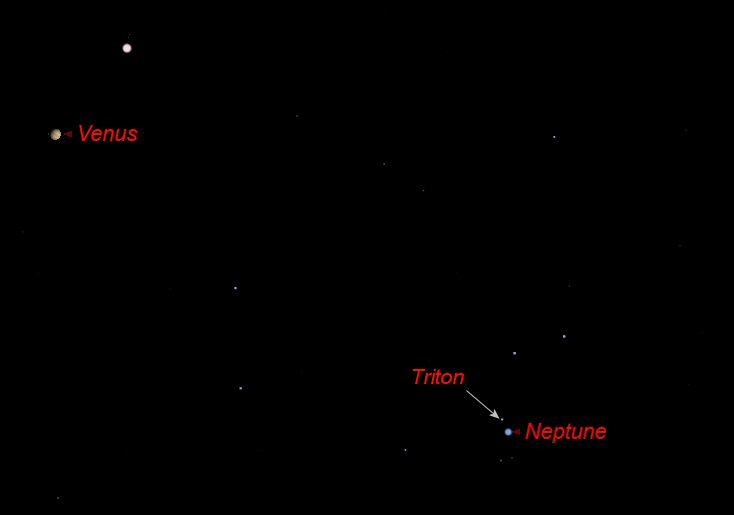
Neptune close to Venus 15th February
NEPTUNE is always difficult to find but will be a little easier to find on the 14th and 15th of this month using a telescope (see chart above). Neptune will be still be difficult to find in the sky close to Venus as it is very small at just 54' (arc-minutes) only magnitude +7.9.
Once Neptune has been found in a telescope there is another difficult but interesting task that can be attempted. This to try to see Neptune's largest moon called Triton but it will be a very difficult task. Triton is 2,720 kilometres in diameter but will appear very small.
THE SUN
The Sun rises at about 08:00 at the beginning of the month and 07:50 by the end. It sets at 16:00 at the beginning of the month and 16:30 at the end of the month.
The Sun is over half way through its Active Phase when there is more activity on the surface. There is an 11 year cycle when the Sun increases and decreases activity on the surface. The most obvious change on the Sun is the appearance of Sunspots as shown on the image below. These and other activity is caused by the interaction of powerful magnetic fields in the Sun.
More sunspots appear and there are often huge ejections of energetic particles thrown into space. When these particles encounter the Magnetic fields surrounding Earth they are captured and drawn into the north and south poles. The energetic particles cause the upper atmosphere to glow and produce the Aurora Borealis (northern lights) and the Aurora Australis (southern lights).
Nearly all telescopes can be modified to allow the safe observation of the surface features on the Sun by fitting a special Solar Filter to the telescope. These filters reject most of the sunlight and only allow a small fraction of the light to pass through. These must be the correct approved type or permanent eye damage can occur. If a telescope is not available the Sun can still be observed by downloading daily images from NASA's orbiting Solar and Heliospheric Observatory (SOHO) at: http://sohowww.nascom.nasa.gov/ .
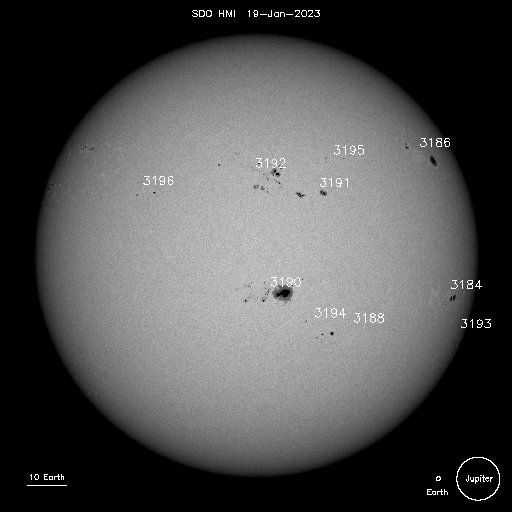
Sunspots imaged by SOHO on 19th January
THE MOON PHASES DURING FEBRUARY
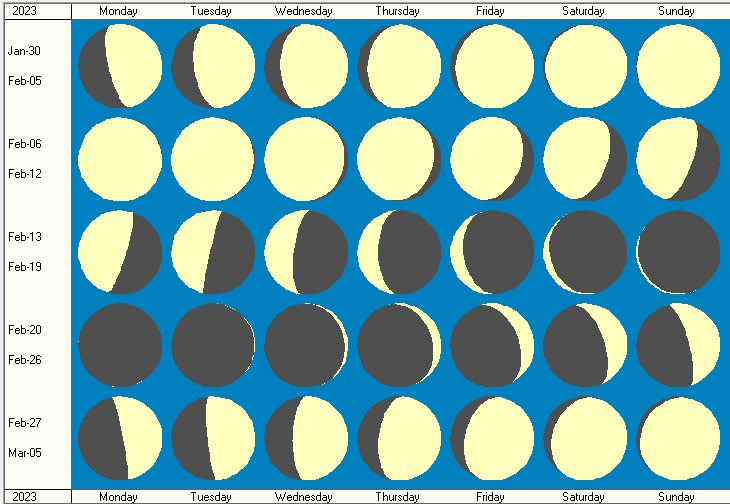
Full Moon will be on 5th February
Last Quarter will be on 13th February
New Moon will be on 20th February
First Quarter will be on 27th February
A NEW COMET IN THE NIGHT SKY – FEBRUARY 2023
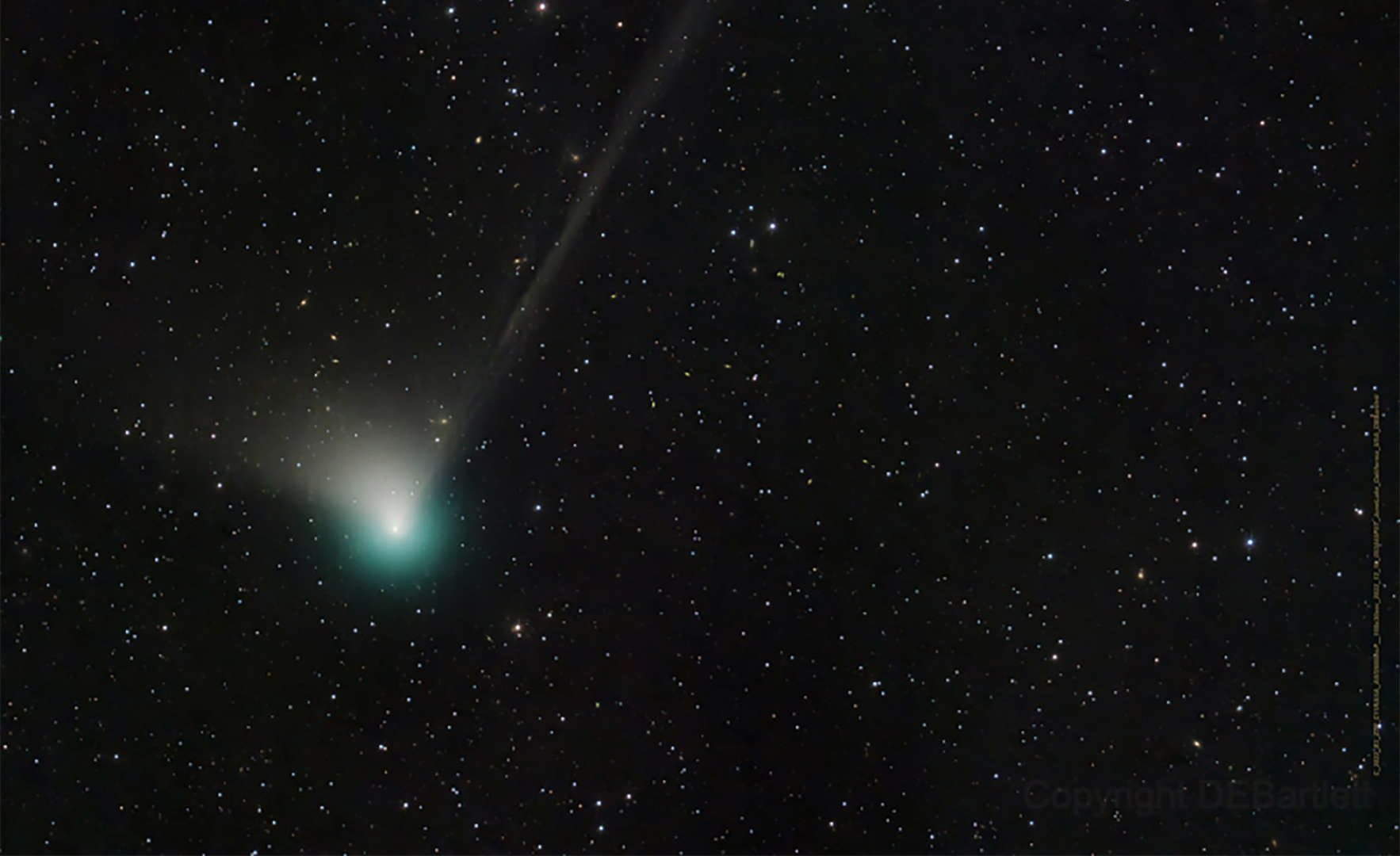
Comet C/2022 E3 (ZTF) imaged at the Zwicky Transient Facility
There is a new comet that may be a significant object to observe during February. This new comet is called C/2022 E3 (ZTF) and was only discovered last year. It has been dubbed as ‘the green comet' as its coma has a green glow. It is a long period comet that has not passed by Earth since the Ice Age but will be at its closest and visible in the night sky during February. The comet will not be visible again for another 50,000 years, making seeing it a true once in a lifetime opportunity.
The comet has a long orbit that takes it from the outer reaches of the Solar System in toward the Sun over thousands of years. It will be closest to the Earth on 1 st February, at a distance of about 42 million kilometres (26 million miles). In the weeks surrounding its closest approach it may be just visible with the naked eye or fairly easily seen using binoculars.
Comet C/2022 E3 (ZTF) was discovered as it moved inside Jupiter's orbit on its journey towards the Sun. It was discovered by the Zwicky Transient Facility, a public-private partnership that examines the night sky, in March 2022. Scientists first thought it was an asteroid but it has since got significantly brighter as it traversed across the northern constellation Corona Borealis.
The comet has a green coma – which is the cloud of gas surrounding the icy rock core and has a yellowish tail. In was first photographed in December. It was thought that the comet may become a ‘naked eye' object on a dark and clear night but comets, like meteor showers, tend to be unpredictable. However, you will get a better view of it with binoculars or a small telescope using a low magnification. In the UK, observers were able to see the comet close to the north-eastern horizon in the early hours of the morning. But during February it will have moved into the evening sky and should be easier to find.
The comet is expected to be just bright enough to see with the naked eye in a dark and clear sky away from street lights. However it will not be quite the spectacle that Comet Neowise was back in 2020 but it will be rewarding if it can be found.
If seen with the naked eye it will appear as a small and faint patch of misty light. Using standard binoculars (9 x 50) it may be possible to see the greenish coma and the faint ‘fan shaped' dust tail. It will still be an awesome opportunity to make a personal connection with an icy visitor from the distant outer solar system.
Tracking Comet C/2022 E3 (ZTF)
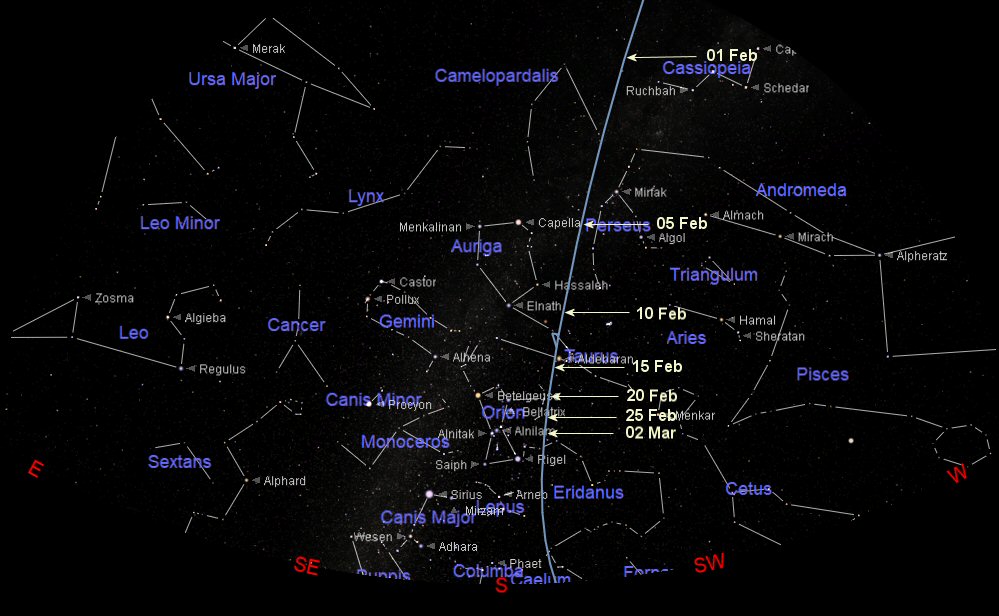
Location of Comet C/2022 E3 (ZTF) during February
The chart above shows the night sky looking south during the month of February. The path of Comet C/2022 E3 (ZTF) is shown with the approximate location every five days during the month.
Comets are like dirty snowballs typically 5 to 25 kilometres across. They originate from two different areas way out beyond the orbits of the outer planets. There is a ‘doughnut' shaped ring beyond the orbit of the outermost planet Neptune called the Kuiper Belt. This is comprised of millions of these Cometary objects. These objects are composed mainly of frozen water with some frozen gases such as Carbon dioxide and some dust.
Like the asteroids, occasionally some of these icy objects may have close encounters or even collisions. They may then be disturbed from their normal orbit around the Sun and begin to spiral in towards the Sun. As these Comets approach the Sun, the heat of the Sun will melt the ice. It sublimes (melts directly) into vapour and forms a tail on the comet.
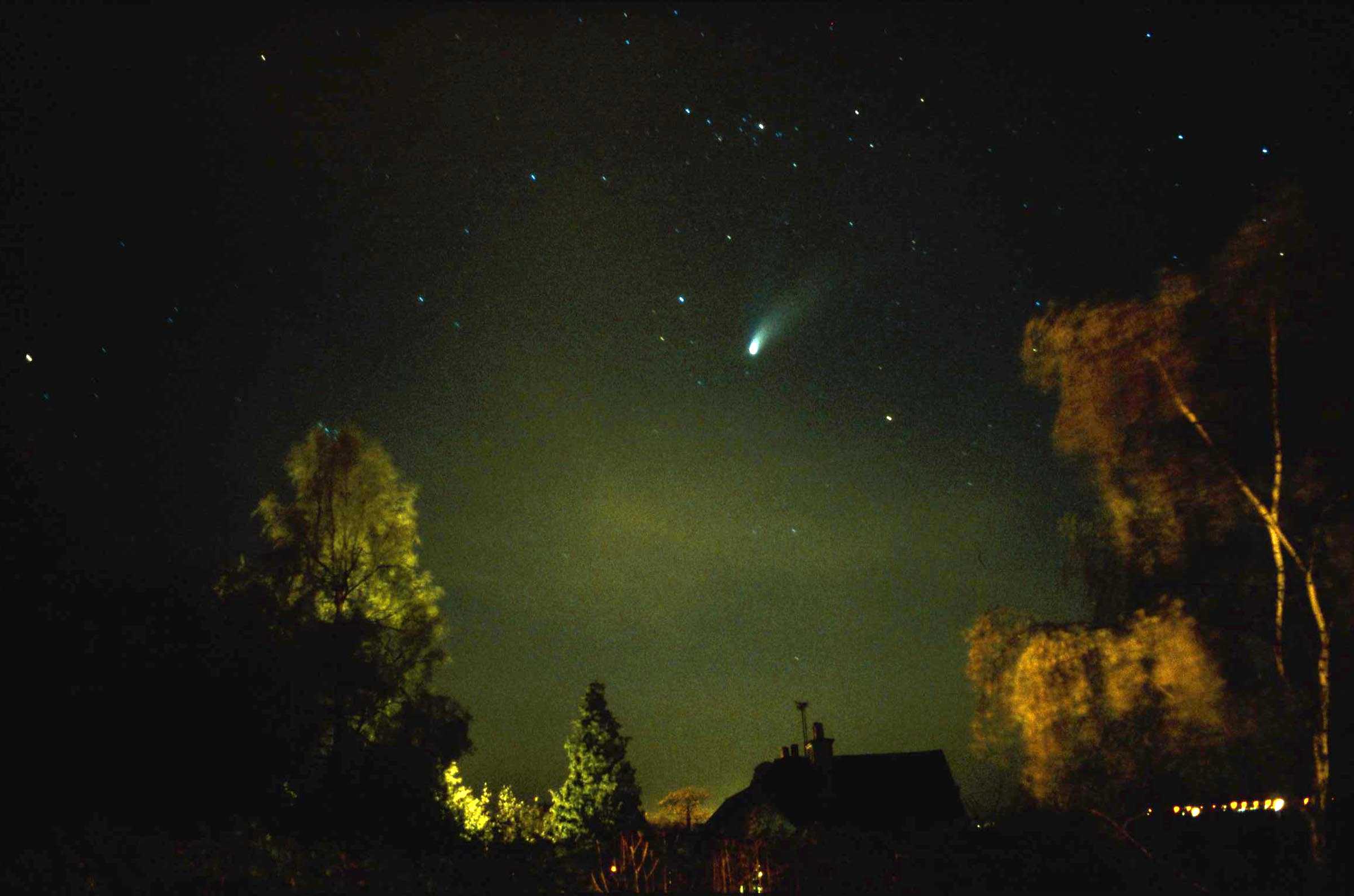
Comet Hal;-Bopp 1997 imaged by Lee Mcdonald 1997
Other comets may originate from a vast halo beyond the Kuiper Belt. This halo is called the Oort Cloud and is made of millions of dusty ice balls left that were over when the Sun and planets formed. Sometimes one of these ‘giant snowballs' may be moved out of its normal orbit and fall in towards the Sun. As it moves closer to the Sun gravity begins to pull it in faster. Once inside the orbit of Jupiter, the heat from the Sun begins to melt the ice. The ice (mainly H2O and CO2) sublimes directly into gas, due to the lack of pressure in space.
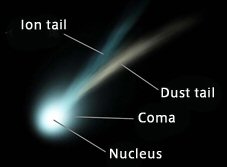
The parts of a typical comet
The gas produced by the melting ice is blown out behind the comet into straight ion tail, pointing away from the Sun by the radiation. The heavier particles form a curved tail left behind and along the path of the comet.
The Comet will loop around the Sun and back out to the edge of the solar system. Some comets return to become regular comets like Halley's Comet which returns every 76 years but some may have periods of thousands of years like C/2022 E3 (ZTF).