WHAT'S UP THIS MONTH - OCTOBER 2022
British Summer Time (BST) begins on 30th October so clocks will be put back one hour
(Link to What's Up November 2022)
(Link to What's Up September 2022)
THESE PAGES ARE INTENDED TO HELP YOU FIND YOUR WAY AROUND THE SKY
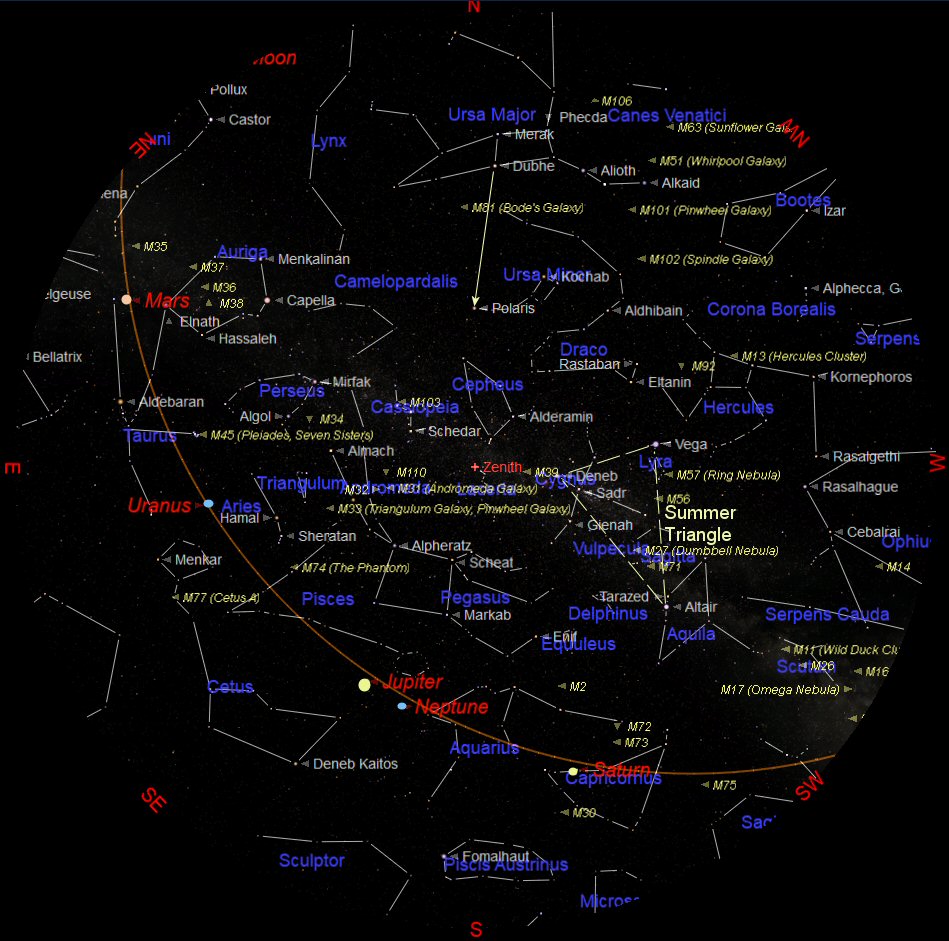
The chart above shows the whole night sky as it appears on 15th October at 22:00 (10 o'clock) British Summer Time (BST). As the Earth orbits the Sun and we look out into space each night the stars will appear to have moved across the sky by a small amount. Every month Earth moves one twelfth of its circuit around the Sun, this amounts to 30 degrees each month. There are about 30 days in each month so each night the stars appear to move about 1 degree. The sky will therefore appear the same as shown on the chart above at 9 o'clock BST at the beginning of the month and at 11 o'clock BST at the end of the month. The stars also appear to move 15º (360º divided by 24) each hour from east to west, due to the Earth rotating once every 24 hours.
The centre of the chart will be the position in the sky directly overhead, called the Zenith. First we need to find some familiar objects so we can get our bearings. The Pole Star Polaris can be easily found by first finding the familiar shape of the Great Bear ‘Ursa Major' that is also sometimes called the Plough or even the Big Dipper by the Americans. Ursa Major is visible throughout the year from Britain and is always quite easy to find. This month it is located high in the North West. Look for the distinctive saucepan shape, four stars forming the bowl and three stars forming the handle. Follow an imaginary line, up from the two stars in the bowl furthest from the handle. These will point the way to Polaris which will be to the north of overhead at about 50º above the northern horizon. Polaris is the only moderately bright star in a fairly empty patch of sky. When you have found Polaris turn completely around and you will be facing south. To use this chart, position yourself looking south and hold the chart above your eyes.
The planets visible in the evening sky this month: Saturn, Neptune, Jupiter, Uranus and Mars.
THE SOUTHERN NIGHT SKY THIS MONTH
The night sky looking south at about 22:00 BST on 15th October
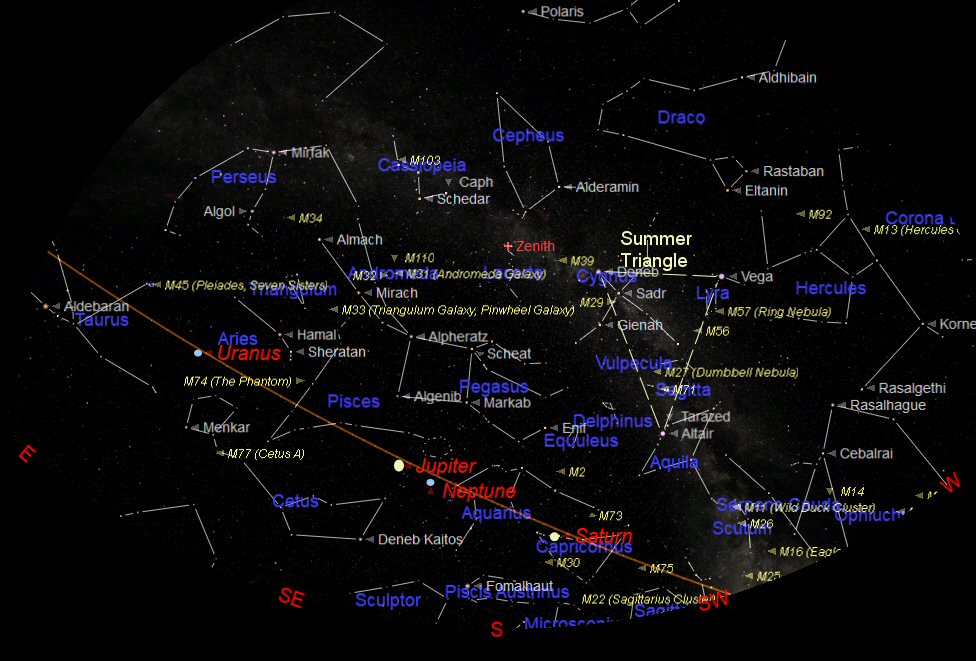
The chart above shows the night sky looking south at about 22:00 BST on 15th October. West is to the right and east to the left. The point in the sky directly overhead is known as the Zenith and is shown (in red) at the upper centre of the chart. The curved brown line across the sky at the bottom is the Ecliptic or Zodiac. This is the imaginary line along which the Sun, Moon and planets appear to move across the sky. The brightest stars often appear to form a group or recognisable pattern; we call these ‘Constellations'.
Constellations through which the ecliptic passes this month are: Sagittarius (the Archer), Capricornus (the Goat), Aquarius (the Water Carrier), Pisces (the Fishes), Aries (the Ram) and Taurus (the Bull).
Still prominent in the southern sky is the Summer Triangle that dominates the Summer Sky. It is defined by three bright stars: Deneb in the constellation of Cygnus, Vega in Lyra, and Altair in Aquila. The Milky Way (our Galaxy) flows through the Summer Triangle and passes through Aquila and Cygnus. The Summer Triangle is bigger than may be expected but once it has been found it is very easy to find again. As the Summer Triangle is so easy to find it is very useful to use as a starting place for finding our way around the night sky.
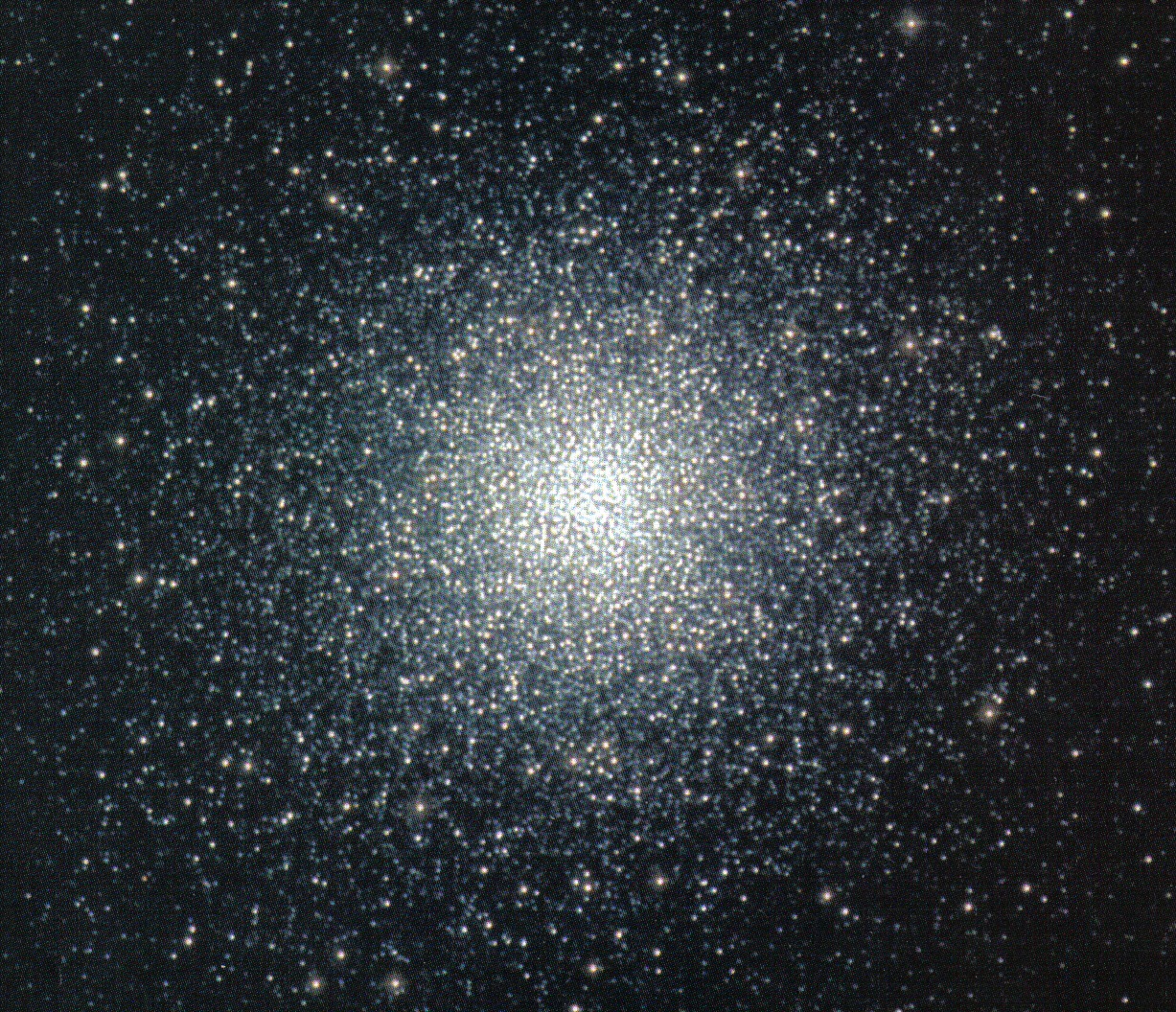
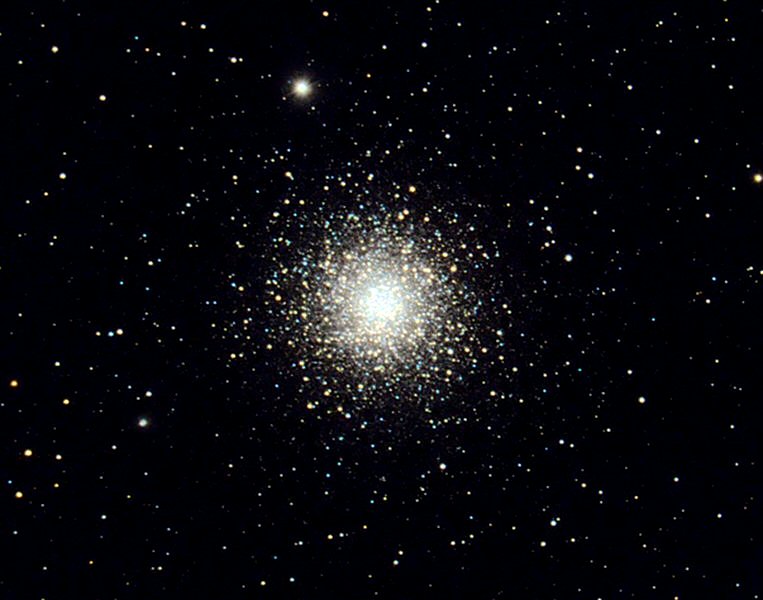
To the west (right) of the Summer Triangle is the constellation of Hercules (the Strong Man). Hercules has a distinctive distorted square shape, at its centre, called the ‘Keystone'. This is due to its resemblance to the centre stone of an arch or bridge. The jewel of Hercules is without doubt the Great Globular Cluster, Messier 13 (M13) that can be found in the western vertical imaginary line forming the ‘Keystone'. It is just visible using a good pair of 9 x 50 binoculars. The spherical cluster, of about a million stars can be seen using a 90mm f 10 telescope but will look even more impressive when using a larger telescope. Globular Clusters are thought to be the dense centre of small galaxies that have ventured too close to our galaxy.
To the East (left) of the Summer Triangle is the constellation of Pegasus (the Winged Horse). The main feature of Pegasus is the square formed by the four brightest stars. This asterism (shape) is known as the Great Square of Pegasus. The square is larger than might be expected but once found is easier to find again.
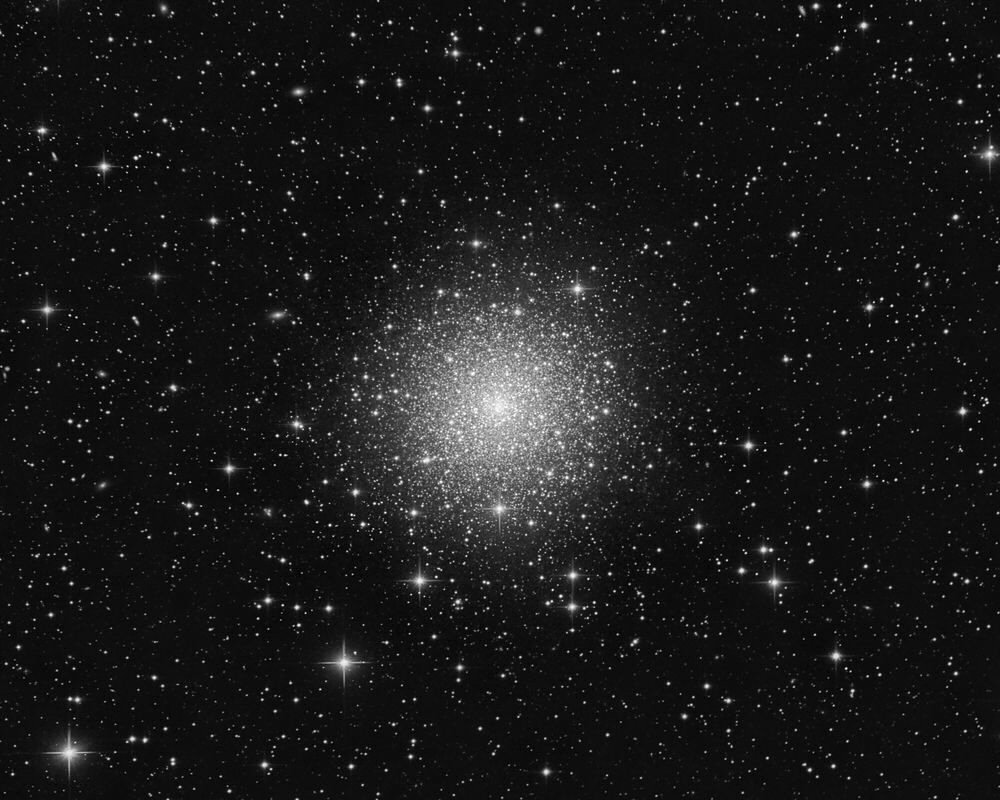
The square can be used to judge the seeing condition of the night sky. Under perfect conditions about ten stars can be seen inside the square this would indicate a very good night for observing. If three to five stars can be seen then conditions will still be good. If fewer or none can be seen then stick to looking at the Moon or planets. There is a very nice Globular cluster in Pegasus it is known as Messier 15 (M15) and is a lovely sight to see in a medium to large telescope .
The top easterly (left) star of Square of Pegasus is called Alpheratz and is shared with the constellation of Andromeda. In Greek mythology Andromeda is a princess who was chained to a rock as a sacrifice to a sea monster but she was saved from death by Perseus who married her and took her back to Greece to reign as his queen. The constellation of Andromeda is marked by two diverging lines of stars emanating from the star Alpheratz.
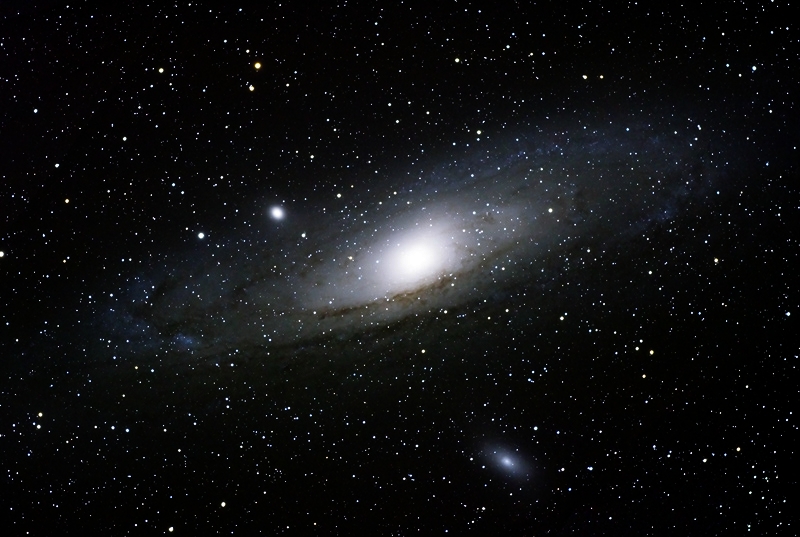
Just above the upper line of stars is one of the most remarkable objects to be found in the night sky. This is the Great Andromeda Galaxy called Messier 31 (M31). It is the closest Giant Spiral Galaxy to us and can be seen using binoculars or a small telescope. It is 2.54 million light years away from us and appears as a small elliptical smudge of light using a telescope.
CONSTELLATIONS AROUND THE SUMMER TRIANGLE
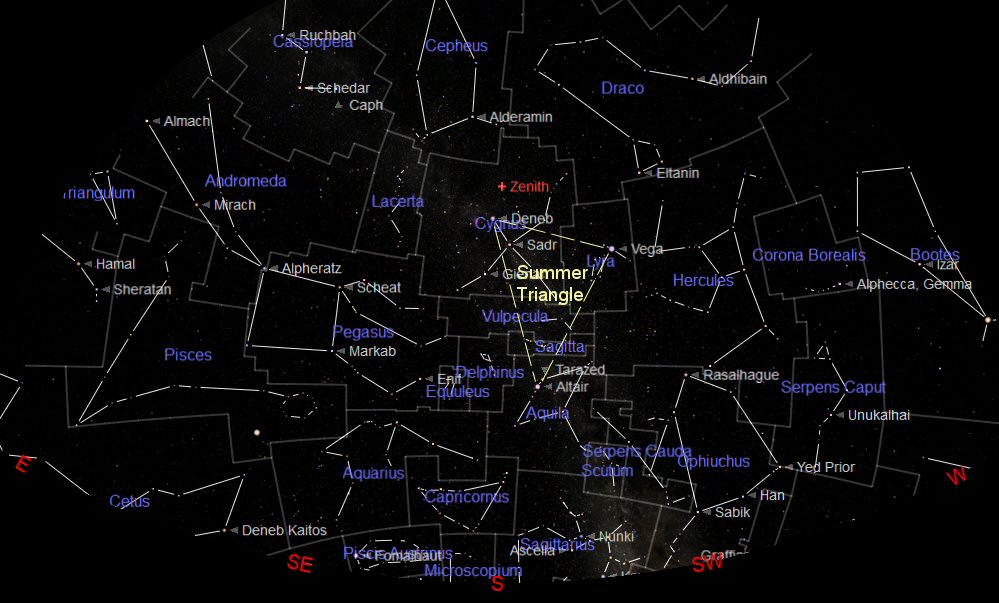
Chart showing the constellations surrounding the Summer Triangle
The chart above shows the sky around the Summer Triangle. The term ‘Summer Triangle' was suggested by Sir Patrick Moore and has now become the best known feature of the summer night sky. The corners of the imaginary triangle are positioned on the three obvious bright stars: Deneb in the constellation of Cygnus, Vega in Lyra, and Altair in Aquila. The Summer Triangle was featured in the September Magazine as a good place to start exploring the autumn night sky. This month we use the Triangle to identify the surrounding constellations. Here is a brief mention of the constellations that can be found in the Summer Triangle:
THE CONSTELLATION OF AQUILA (the Eagle)
The constellation of Aquila (the Eagle) is found at the bottom corner of the Summer Triangle. There are no interesting objects in Aquila but the one bright star, Altair, has a fainter star above and below it that makes it quite easy to find.
THE CONSTELLATION OF CYGNUS (the Swan)
The constellation of Cygnus (the Swan) is located at the top of the Summer Triangle. Cygnus (the Swan) does actually resemble the swan it is supposed to represent. The brightest star in Cygnus is Deneb that represents the Swan's tail.
THE CONSTELLATION OF LYRA (the Harp)
The constellation of Lyra (the Harp) is located to the west (right) of Cygnus but is much smaller. The most obvious feature of Lyra is the very bright star Vega that is located the top right corner of the Summer Triangle.
There are two small constellations that reside within the Summer Triangle
SAGITTA (the Arrow) and VULPECULA (The Fox)
Sagitta really does look like an ‘arrow'. It is composed of three stars that look like the shaft of the arrow and two stars that resemble the flight feathers.
Vulpecular is a quite indistinct constellation located in the Summer Triangle but is just three rather faint stars that do not resemble anything like the fox that it is supposed to represent.
Constellations to the west of the Summer Triangle
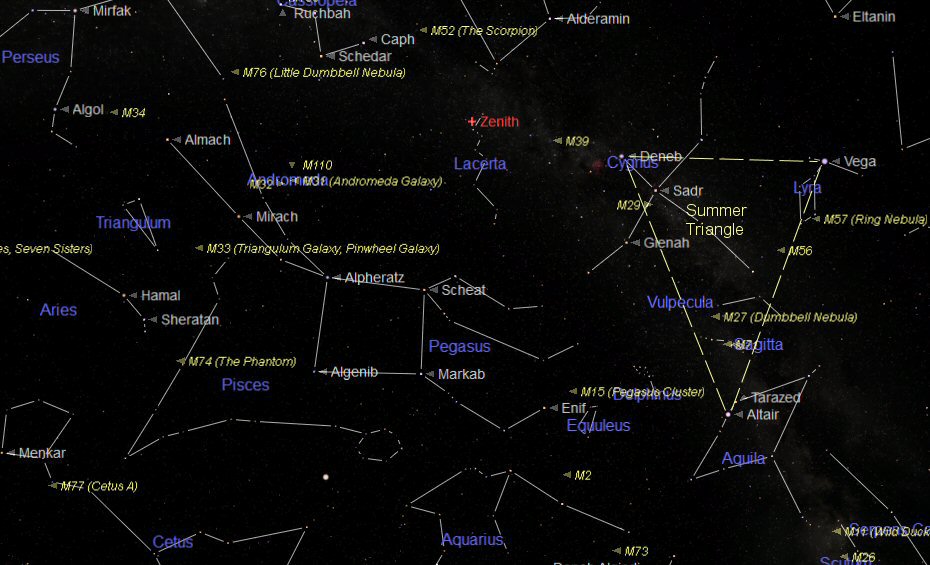
Chart showing the constellations to the west of the Summer Triangle
The chart above shows the sky to the west (right) of the Summer Triangle. To the west (right) from the upper right star of the Summer Triangle, called Vega, is the constellation of Hercules the Strong Man from mythology.
Hercules is the great strongman from Greek mythology. He is usually illustrated in the sky as the strong man with a club held above his head. The ‘Keystone' (centre stone of an arch) asterism (shape) can be a little difficult to identify in a light polluted sky but easy to find again.
The jewel of Hercules is without doubt is the Great Globular Cluster, Messier 13 (M13). M13 can be found about 2/3 of the way up the western (right) vertical imaginary line of the ‘Keystone'. It is just visible using a good pair of 9 x 50 binoculars. The spherical cluster, comprised of about a million stars, can be seen using a 90mm f 10 telescope but will look even more impressive when using a larger telescope.
|
|
The Great Globular Cluster Messier 13 (M13) |
A smaller Globular Cluster Messier 92 (M92) |
Further to the west from Hercules is the bright orange star called Arctaurus located in the constellation of Boötes the Herdsman. Arctaurus is the only bright star in Boötes, the others are fainter and form the shape of an old fashioned diamond shaped kite with Arctaurus located where the string of the tail would be attached. Arctaurus is a Red Giant star that is slightly more massive than our Sun but is older at 7 billion years and approaching the end of its ‘life'.
Constellations to the east of the Summer Triangle
Chart showing the constellations to the east of the Summer Triangle
The constellations of Pegasus and Andromeda share and are joined at the star Alpheratz. Alpheratz is actually designated as belonging to Andromeda but looks to be more a part of Pegasus as it is required to complete the familiar ‘Great Square of Pegasus'. The Square is larger than may be expected which sometimes makes it a little difficult to initially identify.
Pegasus is named after the mythical winged horse and with Andromeda included to provide the wings and a lot of imagination the stars could be said to resemble the flying horse. The square generally is used to represent the body of the horse and the three lines to the west (right) from the stars Scheat and Markab do look a little like the horse's legs.
|
|
Messier 15 (M15) Globular Cluster |
The Great Andromeda Galaxy Messier 31 (M31) |
The constellation of Andromeda is host to the only ‘naked eye' Galaxy, known as Messier 31 (M31). It is the most distant object that can be seen with our naked eyes (2.54 million light years away). It is quite easy to find using binoculars and is well place at this time of year. Messier 31 (M31) is a Giant Spiral Galaxy similar to our galaxy the Milky Way. So when we look at M31 we can get an idea what we look like viewed from M31.
The pointer to Andromeda is the top left star of the square named Alpheratz. Strangely Alpheratz is officially not part of Pegasus but is designated as Alpha (a) Andromedae. From Alpheratz follow the fairly obvious line of stars to the left (east). Locate the second star in the line which is shown as Mirach on the chart above. From Mirach follow a slightly fainter short line of stars to the north (above) Mirach to the second star. Just to the right of this star is the faint fuzzy patch of light that is M31 the Great Andromeda Galaxy. Almach the star at the end of the line is worth looking at as it is a beautiful blue and golden double star.
THE SOLAR SYSTEM - OCTOBER 2022
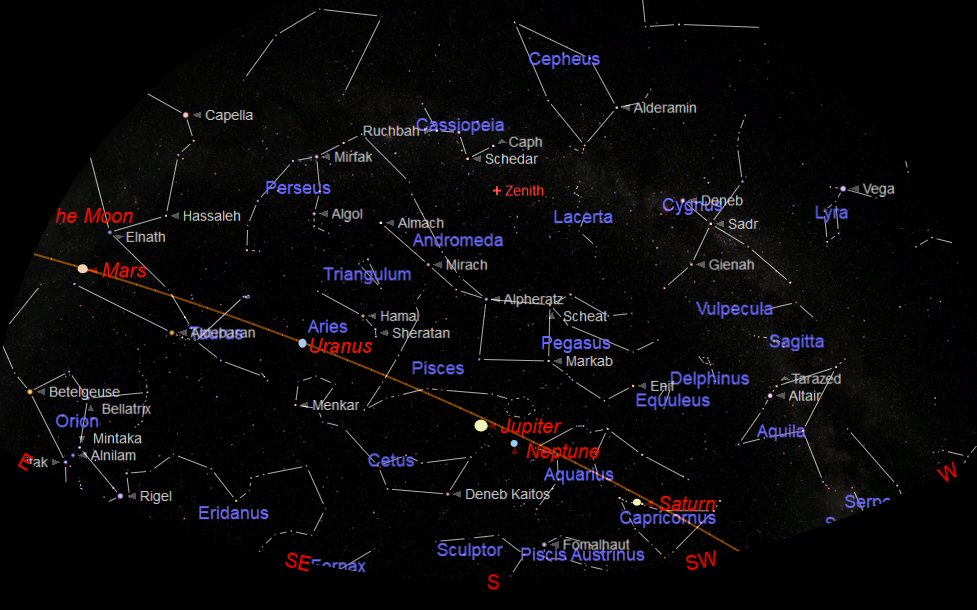
The location of the planets at midnight on 15th October 2022
The chart above shows the location of the planets along the Ecliptic in the early morning sky. The sky has been darkened to make the planets visible. The planets are: (in order as they appear) Saturn, Neptune, Jupiter, Uranus and Mars (midnight). Venus and Mercury are close to the Sun this month. The planets appear low in the sky, in the bright morning or evening sky so are not well positioned for observing.
MERCURY was at its Inferior Conjunction with the Sun on 23rd September this meant it was passing in front of the Sun. After conjunction it moved into the morning sky and will now rise just before the Sun in the east. Mercury will be at its greatest westerly elongation on 8th and 9th October. This is when it will be at its apparent furthest point from the Sun and at its best.
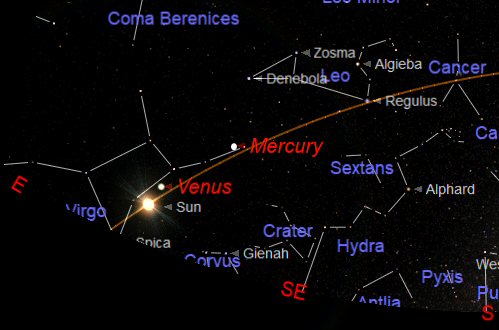
Mercury and Venus at sunrise on 15th September
VENUS will be at its Superior Conjunction (behind the Sun) on 22nd October so it will not be visible this month. Over the next few months it will start to re-appear low over the western horizon in the early evening. As Venus is located on the other side of the Sun it will appear smaller but fully illuminated. It will be close to the Sun and difficult to see.
Over the next few months Venus will appear to move further away from the Sun and will be easier to observe in the western sky after sunset. It will appear to grow larger as its orbit brings it closer to us. As Venus moves around the Sun less of the illuminated side will be visible. It will begin to look ‘half Moon' shaped then progress to become a crescent shape. As it moves towards us it appears larger but progress to a thinner crescent so Venus remains at about the same brightness. It always has an apparent brightness of about -4.2 (the brightest planet).
MARS will be best seen after midnight in the east and will move west throughout the night until sunrise. It is still some distance away but is approaching its closest position when it will be at Opposition on 8 th December. The chart below shows Mars rising in the east in the late evening. It will be at its best after midnight this month.
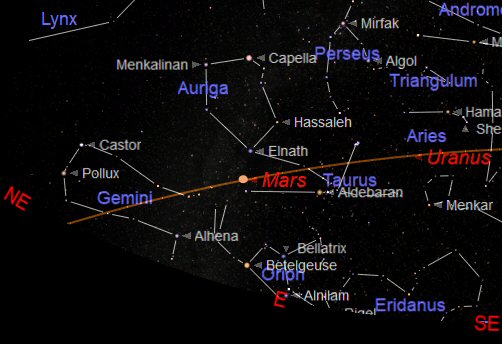
Mars rising in the east at 23:00 on 15th October
Mars will be at its best during December 2022 when it will be at or close to its opposition. Although Mars will not be as close to Earth as it can be, it will be high in the sky and away from the turbulent and contaminated air close to the horizon. So we should be able to obtain some good views of the Red Planet around Christmas time. A telescope of over 100mm aperture should be able to show the dark markings on the surface and one of the polar ice caps.
JUPITER was at Opposition (directly in line with the Sun and Earth) at midnight on 26th September. At this point Jupiter was at its best position for observing and will be a little higher in the sky than it was last year. So it will be a clearer to see as it will be higher above the horizon and in slightly clearer and less turbulent air. The cloud markings and the four brightest (Galilean) moons will be visible, using a smaller telescope, even with the turbulent air above the horizon.
The four Galilean moons are large and about the same size as our Moon. They are named (from the inner to outer) Io, Europa, Ganymede and Callisto. These four largest moons are known as the Galilean moons as they were discovered by Galileo Galilei in 1610. Ganymede is the largest moon in the Solar System at 5262 km in diameter (our Moon is 3,476 km). The Galilean moons can be seen in any telescope and even using larger binoculars.
Jupiter's Galilean moons are very different to each other in size and appearance. Io is the inner moon and is covered in active volcanoes. Europa is the smallest and mainly water ice. Ganymede is the largest moon and Callisto has the oldest surface in the Solar System.
The movement of the moons can be followed using a small telescope. The inner moons can be seen to have moved from one night to the next but the inner moons can be seen to move in minutes especially when close to Jupiter. A high magnification eyepiece will be needed to see details on the surface and movements of the moons.
Sometimes the shadow of a moon can be seen crossing the face of Jupiter. It is also interesting to watch a moon disappear behind Jupiter but it very difficult to see a moon moving across the bright face of the planet. The movements of the moons can be predicted using a computer planetarium application. Stellarium is a good one and it is free to download from the internet.
The image below shows Jupiter imaged by Peter Tickner. For those with a smaller telescope, do not feel disappointed that the view is not as good as shown in the image below or in magazines and on the internet. The important thing is that we are using ‘our own' telescope to see this beautiful object. The light from the planet has travelled through space and has entered our eye to produce a real image on our retina. This means the light from the planet is actually entering our body and activating our visual receptors to create an image in our brain. It is exciting to think this is as near as we can get to touching the planet.
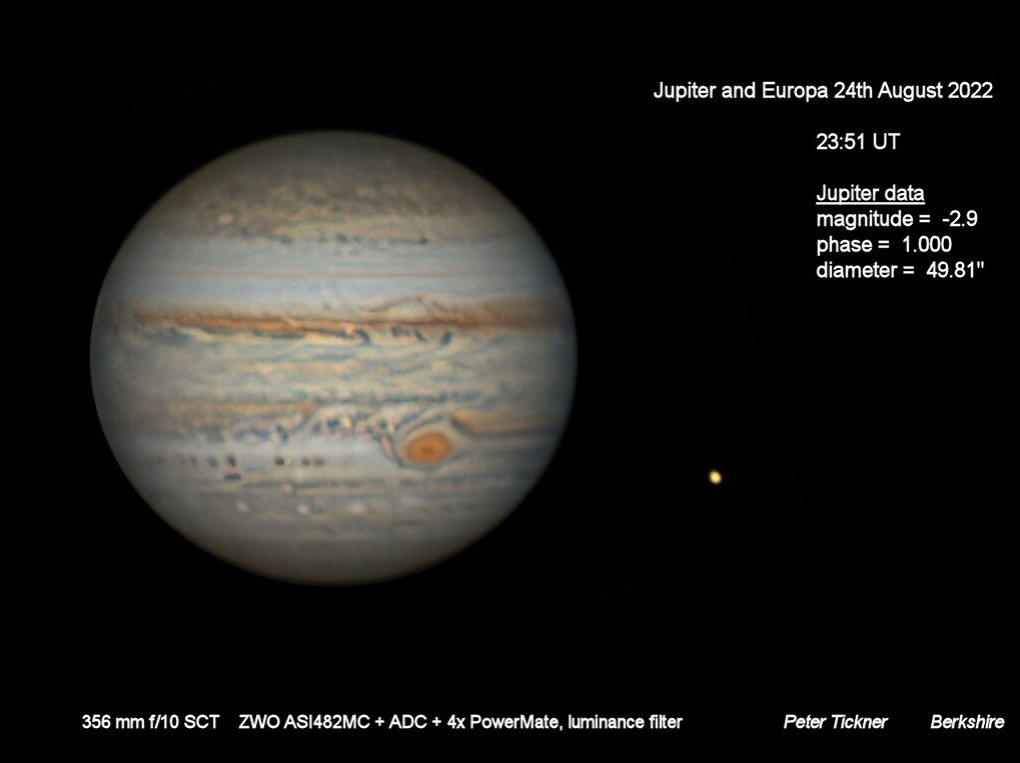
Jupiter and Moon Europa imaged by Peter Tickner Reading Astronomical Society
SATURN is the first planet to rise over the eastern horizon so it will be seen in the south eastern sky as soon as it gets dark. It was quite low over the south eastern horizon at the beginning of September but it will become better in the darker autumn sky earlier and appear higher in the sky this month.
Saturn will look small in a small telescope and not much bigger in a medium sized telescope but the ring will be visible even using a small beginner's telescope. The view of Saturn is very dependent on the seeing conditions. This is the term used by astronomers to describe how clear the sky appears. This depends on the brightness of the sky and how transparent it is and how steady the atmosphere is. The image above was taken on a night when the ‘seeing' was very good. The shadow of the planet can be seen on the ring to the left.
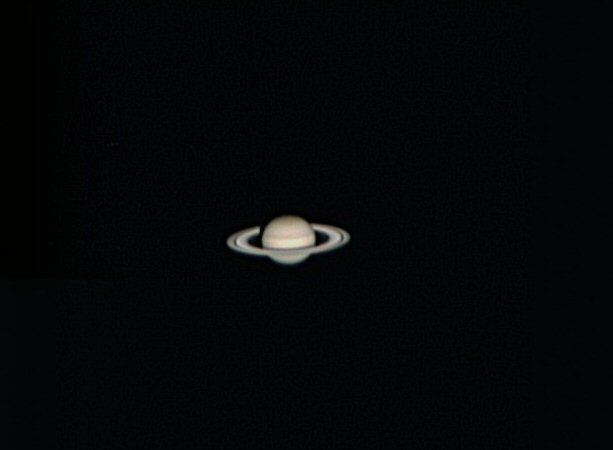
Saturn imaged by Steve Harris
The Cassini Division (gap in the ring) can be seen quite clearly. The ring is easier to see when Saturn is at its maximum tilt but becomes very difficult to see when the tilt is at minimum. When our view is edge on the ring becomes very difficult to see and all but disappears for a few of days. Although the ring is 282,000 km in diameter it is only about 100 metres thick.
URANUS is observable later in the evening in the east this month. It rises over the eastern horizon at about 19:00 this month. Uranus will be best seen later is the night as it rises higher in the sky. It will be best at about 02:30 when it is at its highest in the south.
NEPTUNE is a lot smaller and fainter than Uranus but is close to Jupiter that makes it easier to find. It will still be difficult to see in the bright late summer sky and will need a telescope and a high magnification to see, looking like a small blue ‘fuzzy' star.
THE SUN
The Sun rises at about 06:20 BST at the beginning of the month and 6:50 BST by the end of the month. It sets at 19:30 at the beginning of the month and 18:50 at the end of the month. There have been a lot of very nice Sunspots and even some impressive groups of sunspots recently.
Sun spots can be seen and studied using most telescopes. However the telescope must be fitted with a special Solar Filter. This filter must be a specially manufactured solar filter and no other type of filtering device can be used. This special filter fits over the front of the telescope to hugely reduce the amount of sunlight that can enter the telescope. The telescope can be used as normal but only the Sun is bright enough to be visible through the filter.
Sunspots and other activity on the Sun can be followed live and day to day by visiting the SOHO website at: http://sohowww.nascom.nasa.gov/ .
There have been some very nice sunspots and groups of sunspots recently. These sunspots are caused by the magnetic forces in the Sun when they react with the upper layers of the Sun. The magnetic field causes an indentation that can reveal a slightly cooler and less bright layer beneath the surface. The sunspots below are larger than the size of Earth.
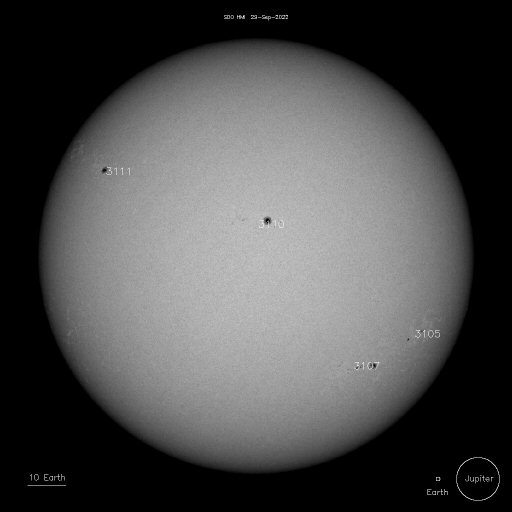
Sunspots imaged by SOHO on 29th September 2022
THE MOON PHASES THIS MONTH
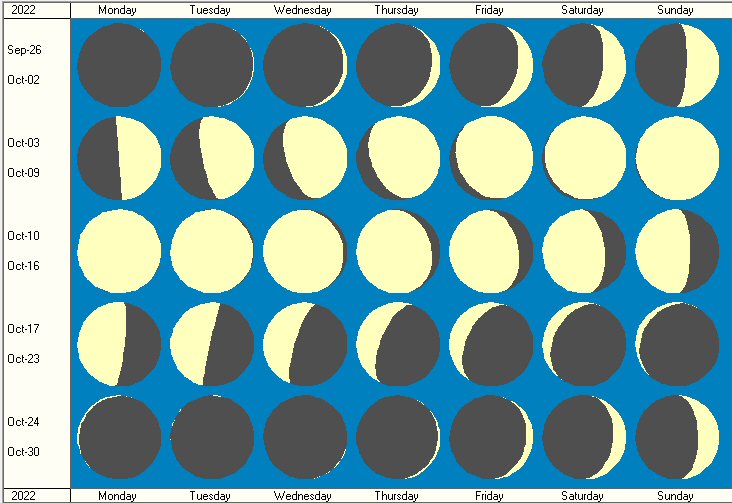
First Quarter will be on 3rd October
Full Moon will be on 9th October
Last Quarter will be on 17th October
New Moon will be on 25th October
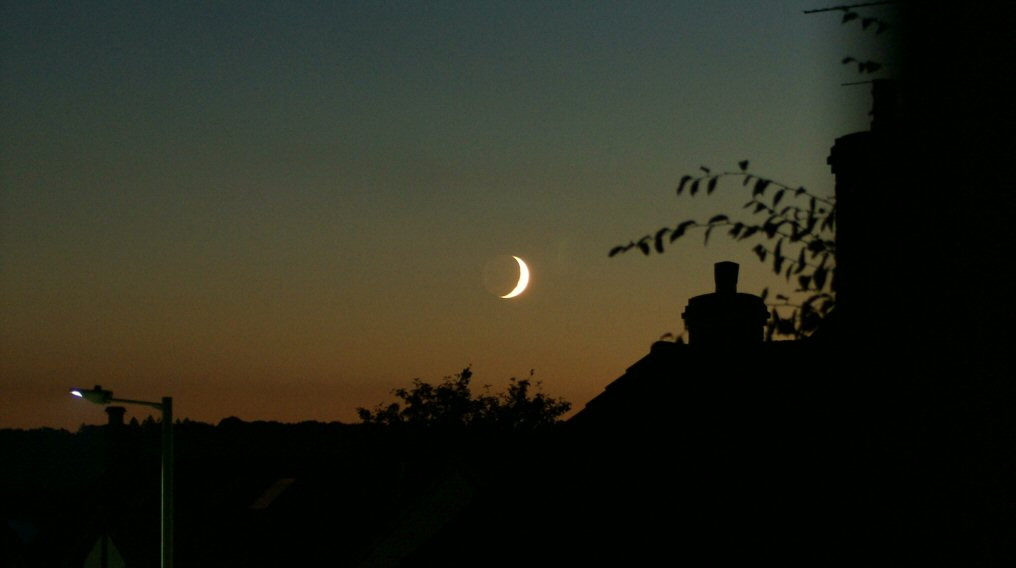
The three day old New Moon imaged 29th September by Steve Harris