Other articles in this series
ASTRONOMICAL FILTERS
An astronomical filter is an accessory
used by astronomers to simply enhance the details of an object they are
observing (much as with amateur photography).
The most common filters screw into the bottom of the eyepiece body.
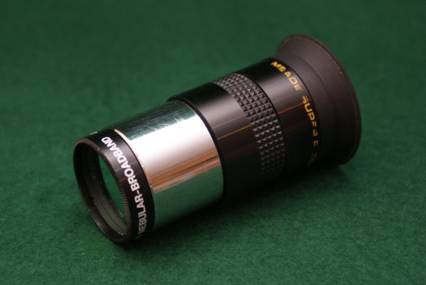
A
Broadband filter fitted to a standard 1¼" eyepiece
Most
astronomical filters work by blocking a specific part of the colour spectrum
above and below a ‘bandpass’ significantly increasing the signal
to noise of the interesting wavelengths thus giving the object more contrast or
definition. While colour filters
transmit certain colours from the spectrum and are usually used for observation
of the planets and the Moon the polarizing filters work by adjusting the
brightness and are usually used for observing the Moon. Broadband and narrowband filters transmit the
wavelengths that are emitted by a nebula (by the Hydrogen and Oxygen atoms) and
are frequently used for reducing light pollution.
COLOUR FILTERS
Colour
filters work by absorption/transmission and can tell which part of the spectrum
they are reflecting and transmitting. Filters
can be used to increase contrast and enhance the details of the Moon and
planets. Each of the visible spectrum
colours has a filter and every colour filter is used to bring a certain lunar
and planetary feature. For example: the
#8 yellow filters are used to show darker features on Mars and Jupiter’s belts.
The ‘Wratten’
system is the standard number system used to refer to the colour filter types. It was first manufactured by Kodak in 1909.
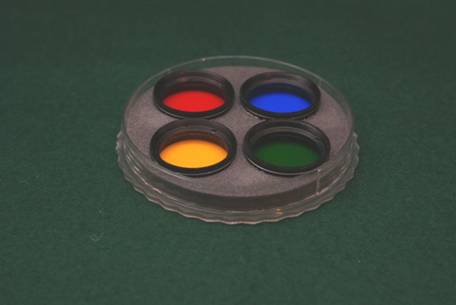
A
set of the most commonly used coloured filters
Some of most
common colour filters and their uses are:
Chromatic aberration
filters: Used for reduction of the
purplish halo caused by chromatic aberration of refracting telescopes. Such halos can obscure features of bright
objects especially Moon and planets.
These filters have no effect on observing faint objects.
Red: Reduces sky brightness, particularly during
daylight and twilight observations.
Improves the definition of maria
on the Moon, ice and polar areas of Mars.
These can be used to improve the contrast of blue clouds against the background
clouds on Jupiter and Saturn.
Deep yellow: Improves resolution of atmospheric features of
Venus, Jupiter (especially in the Polar Regions) and Saturn. Increases contrast of polar caps, clouds, ice
and dust storms on Mars. Enhances comet tails.
Dark green: Improves cloud patterns on Venus. This filter can be used to reduce sky
brightness during daylight observations of Venus. Increases contrast of ice and polar caps on
Mars. Improve visibility of the Great
Red Spot on Jupiter and other features in Jupiter’s atmosphere. Enhance white clouds and Polar Regions on
Saturn.
Medium blue: Enhances contrast of Moon. Increases contrast
of faint shading of Venus clouds.
Enhance surface features, clouds, ice and dust storms on Mars. Enhance definition of boundaries between
features in atmospheres of Jupiter and Saturn.
Improve definition of comet gas tails.
MOON FILTERS
Neutral density filters (also known in
astronomy as Moon filters) are another approach for contrast enhancement and
glare reduction. They work simply by
blocking some of the Moon`s light to enhance the contrast. Neutral density filter are mainly used in
traditional photography but are used in astronomy to enhance lunar and
planetary observations.
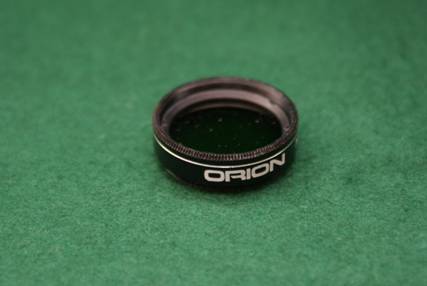
A Neutral Density
Moon Filter
If the Moon is near ‘full’ and a new
astronomer does not have a moon filter then it may be useful to lessen the
glare by reducing the amount of light entering the telescopes. This can be done by fitting the dust cover
over the telescope and removing the small cap to reduce the aperture. However using the full aperture of the
telescope with a filter fitted does provide a better image. So if observing the Moon is an important
aspect of future observing then for a small outlay of less than £20 to buy a
moon filter will be money well spent.
POLARISING FILTERS
Polarising
filters adjust the brightness of images to a better level for observing but
much less so than solar filters. With these
types of filter the range of transmission varies from 3% to 40%. They are usually used for the observation of
the Moon but may also be used for planetary observation.
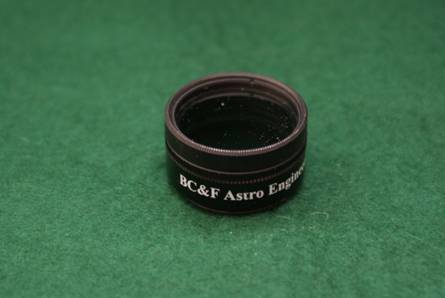
A
Polarising Moon Filter
Polarising
filters consist of two polarizing layers in a rotating cell which changes the
amount of transmission of the filter by rotating them. This reduction in brightness and improvement
in contrast can reveal the lunar surface features and details especially when
it is near full. Polarising filters must
not be used in place of solar filters designed especially for observing the
sun.
BROADBAND
FILTERS
The
Broadband or light pollution reduction (LPR) filters are nebular filters that
block the light pollution in the sky and transmit the H-alpha, H-beta, and
O-III spectral lines which makes observing nebulae from the city and light
polluted skies possible. These filters
block the Sodium and Mercury vapour light, and also block the natural ‘skyglow’ such as the auroral
light. The broadband filters differ from
the narrowband with the range of wavelengths transmission. The broadband filters have a wider range
because the narrower transmission range causes a fainter image of sky objects,
and since the work of these filters is revealing the details of nebulae from
light polluted skies it has a wider transmission for more brightness.
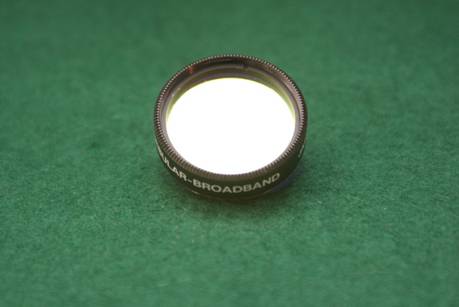
A
Broadband Filter
Broadband filters are
particularly designed for nebulae observing, are not useful with other deep sky
objects. However it can improve the
contrast between the object being observed and the background sky and may
clarify the image.
NARROWBAND
FILTERS

The
three main spectral lines that Narrowband filters transmit
Narrowband
filters are astronomical filters that transmit only a narrow band of spectral
lines (usually 22nm or less). These
filters are mainly used for nebulae observation. Emission nebulae mainly radiate the doubly
ionized oxygen in the visible spectrum that emits near 500nm wavelength. These nebulae also radiate weaker at 586nm
from the Hydrogen-beta atoms.
There are
three main types of Narrowband filters:
Ultra-high
contrast (UHC)
Oxygen-III
Hydrogen-beta
and Hydrogen-alpha
Hydrogen-beta
and Hydrogen-alpha are the narrowest of the three filters, with 8nm range. The UHC filters range from 484 to 506nm. It transmits both the O-III and H-beta
spectral lines, blocks a large fraction of light pollution and brings the
details of planetary nebulae and most of emission nebulae under a dark sky.
INFRARED CUT-OFF
FILTERS
Infrared cut-off filters, sometimes called IR filters
or heat-absorbing filters, are
designed to reflect or block mid-infrared wavelengths while passing visible
light. They are often used with webcam
video cameras to block IR due to the high sensitivity of the camera sensor to
near-infrared light. These filters have
a red hue to them so they also sometimes block some of the light from the
longer red wavelengths.
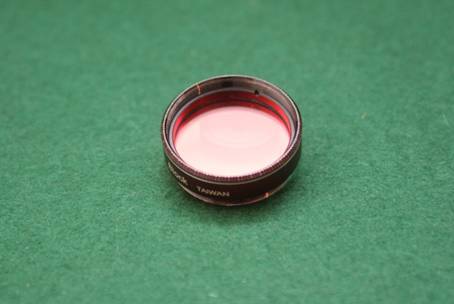
An Infrared cut-off filter