Other articles in this series
USING BINOCULARS FOR ASTRONOMY
Nearly all amateur
astronomers will have a trusted ‘pair of binoculars’ and will often recommend
to a beginner that it should be the first instrument to be purchased. This article will endeavor to give some
guidance in purchasing binoculars and using them to observe the night sky.
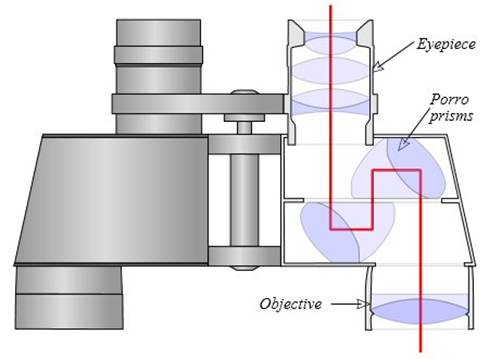
The
typical light path through a binocular
The objective lens gathers light and focuses it into
an image. The eyepiece is used to
magnify the image and direct the light into the eye. Prisms are introduced into prismatic
binoculars to enable the body to be physically reduced in length compared to
that of a telescope. They also ensure
that the image is orientated the right way up and the right way round.
Binoculars come in many
designs to suit the purpose or requirements of the user. The picture below shows a small selection
from the range of binoculars that are available.
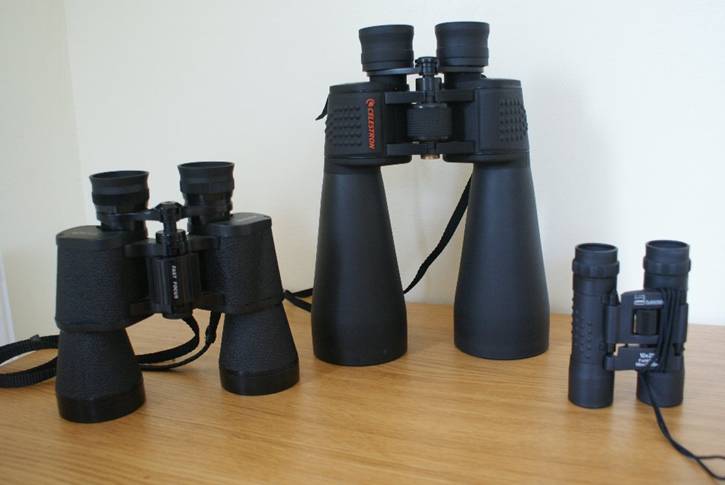
Binoculars
8 x 50 (left) 15 x 70 (middle) 10 x 25 (right)
Binoculars for astronomy use
should have an aperture (lens diameter) of at least 50mm (the second number in
the descriptions above). The 10 x 25 instrument
shown on the right is too small to be much use for astronomy. An aperture of less than 50mm will not gather
enough light to give a really good view of the night sky. Binoculars over 50mm do tend to be more
expensive and heavier so 50mm is a good size to start with. A magnification of 7x
or 8x is the best but up to 10x can be used.
The 10x may be difficult to hold steady but if supported on a wall or
fence they can be used. So look for a 7
x 50 or 8 x 50. What about cost? Normally the old adage ‘you get what you pay
for’ is true. About £35 to £50 will
provide a good quality pair but spend as much as you can afford.
The binoculars shown
in the image below are typical of a good but rather aging 10 x 50 instrument. Modern versions would be lighter than this
model but the salient features are much the same.
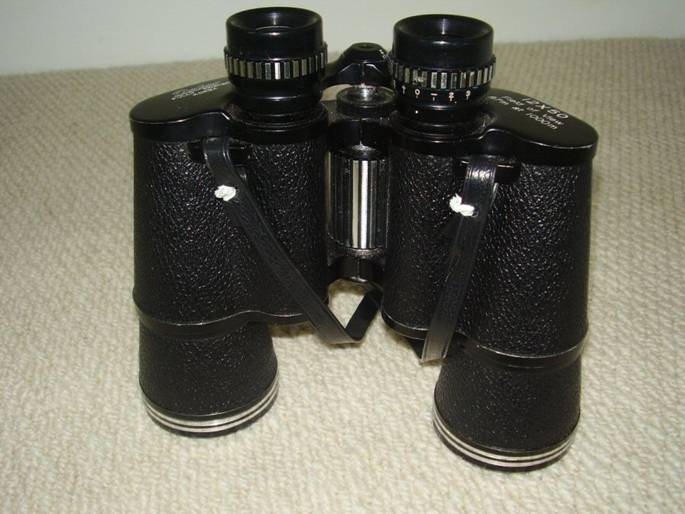
A
typical 10 x 50 binocular
The most important feature is of course the
optical quality but most modern instruments costing around £50 (before special
offer price reduction) are of a reasonable quality. Binoculars with an aperture of less than 50mm
are not best suited for astronomy as they cannot capture enough light. Most binoculars have the following features
that are designed into the instrument to allow it to be adjusted to suit the
user and the purpose of use.
The two optical bodies are hinged together to
allow them to be adjusted to the positions of the users eyes. By adjusting the angle of the hinge the
eyepieces can be moved closer or further apart to achieve the most comfortable
position to suit the user’s eyes.
Incorporated into the hinge between the two
optical bodies is a focus adjuster often in the form of a rotating barrel. (The central focusing barrel can be clearly seen
in the image above.) Rotating the barrel
moves the two eyepieces in and out of the bodies. This allows the binocular to be focus on
objects at different distances.
The right hand eyepiece can be rotated to
adjust the focus of each optical body to suit each eye this is called ‘diopter adjustment’.
The way to do this is to find a bright star in the binocular (or any
distant object can be used during the day).
Close the right eye and adjust the focus to suit the left eye using the
central focusing barrel. When the sharpest
image is achieved (for a star the smallest point of light) open
the right eye and close the left. Now
adjust the right eyepiece by rotating the dioptre adjuster each way until the sharpest
image is achieved. Open both eyes and
adjust the focus to suit both eyes using the central focusing barrel to check
the quality of the view.
Finally binoculars are usually supplied with
a strap for hanging the instrument around the neck. It is a very important to leave this on and
use it all the time. It saves putting
the binocular down when not being used, it may be difficult to find again in
the dark. It is also useful for resting
the arms after holding them up for some time.
It also stops the binocular falling to the ground and being damaged if
accidently dropped.
Some binoculars may have
rubber cups fitted to the eyepieces.
These are good because the help by excluding unwanted light from street
lights or other sources. Lens covers may
also the supplied to prevent dust accumulating on the glass so if supplied they
should be fitted when the binocular is not in use.
Some cheaper binoculars may display a flare
or spikes around the stars but this is not a big problem as long as the effect
is not too noticeable. Using binoculars
will allow the positions and patterns of stars to be appreciated so some
distortion of the star images can be acceptable. So let us move on to using the binoculars for
astronomy.
The first thing to consider is getting
comfortable for observing. All the usual
advice given to beginners to astronomy applies.
That is: dress to keep warm, make yourself comfortable and avoid lights
that shine directly into your face.
Little needs to be said about dressing to keep warm except to start
observing in warm clothes and don’t wait until cold has set in before dressing
up.
To be comfortable a reclining garden chair
will allow views of the sky overhead to be obtained without a resulting neck
ache. It also avoids the feeling of
swaying or falling over when looking up into the sky for a while. It is also very comfortable. If a star chart is to be used in conjunction
with the binocular a small side table is handy and a not too bright red light
should be used to read it.
Before starting to use the binocular have a
look around the night sky for a few minutes to allow your eyes to adapt to the
dark. This will take about ten
minutes. Pick out the brightest stars
and try to identify them. Familiarise
yourself with the positions of those bright stars because they do appear to
move from quite noticeably from east to west as Earth rotates.
Start at one of the bright stars then try to
identify the star patterns on the star chart.
This could be a little difficult at first because many more stars will
be seen than are shown on the chart. It takes
a while to match the slightly brighter ones to the stars shown on the
chart. The good thing is binoculars
always show the stars the right way up and in the correct orientation. Gradually work outwards from the bright stars
and you will soon start to become familiar with that part of the sky. Do stop occasionally and just sweep across
the sky and marvel at the thousands of stars.
Do the same for other bright stars.
The bright stars of the Summer Triangle are a good place to start.
When you feel ready to search for something
interesting have a look at the chart and find an interesting object. It is useful to make a list of objects before
moving out to observe. These objects can
be checked in books or on the internet to see if they are within the grasp of
binoculars. It is also useful to have an
idea what the object you are looking for actually looks like. Two objects to start with are M27 the
Dumbbell Nebula in Vulpecula and M31 the Great Galaxy
in Andromeda.
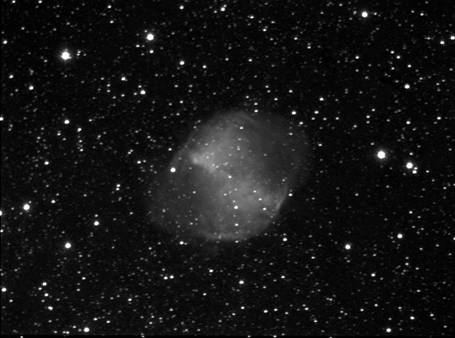
M27 the Dumbbell
Nebula in Vulpecula
While looking for M27 you
will pass through the beautiful star fields of our Milky Way galaxy.
A typical 8 x 50 or 10 x 50 binocular will
not show detail on any astronomical target other than the Moon. The true purpose of binoculars is to enhance
the wide view of the night sky. Stars
will appear brighter and many more will be seen than is possible with the
unaided eye. So the main aims of using
binoculars are: to study the star patterns, seek out the brighter deep sky
objects and transient objects like comets.
Binoculars larger than 50mm aperture are
heavier and generally have a higher magnification (higher than 15x). These two
factors make it more difficult to keep a target steady and in clear view. It is therefore necessary to have additional
support for the binocular. A simple
support can be used by utilising a suitable wall or even a long handled
broom. There are custom made support
frames available to buy or for manufactured by those with a little DIY
knowledge and skill. The device below is
a proprietary binocular support mounted to a tripod. It has a counter balance weight and a parallelogram
frame that allows the binocular to be raised or lowered while maintaining the
same line of sight. The binocular can be
elevated or lowered and the frame can be rotated on the tripod to enable any
object to be viewed.
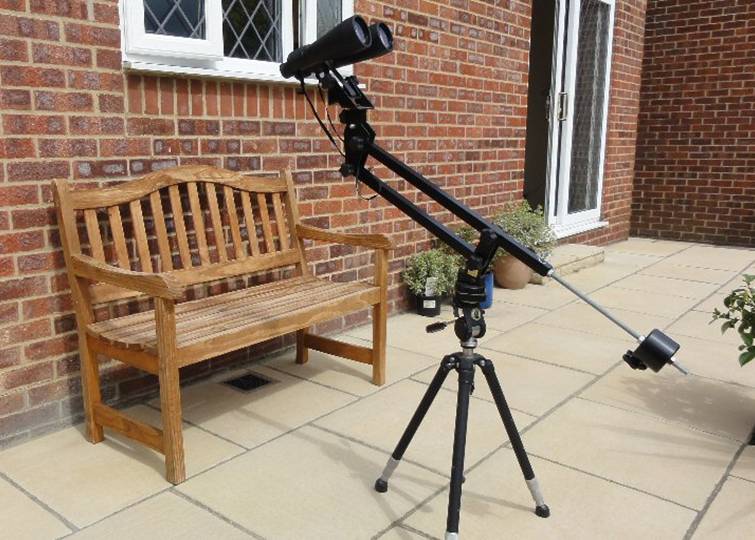
A Parallelogram
Binocular Support with 15 x 70 fitted
Some objects are best seen using binoculars
because they appear so large in the sky that a telescope cannot fit the whole
object into its field of view. One such
object is M45 the Pleiades (Seven Sisters star cluster) in the constellation of
Taurus. Another cluster best seen using
Binoculars is M44 the Beehive Star Custer in the constellation of Cancer.
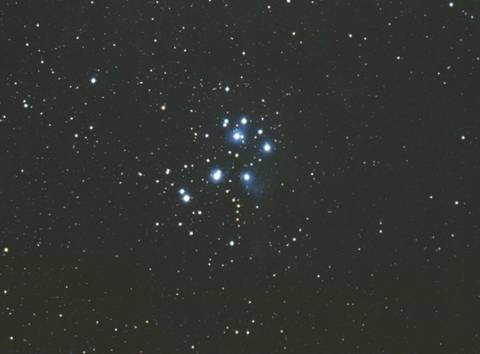
M45
the Pleiades (Seven Sisters star cluster) in Taurus