Other articles in this series
STARTING ASTRONOMY AS A HOBBY
This is the first article
introducing a series of articles aimed at newcomers to astronomy. The aim of these articles is to provide advice
for complete newcomers to astronomy. It
will give advice on how to get started and what is needed. Later articles will give guidance on moving up
to purchase equipment, where to get it and how to use it. This first article is focused on the absolute
newcomer who has no knowledge of astronomy at all.
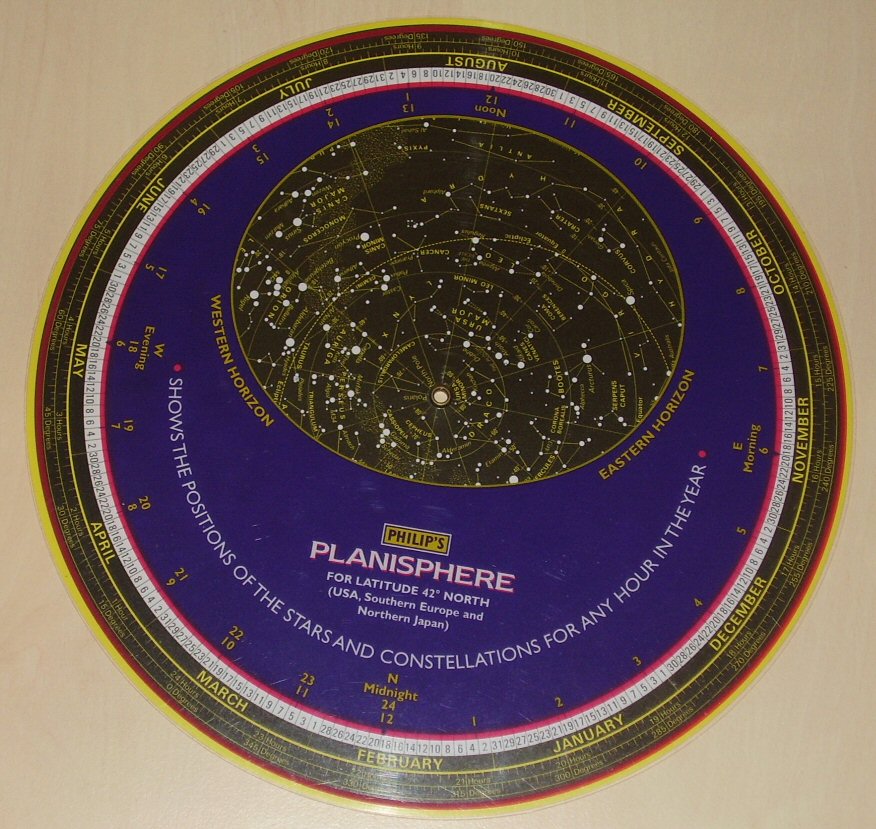
One of the first questions asked, when thinking about taking up astronomy as a hobby is, what equipment do I need? The simple answer is, very little to get started. A clear night and a star chart is enough. Star charts can be bought from most of the larger book shops such as W. H. Smith. Another option is to by a 'Planisphere' This is a special circular chart set in rotating discs that can be set to the time and dat required. The window on the planisphere will display the visible sky at that set time. These devises are very useful as they display the sky as it actually appears at the time you choose to observe.
 .
.
Some charts may be a bit complicated for a first time observer or a younger person so a cheap simple one may be best. Many of the monthly astronomy magazines have a simple but very good chart showing the sky as it appears in the current month, with only the brightest stars shown. Astronomy Now is the most popular British magazine and is available from W. H. Smith costing £3.99 a month. The advantage of buying a monthly magazine is it also gives guidance to any special events occurring that month and interesting things to look for. It also has many interesting articles on a wide range of astronomical subjects. The charts and what's up guide at the back of our monthly Beginners Magazine may also be used. Copies of the monthly magazine can be found on this website from the Front Page.
Having found this
position, shaded from irritating lights, the observers should make themselves
comfortable. Warm clothes are essential
even on summer nights. Sitting still for
a long time in the cool night air will soon cause discomfort and ruin the
enjoyment of the session. A deck chair
or a lounger will provide a very comfortable reclining position to avoid neck ache
through looking up into the sky for a long period of time. A sleeping bag or duvet is good on a cold
winter night and a hat should be worn because a lot of our body heat is lost
through the head.
As it will be dark a
torch will be needed to see the star chart. Do not use a white light torch because it will
ruin your night vision. Your eyes will
take about 10 to 15 minutes to fully open but a flash of light will cause them
to close up and the fainter stars will not be seen for another ten minutes. A small red light is best, perhaps a rear
cycle lamp. Even a cycle lamp may be too
bright so a piece of card with a small hole (10mm
diameter) placed over the lamp will be about right. The card can be secured using adhesive tape or
rubber bands.
The final preparation is
to find a start point in the sky and here is a little problem, the stars appear
to move across the sky. This means they
will be in a slightly different position at different times. (From hour to hour and night
to night.) What we must do is try
to recognise a familiar position or pattern of stars.
Some of the brighter
stars appear to form patters in the night sky and seem to be associated with
each other, we call these groups of stars Constellations. The stars in these groups are more often than
not un-associated and may be further from each other than they are from us.
Some constellations like LEO (The Lion) and Orion (The Hunter) do look rather
like what they a named after but still need a little imagination. Most however have no recognisable shape but
still have an apparent association with the other members of the group.
Constellations are not
all the same size and are defiantly not the same shape so it is difficult to
know where one ends and another begins. Star charts will show where the borders are
but it is not really important to the astronomer because the main pattern is
only used to identify the approximate area of sky to be searched for other
objects.
The method used to find
interesting objects in a constellation is called 'star hopping'. Star hopping involves firstly finding the
constellation in which the target is located or is near. Then by finding two or more stars within the
constellation, they are used as a guideline to point towards the target object.
It may be necessary to use a number of
stages to work out a route to an elusive object. This may be done by first finding the
direction to a particular star then using that star and another to plot out the
position to the target.
To become familiar with
the constellations requires nothing more than a clear night and a simple star
chart. As familiarity increases then a
pair of binoculars might be useful to identify the fainter members of a
constellation. In the articles in this
series will consider observing with binoculars.
The articles will give further advice for buying a telescope if the
hobby is to be pursued further.
As a final piece of
advice, have a look around your area to see if you have a local astronomical
society or club. If not ask your friends
if they would like to join you in your exploration of the sky. It is much more fun to share your hobby whatever
it is and by meeting people who are more experienced, you can learn from them.