Other articles in this series
WHAT CAN BE
SEEN WITH YOUR FIRST TELESCOPE
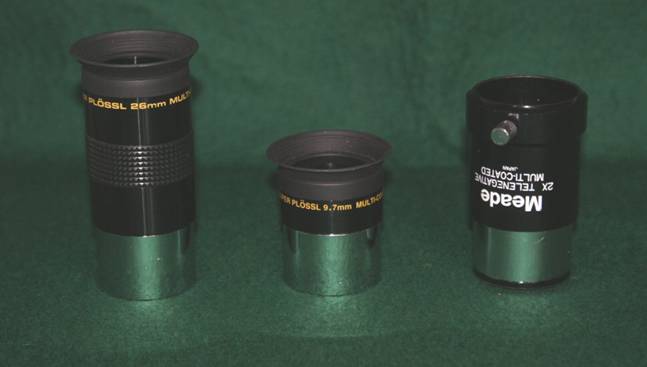
Meade Series 4000
eyepieces 26mm and 9.7mm with a 2x Barlow
First it needs to be
stated that the views through a small telescope, like those normally purchased
as a first telescope, will not produce views like those seen in books and
magazines. The sorts of images
reproduced in magazines are mainly those taken by experienced astronomers using
state of the art equipment. The whole
point of using a telescope is to be able to see these objects yourself. To be able to sense with our own eyes the
photons that have actually come directly from the Moon, planets and even the
stars is the ultimate thrill of using a telescope. As these photons of light enter our eye they
activate our visual sensors and we are in effect able to touch those particles
that have come from so far away. A
beginner need not be disappointed at not seeing the same detail shown by the
world’s giant telescopes or space probes these can be seen on the internet or
in the astronomy magazines. Enjoy
finding and seeing these objects ‘live’ in the night sky and for real from your
own backyard.
Before considering
what we are able to see in our first telescope we should re-visit some the
equipment that is typically supplied with a first telescope. Most telescopes are supplied with two
eyepieces (see the image above). These
are usually marked to enable them to be identified by the focal length. This is marked somewhere on the eyepiece body
and appears as a dimension in millimetres.
The larger one is normally between 20mm and 25mm and is the lower power
(lowest magnification). The smaller
(higher magnification) is normally around 10mm.
Magnification,
strictly speaking, is not an attribute of the telescope it mainly depends on
the eyepiece being used. A telescope of
a specific focal length will produce an image of a specific size and this
cannot be changed. For example a
telescope of a certain focal length may produce an image of the full moon 10mm
in diameter. A longer focal length will
produce a larger image (perhaps 15mm) and a shorter focal length will produce a
smaller image (Perhaps 6mm).
The eyepiece is then
used, much like a microscope, to magnify that image. A larger image to start with will allow the
eyepiece to produce a larger image to view (higher magnification).
The eyepiece with the
longer focal length say 25mm (low power) used on a telescope with a 1000mm focal
length will produce a magnification of 1000 ÷ 25 = 40x. A short focal length 10mm (high power)
eyepiece used on the same 1000mm telescope will produce a magnification of 1000
÷ 10 = 100x. However the same eyepieces
used on a 1500mm focal length telescope (that naturally produces a larger
image) will have magnifications of: 1500 ÷ 25 = 60x and 1500 ÷ 10 = 150x.
Some telescopes are
supplied with a ‘Barlow Lens’ (see the image above). This is a single lens set into a body that
fits into the focusing unit which generally has a 1¼ inch (31.75mm) diameter
interface. The eyepiece can be removed
and the ‘Barlow’ fitted into the focuser.
An eyepiece can then be fitted into the ‘Barlow’. The ‘Barlow’ has the effect of doubling the
focal length of the telescope. So in the
magnification calculation example above the 1000mm focal length of the
telescope now becomes 2000mm so the magnification is now 2000 ÷ 10 = 200x. NOTE: after fitting the ‘Barlow’ a
considerable amount of refocusing will be required and the object being
observed will move across the field of view twice as fast.
Using different
magnifications is often misunderstood by newcomers to astronomy who mistakenly
think ‘the higher the magnification used the better will be the view of the
object being observed’. This is not
always the case it depends as much on the type of object to be observed and the
‘seeing’ conditions of the sky on that night.
An object that appears large and relatively faint in the sky will often
look best at a low magnification. For
example M45 the Seven Sisters star cluster or M31 the Great Galaxy in
Andromeda. High magnifications can be
used on the Moon and the planets to see more detail. The conditions may still restrict the amount
of magnification that can be used. If there
is a lot of turbulence in the atmosphere using a lower magnification may actually
improve the view.
Now to consider what we will be able to see
when we take ‘first light’ through our new telescope. Let us consider a typical type of beginner’s
telescope.
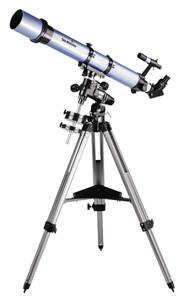
The Skwatcher Evostar 90
The Skwatcher Evostar 90 has an aperture (lens diameter) of 90mm and a
focal length of 900mm. It is supplied
with 10mm and 25mm eyepieces. It is also
supplied with a 2x Barlow which effectively converts the 10mm to a 5mm and the
25mm to a 12.5mm. These combinations
allow magnifications of: 36x, 72x, 90x and 180x to be
obtained.
This telescope will produce excellent views
of the Moon and full magnification of 180mm can be used for observing the Moon.
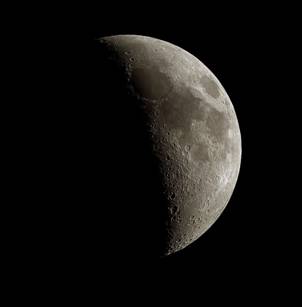
The sort of view of
the Moon using 36x magnification
The low power
eyepiece should be used first to get an overall view of the Moon. If the Moon is near ‘full’ then it may be
useful to lessen the glare by reducing the amount of light entering the
telescopes. This can be done by fitting
the dust cover over the telescope and removing the small cap to reduce the
aperture. The large dark areas known as
‘Maria’ or seas can be seen very well.
Many large craters will be seen all over the Moon but are more obvious
in certain areas. From night to night
the ‘Terminator’ will move across the Moon revealing different targets to view.
Areas of special interest can be selected and
centralised in the field of view. By
carefully changing the eyepiece to increase the magnification a closer view can
be obtained.
Mars is the next planet out from Earth so it does not
show significant phases but it does lose the edges. Some years Mars does not have the closest of
approach to Earth and will look quite small through the telescope compared to
2003 when it was at its closest. The
highest possible magnification and good ‘seeing’ conditions will be required to
see any detail on the surface.
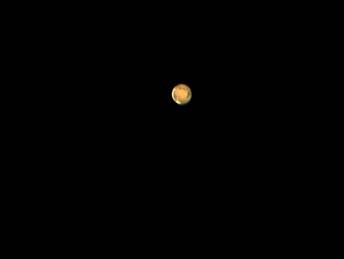
Mars as it may have appeared in 2003
The planets Jupiter and Saturn are the most spectacular
of the planets to observe through a telescope. Jupiter is a very good and easy target for a
first telescope. It is large, bright and
shows some colour even when using a small telescope. At 35 arc seconds in diameter it is about the
same size as Venus and three times the size of Mars. It is bright because a lot of sunlight is
reflected off the light coloured clouds that cover its surface.
Fit a low power eyepiece into the focuser. Release the drive clutches and use the finder
to locate Jupiter. Lock the clutches and
centralise Jupiter in the finder. Look
through the low power eyepiece and use the focusing knob to adjust the focus
until the edge of Jupiter looks sharp.
The four large moons should be in a line to the sides of Jupiter and
should appear as sharp points of light (looking like stars). They may sometimes all be to one side or one
might be missing as it passes in front or behind the planet. Adjust the focus if necessary until the moons
appear as points of light.
Centralise Jupiter in the field of view and gently
replace the low power eyepiece with the higher power eyepiece and
re-focus. On a good night a Barlow lens may be used to increase the magnification
further. Jupiter will now appear larger
and two darker (brown) parallel bands should be visible on the planet.
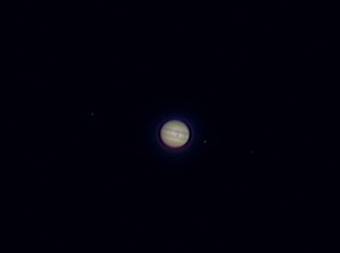
The sort of view of Jupiter obtained
using maximum magnification
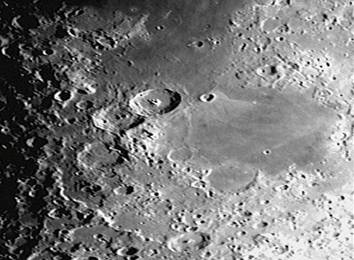
The sort of view of
the Moon obtained using maximum magnification
On a good calm night when the air is clear
the view of the craters, mountains and valleys can be breathtaking. By tracking across the surface of the Moon,
using the drive knobs, it almost looks as if the observer is flying over the Lunar landscape.
The planets are a little more difficult to
observe and need a little more skill which is easily developed. Mercury and Venus do not show any surface
detail but they do develop phases similar to the Moon. So when they first appear low in the western
twilight they are emerging from behind the Sun.
Consequently the Sun is shining on virtually the whole surface and the
planet looks ‘full’. However as the
planet is further away from us it will appear small in diameter. As the planets move around the Sun less of
their surfaces are illuminated. When
they draw level with the Sun one side will be bright and the other will be
dark.
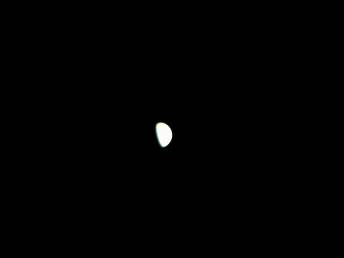
Venus as it appeared
on 19th February 2012
As Venus or Mercury
move closer to Earth they begin to leave the Sun behind so it will be
illuminating the far side and the side facing us will become progressively
darker. The crescent shape will become
narrower but the apparent size will become larger as the planet moves
closer. The image above gives some idea
of what Venus will look like using a 900mm focal length telescope with a 10mm
eyepiece and a Barlow lens (180x magnification). Venus is bright enough to dazzle so the
aperture of the telescope may need to be reduced to lessen the glare.
Take some time to
adjust the focus and to get used to looking at the surface detail. If you have a Barlow Lens centralise Jupiter
and gently remove the high power eyepiece.
Fit the Barlow and fit the eyepiece back into the Barlow. The focuser will need to be adjusted ‘in’ by quite
an amount to re-focus. The image will
now be even bigger and appear similar to the image in the previous column.
Saturn is our next
target and is spectacular due to its beautiful ring system. The planet itself is about half the diameter
of Jupiter but only a quarter of the surface area. It receives less than half the sunlight of Jupiter
and therefore reflects much less light back to us. However the rings stretch over half the
diameter to each side making it a larger target. The rings are tilted about half way towards
us this year so they are beginning to approach their best. Use the same technique to find Saturn as was
described to find Jupiter in the previous column, starting with the low power
eyepiece.
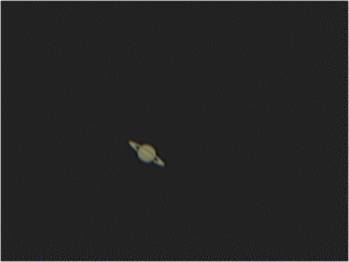
The sort of view of
Saturn obtained at maximum magnification
Deep space objects
such as galaxies, star clusters and nebulae are difficult to see in a small
telescope but in a dark sky away from street light pollution some can be seen.
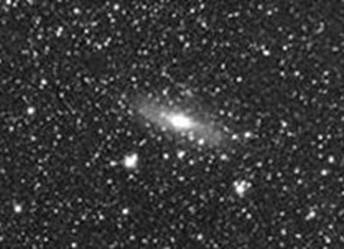
M31 The
Andromeda Galaxy
M31 is the only spiral
galaxy that can be seen through a small telescope and is worth searching out to
say “I have seen it”. Other deep sky
objects to look for are M42 the Orion Nebula, M13 the Globular Cluster in
Hercules and M45 the Pleiades Open Star Cluster in Taurus.
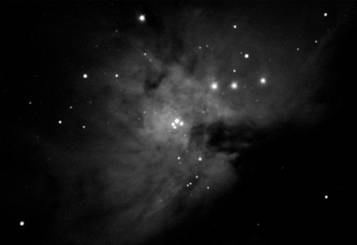
M42 the Great Nebula
in Orion
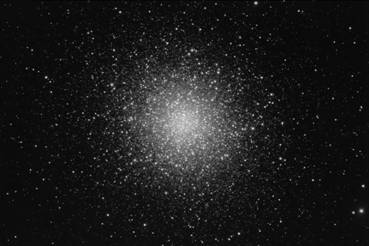
M13 The Globular Cluster in Hercules
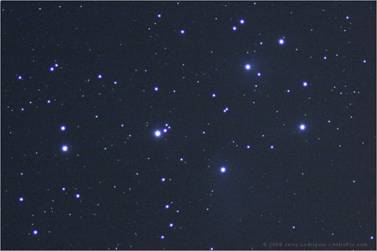
M45 the Pleiades
(Seven Sisters) in Taurus