Other articles in this series
WHAT TELESCOPE SHOULD I LOOK FOR?
Before looking at the range of telescopes that is
available, consideration should be given as to what the telescope is to be used
for. This is the most important
consideration of all. The worst possible
choice is the one that never gets used. The telescope that is too complicated or too cumbersome to set up will
spend its time at the back of a shed or garage and never be used. The first telescope should be easy to set up,
easy to use yet give impressive views of the sky.
First we must consider some of the physical
characteristics of a telescope and how they affect our requirements.
The main specifications for a really useful first
telescope should be: a minimum aperture of at least 90mm for a refractor or 130mm
for a reflector and 1,000mm focal length for each. This combination will provide enough light
grasp and permit a high enough magnification to see detail on the brighter
planets.
One of the most important attributes for an astronomical
telescope is the ‘light grasp’. This is
an expression used by astronomers to describe the process of the main optic
directing light from a distant object into the eye. The pupil of a young human eye is about 7mm
in diameter when fully adapted to the dark.
This is equivalent to 38 square millimetres (38mm²). A 100mm diameter telescope has an aperture
area of 7,854mm². It is therefore
capable of directing up to 206 times as much light into the eye of the
observer. Put another way it will enable
the observer to see objects about 200 times fainter than could be seen with the
unaided eye. So a larger aperture will
allow even fainter objects to be seen.
The focal length is also important. The FOCAL LENGTH is effectively the length of
the telescope. It is measured as the
distance from the main optic to the point where the image is formed. A short focal length will give a wide field
of view but the objects in the field of view will appear small. A long focal length will give a narrow field
of view (small area of sky) but the objects in view will appear larger. Short focal lengths are best for looking at
star fields and larger objects. Long
focal lengths are most suitable for small objects and studying fine detail, for
example on the Moon and the planets.
Magnification, strictly speaking, is not an attribute of
the telescope it mainly depends on the eyepiece being used. A telescope of a specific focal length will
produce an image of a specific size and this cannot be changed. For example a telescope of a certain focal
length may produce an image of the full moon 10mm in diameter. A longer focal length will produce a larger
image and a shorter focal length will produce a smaller image. The eyepiece is then used, much like a
microscope, to magnify that image. A
larger image to start with will allow the eyepiece to produce a higher
magnification.
A long focal length 25mm (low power) eyepiece used on a
1000mm telescope will produce a magnification of 1000 ÷ 25 = 40x. A short focal length 10mm (high power)
eyepiece used on the same 1000mm telescope will produce a magnification of 1000
÷ 10 = 100x. However the same eyepieces
used on a 1500mm focal length telescope (that naturally produces a larger
image) will have magnifications of: 1500 ÷ 25 = 60x and 1500 ÷ 10 = 150x.
To summarise, if the craters on the Moon or
the cloud bands on Jupiter are to be studied then a telescope with a relatively
long effective focal length should be sought.
A shorter focal length telescope will be more suited to wide field views
of the stars. A good all round first
telescope should have a focal length of around 1000mm to 1200mm.
TYPES OF TELESCOPES
REFRACTING TELESCOPES
All refracting
telescopes use a glass lens as their primary focusing unit. This lens is normally made up from two or
more lens elements to produce a clearer image and reduce colour distortions
caused by refraction as explained below.
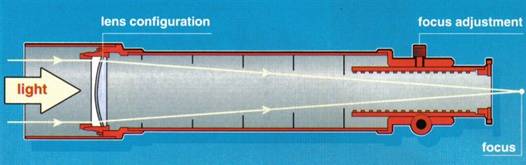
Lenses use the
property called REFRACTION to change the direction of rays of light and direct
them towards a desired position.
Refraction occurs when light passes between two different transparent
materials such as glass, air and water.
When light passes, at
an angle, through the surface of a block of glass the angle is changed. As the light re-emerges through the opposite
side of this material its angle will be changed again back to its original
angle. To utilise this phenomena lenses
are produced with a curved surface so when parallel rays of light meet the
surface it will present an angled surface to each ray. The paths of all the rays hitting the lens
will be bent towards the centre line of the lens. As the light emerges from the back face of
the lens it is again bent. If the back
surface is convex the same as the front surface then the light will be bent
even more towards the centre line of the lens.
REFLECTING TELESCOPES
A Newtonian is the simplest type of reflecting telescope.
Below is the layout of the optics of a Newtonian tube assembly. The Newtonian configuration is the simplest
layout and therefore generally the cheapest of all the reflecting type
telescopes. Used with the simple Dobsonian mounting this type of telescope can make a very
useful and cheap option for a first telescope at around £200 for a 150mm
(6″) instrument.
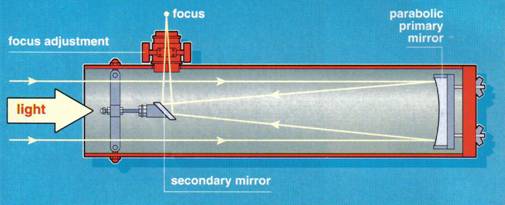
Light from a distant
object enters the open tube and is reflected back up the tube by a parabolic
(concave) mirror. Because the mirror is
curved the light is focused into a point where an image is formed. To enable the observer to study the image
without blocking the light entering the tube, a second small ‘flat’ mirror is
mounted at an angle of 45° at the top of the tube to direct the light out
through a hole in the tube. A focusing
unit is fitted to the hole to hold and adjust the eyepiece. The eyepiece is a simple microscope used to
magnify the image formed by the mirror.
Using a variety of eyepieces with different focal lengths, higher or
lower magnifications can be obtained.
There are other variations of the reflecting
telescope layout such as the Cassegrain. This design replaces the flat angled
secondary with a small convex mirror that redirects the light back down the
tube and through a hole in the centre of the Primary Mirror where the eyepiece
is mounted.
REFRACTING TELESCOPES
A first telescope
must be easy to use, portable enough to move around and set up and be within a
modest budget. The budget available is
important but if possible at least £230 should be spent on a new telescope or
the pro-rata amount for a second hand instrument (say £100 for a telescope that
costs £250 new). Avoid the models that are sold in high street stores as they tend to be
poor quality.
Some of the best
manufacturers to look out for are: MEADE, CELESTRON, ORION, SKY WATCHER, TAL,
KONUS and BRESSER. Suppliers of these
telescopes can be found in the adverts in popular astronomy magazines such as
‘Astronomy Now’ and ‘Sky at Night’.
There now follows a
few examples for consideration.
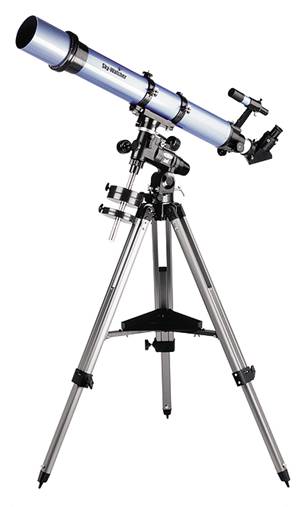
The Skwatcher Evostar 102
This telescope
represents the ultimate first refracting scope for the beginner. It has an aperture of 102mm and a focal
length (FL) of 1000mm. It is supplied
with the tripod, two eyepieces, even a camera adaptor. The MRP is about £269.
The telescopes in
this range are:
Evostar – 90 90mm FL
900 £199 A little small (ok)
Evostar – 102 102mm FL
1000 £269 Perfect
Evostar – 120 120mm FL
1000 £349 A bit expensive
Evostar – 150 150mm FL
1220 £549 Big & expensive
Most manufacturers
listed above have a similar range. The
telescopes in these ranges are typically supplied on a tripod and with an
equatorial mounting. They usually have
two eyepieces (25mm and 10mm) and sometimes include a Barlow Lens (see page 6). All are supplied with a 90° Star
Diagonal. This is a mirror set at 45° to
direct the image into a comfortable position for viewing through the eyepiece.
The smaller examples
are usually supplied with a 30mm aperture finder whereas a 50mm would have been
better but this can be upgraded later.
There are other telescopes at 60mm to 70mm aperture that are not bad if
only a small budget is available (£60 to £100).
Their capability is really limited to observing the Moon and the moons
of Jupiter.
The details of these telescopes can be
checked out on the websites and can be purchased through mail order. They do need to be assembled but this is
generally an easy task.
REFLECTING TELESCOPES
Reflecting telescopes
are generally cheaper than the equivalent sized refracting telescope. This is because they use a mirror as the main
optic and not a more expensive lens. A
mirror only has one surface to be ground and polished but the typical
refractor, that has two or sometimes three lens elements, has four or six
surfaces to be ground and polished.
The cheapest and
simplest reflecting telescope is a Newtonian tube assembly (see page 6) mounted
on a Dobsonian mount.
The mount is a simple Alt azimuth with a turntable for rotation and a trunnion for up and down movement. These are very easy to set up and simple to
use.
Because the Newtonian
has a secondary mirror at the top of the tube there is a small loss of light so
a 150mm will give a just slightly brighter image than a 100mm refractor.
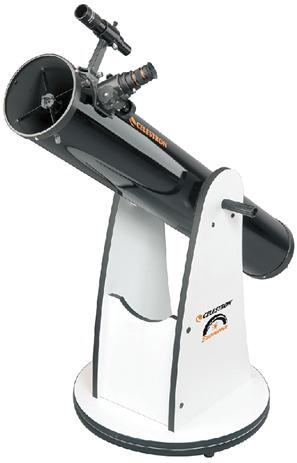
The150mm FL 1220mm Celestron Starhopper £230
Other models in this
range:
Starhopper 200mm (8″) FL 1220mm £335
Starhopper 250mm (10″) FL 1270mm £559
Starhopper 300mm (12″) FL 1500mm £949
Most manufacturers
listed previously have a similar range.
A major advantage,
beside the cheapness, of the Dobsonian is its
simplicity of use. It just needs to be
placed down on a flat surface and it is ready to use. A finder scope is attached to the main tube
to help find a desired object. Once the
object is located in the main telescope it can be tracked by moving the tube
gently, up or down and around while looking through the eyepiece to keep the
object central.
The Newtonian tube assembly can also be
fitted to an equatorial mounting. This
does make the telescope more expensive but can make it easier to track objects
across the sky. The combination gives
the advantage of a large aperture telescope on a mount that can easily be
driven to track objects. Most Dobsonian telescopes use a fairly long focal length tube
assembly whereas a shorter focal length is generally favoured for the equatorially
mounted Newtonian.
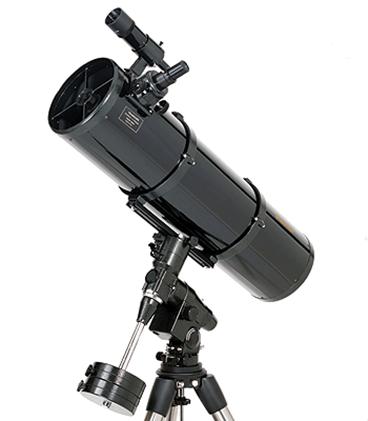
Celestron C8-N 200mm FL 1000
Equatorial Newtonian
Models in this range:
Celestron C8N 200mm (8″) FL 1000mm £299
Celestron C10-N 254mm (10″) FL 1200mm £639
Most manufacturers
listed previously have a similar range.
The small GOTO
computerised telescopes are very good optically but are notoriously difficult
to set up. They need to be levelled, set
to face north, the time and date entered and the location coordinates
entered. The computer then selects two
bright stars for the telescope to be aligned on. Once aligned the computer will automatically
find and track thousands of objects stored in its memory.
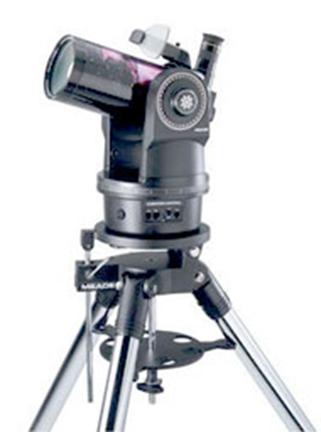
Meade ETX90 PE £499
These telescopes have
an advanced optical system known as a Maksutov-Cassegrain. This system uses curved mirrors and a lens to
extend the effective focal length to an amazing 1250mm. At 90mm aperture, its light grasp is small for
this focal length so deep sky objects are faint and difficult to see. However it does give beautiful views of the
brighter planets and the Moon.
Celestron have a similar model, the Nextstar 4 at £340.
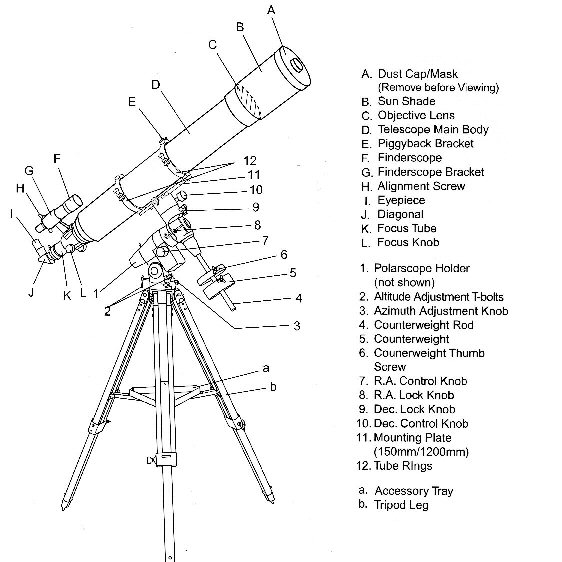
Guide to the parts of a typical telescope.
TELESCOPE JARGON
ALT AZIMUTH A type of telescope
mount that has a vertical axis (Azimuth) and a horizontal axis (Altitude). Both axes need to be moved to track an object
through its apparent arc across the sky.
APERTURE The diameter of the
main objective. This normally is used to describe the size of the telescope.
BARLOW A lens unit inserted
into the focuser that effectively doubles or trebles the magnification of the
eyepiece.
DECLINATION The up / down
movement on an equatorial mounting.
DEWSHIELD A tube fitted to the
open end of the telescope to help reduce dew forming on the lens.
DOBSONIAN A very simple and
cheap telescope mounting usually used with a Newtonian reflecting telescope
tube.
EQUATORIAL MOUNTING A type of telescope
mount that has one axis tilted to point at the celestial pole. By using this design of mount an object being
observed can be tracked by moving just one axis. A must for astro - photography.
EYEPIECE A small microscope
fitted to the telescope to magnify the image formed by the main optic.
FINDER A small telescope
fitted to the main telescope to help find the object to be observed. A finder has a wide field of view and low
magnification and is often fitted with cross hairs.
FOCAL
LENGTH
The distance from the objective to the point where the image is formed.
FOCAL RATIO The ratio obtained
by dividing the focal length of the objective by its diameter, usually written
as f (number).
FOCUSER
or FOCUSING UNIT
The holder for the eyepiece. It
carries adjusting knobs to make minor adjustments to the position of the
eyepiece to give correct focusing.
GOTO This is a
computerised drive system fitted to some modern telescopes. It enables the telescope to automatically
find and track thousands of objects in its database.
LIGHT GRASP The amount of light
that a telescope can direct into the observers eye (the bigger the better).
MAGNIFICATION The ability to
increase the apparent size of the object using different eyepieces. A short focus eyepiece produces higher
magnification, calculated by dividing the focal length of the main optic by the
focal length of the eyepiece: 1000mm ÷ 10mm = 100x magnification.
MAKSUTOV A complex design of
telescope that, through an optical trick, produces a very long effective focal
length in a short tube. These are very
good for planetary observation.
NEWTONIAN A simple reflecting
telescope designed by Sir Isaac Newton.
OBJECTIVE The main light
gathering optical unit of a telescope, the large lens or mirror.
OTA (Optical Tube
Assembly) The
Tube of the telescope without the mounting and stand.
REFLECTOR The type of
telescope that uses a mirror as its main optic, usually called a ‘Reflecting
Telescope’ or ‘Reflector’.
REFRACTOR The type of
telescope that uses a lens as its main optic, usually called a ‘Refracting
Telescope’ or ‘Refractor’.
RIGHT ASCENSION (RA) The rotational
movement on an equatorial. The equatorial axis that can be tilted to align with the Earth’s
pole.
SCT
(SCHMIDT CASSEGRAIN TELESCOPE) A complex
design of telescope that, through an optical trick, produces a long effective
focal length in a short tube.